Adobe’s CEO Pick Signals an Enterprise AI Push
Customer Experience Orchestration
Adobe’s enterprise software strategy for coordinating data, content, personalization and campaign execution across customer touchpoints.
Agentic software
AI systems designed to complete multi-step tasks with less direct user input, such as planning and executing parts of a marketing workflow.
Creative Cloud
Adobe’s subscription suite of creative applications, including products such as Photoshop, Illustrator and Lightroom.
Seat-based subscription
A pricing model in which customers pay per user, distinct from consumption-based pricing tied to AI usage or completed tasks.
CEO transition
Anil Chakravarthy is set to become Adobe president and CEO on December 1, 2026, while Shantanu Narayen moves to executive chair.
Market concern
Adobe shares fell after the succession news, with reports citing investor unease over Wadhwani’s exit and AI disruption risks.
AI workflow bet
The appointment elevates the leader of Adobe’s customer-experience orchestration and field operations businesses as Adobe pushes deeper into enterprise AI.
Adobe’s next CEO will inherit more than a leadership transition. Anil Chakravarthy’s appointment as president and chief executive officer, effective December 1, 2026, with Shantanu Narayen moving to executive chair, signals that Adobe is placing its next strategic bet on enterprise distribution, customer-experience orchestration and AI-enabled workflows — not just its historic dominance in creative tools.9
That message was reinforced by the simultaneous departure of David Wadhwani, head of Adobe’s creativity and productivity business and a widely watched internal contender for the top job. Wadhwani’s unit includes Adobe’s core creative franchises, and Computerworld reported that the digital media business he oversaw generates roughly three-quarters of Adobe’s revenue.3
For enterprise software buyers, the leadership change reads as a governance-level signal: Adobe wants its next phase to be defined not only by Photoshop, Illustrator and Acrobat, but by how those products connect to marketing systems, content supply chains, agentic AI and measurable enterprise outcomes.
Investors responded cautiously. Adobe shares fell after the succession announcement, with Wadhwani’s exit becoming part of the story. Yahoo Finance framed the move as a negative market reaction to the choice of an insider and the loss of the creative-products leader.1 Benzinga reported that Adobe traded 2.97% lower in Friday premarket trading on September 4, while TradingKey later reported a 6.20% decline that day, tying the selloff to executive turnover, AI disruption concerns and uncertainty ahead of Adobe’s September 10 fiscal third-quarter earnings report.47
Chakravarthy is not a neutral caretaker pick. He currently leads Adobe’s Customer Experience Orchestration business and worldwide field operations, a role that puts him close to enterprise buyers, go-to-market execution and the operational systems large customers use to plan, generate, approve, personalize and measure content.9 Business Standard reported that his portfolio has included Adobe CX Enterprise, GenStudio, Brand Visibility, Adobe Experience Platform and CX Enterprise Coworker, as well as the integration of Workfront and Semrush.9
That background matters because Adobe’s central challenge has shifted. The company still owns category-defining creative applications, but generative AI has lowered the cost of image generation, layout production and content adaptation. Benzinga noted that investors are assessing AI’s impact on the creative software industry and pointed to intensifying competition from Canva, Figma and newer AI-powered tools.4
In that environment, Adobe’s defensibility increasingly depends on embedding AI into repeatable enterprise workflows, not simply adding AI features to individual creative applications.
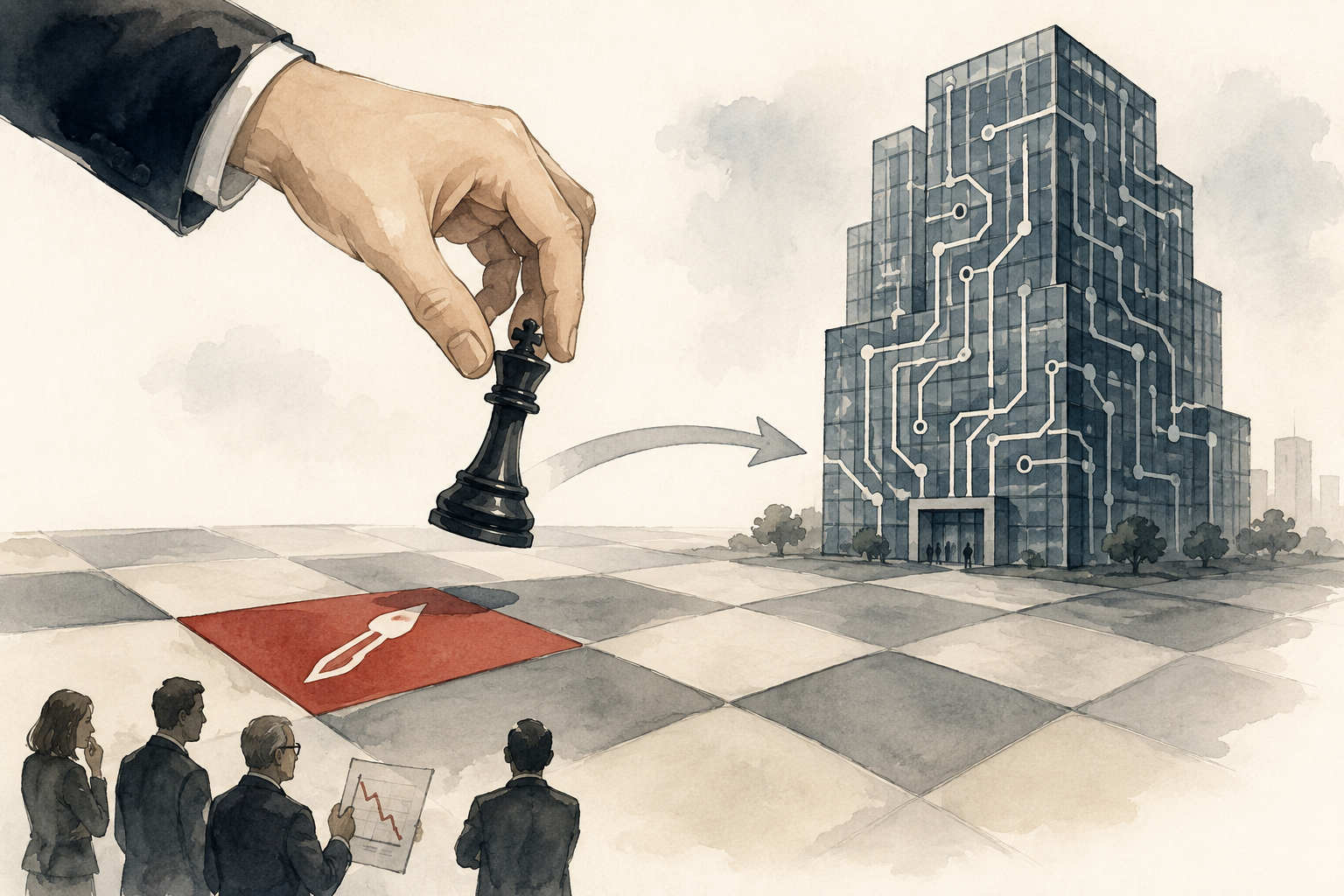
The board’s selection appears to prioritize the executive most associated with enterprise orchestration over the executive most closely linked to the creative engine. Tech Times described the decision as an “agentic” bet that applies Chakravarthy’s enterprise-software playbook at Adobe scale, arguing that Adobe’s next transition is from seat-based subscriptions toward AI-driven, usage-oriented workflows.6 That is an interpretation, not a stated Adobe financial model, but it is consistent with the language around agentic software and customer-experience products used in coverage of the appointment.69
The most immediate strategic risk is continuity in the creative business. Wadhwani led the segment most associated with Adobe’s brand and much of its cash generation. His exit creates an execution gap as Adobe works to defend Creative Cloud from AI-native challengers and lower-cost design platforms.34
For enterprise customers, that matters because Adobe’s value proposition depends on both sides of the house working together. Creative Cloud supplies the asset creation layer; Experience Cloud and related orchestration products manage personalization, campaign operations and measurement.
If the creative side weakens, Adobe’s enterprise AI story loses differentiated content depth. If the enterprise side fails to scale, Adobe risks turning AI into a feature bundle rather than a monetizable workflow platform.
The stock reaction reflects that tension. TradingKey reported that investors were concerned not only about the CEO appointment but also about generative AI’s potential to pressure Adobe’s subscription model and recurring revenue base.7 RTTNews separately described Adobe stock as dropping around 7% after the CEO succession news, underscoring that the market saw the announcement as a catalyst for broader questions about Adobe’s direction.10
Adobe’s historical advantage was tool depth: professionals paid for best-in-class software used to create, edit and publish digital content. Its next advantage, if the strategy works, would be workflow depth: enterprises using Adobe systems to generate compliant assets, coordinate approvals, personalize campaigns, deploy content across channels and measure performance with AI assistance.
That is why Chakravarthy’s field-operations role is important. A CEO with responsibility for worldwide enterprise sales brings a customer-distribution lens to product strategy. In enterprise AI, adoption is rarely just about model capability. Buyers care about integration with data platforms, identity systems, content rights, governance, procurement controls and return on investment.
Adobe’s bet is that its broad installed base and enterprise relationships can convert AI from a creative novelty into an operating layer for marketing and content teams.
GenStudio and Adobe Experience Platform sit at the center of that thesis. They point to a version of Adobe in which AI does not merely generate an image or rewrite copy, but helps orchestrate an entire content supply chain from brief to activation. Business Standard reported that Adobe is pushing further into AI and agentic software across creativity, productivity and customer experience.9 That framing matters for CIOs and CMOs evaluating whether Adobe is becoming a system of work, not just a suite of applications.
The transition will face an early credibility test on September 10, 2026, when Adobe is scheduled to report fiscal third-quarter results.4 Investors will be looking for evidence that AI adoption is translating into monetization, not just engagement.
Enterprise software readers should watch for three signals: growth in digital media recurring revenue, traction for AI-first products and any commentary on whether Adobe is shifting pricing toward consumption, premium AI tiers or workflow-based packaging.
The strategic logic of the CEO choice is clear enough. Adobe is elevating a leader whose career aligns with enterprise transformation, data platforms and field execution at a time when AI threatens to commoditize parts of the creative process. The unresolved question is whether that orientation can strengthen Adobe’s creative franchise rather than dilute it.
Chakravarthy’s appointment does not mean Adobe is abandoning creative tools. It means Adobe appears to believe creative tools alone are no longer enough. The next Adobe will be judged by whether it can turn creativity, productivity and customer experience into one AI-orchestrated enterprise workflow — and whether customers will pay more for that integration than they might save by adopting cheaper AI-native alternatives.






Comments