AI Data Centers Push Freight Forwarders Into Infrastructure Orchestration
Hyperscaler
A large cloud-computing company that builds and operates massive data-center networks, such as Amazon Web Services, Microsoft Azure or Google Cloud.
Freight forwarder
A logistics provider that arranges transportation, customs documentation and related services for goods moving through global supply chains.
Direct-to-site delivery
A logistics model in which equipment is delivered directly to a construction or operating site rather than only to a warehouse or distribution center.
Vendor management
The coordination of multiple suppliers to ensure that equipment, documentation and delivery schedules align with a customer’s project plan.
Bloomberg
news
Kuehne+Nagel CEO Expects to Ride AI-Driven Cargo Wave Into 2029
Investing.com
news
Kuehne+Nagel expects AI data center logistics growth to extend through 2029
AI Understanding
news
Kuehne+Nagel eyes double-digit growth from AI-driven cargo logistics through 2029
Growth runway
Kuehne+Nagel expects double-digit growth in AI-linked data-center logistics through at least 2029.
Amazon pact
A seven-year Amazon logistics agreement signals a shift toward longer-term hyperscaler logistics partnerships.
Service shift
Cloud operators increasingly need vendor management, customs clearance and direct site delivery in addition to transport capacity.
Kuehne+Nagel expects AI-driven data-center logistics to deliver double-digit growth through at least 2029, Chief Executive Stefan Paul told Bloomberg, as cloud operators accelerate infrastructure spending and outsource more complex parts of the equipment supply chain.1 The Swiss forwarder’s newly announced seven-year logistics agreement with Amazon is the clearest signal yet that hyperscaler freight is becoming a managed infrastructure business, not a series of shipment-by-shipment transactions.1
For logistics and technology infrastructure executives, the significance is not just the volume of servers, chips, racks, cooling systems and electrical components moving through global supply chains. It is the changing scope of the work.
Large cloud operators are seeking services that go beyond transportation, including vendor management, customs clearance and direct delivery of equipment to data-center construction sites.2 That shifts competition away from price and capacity alone and toward control-tower visibility, compliance execution, inventory coordination and site-readiness management.
The shift reflects how AI infrastructure is built. Data centers require synchronized delivery of high-value equipment from multiple suppliers, often across borders and on construction timelines that leave little room for customs delays, site congestion or misplaced inventory. For forwarders, that creates an opportunity to capture higher-value services around the freight move. For hyperscalers, it creates a need for logistics partners that can reduce execution risk across a fragmented vendor ecosystem.
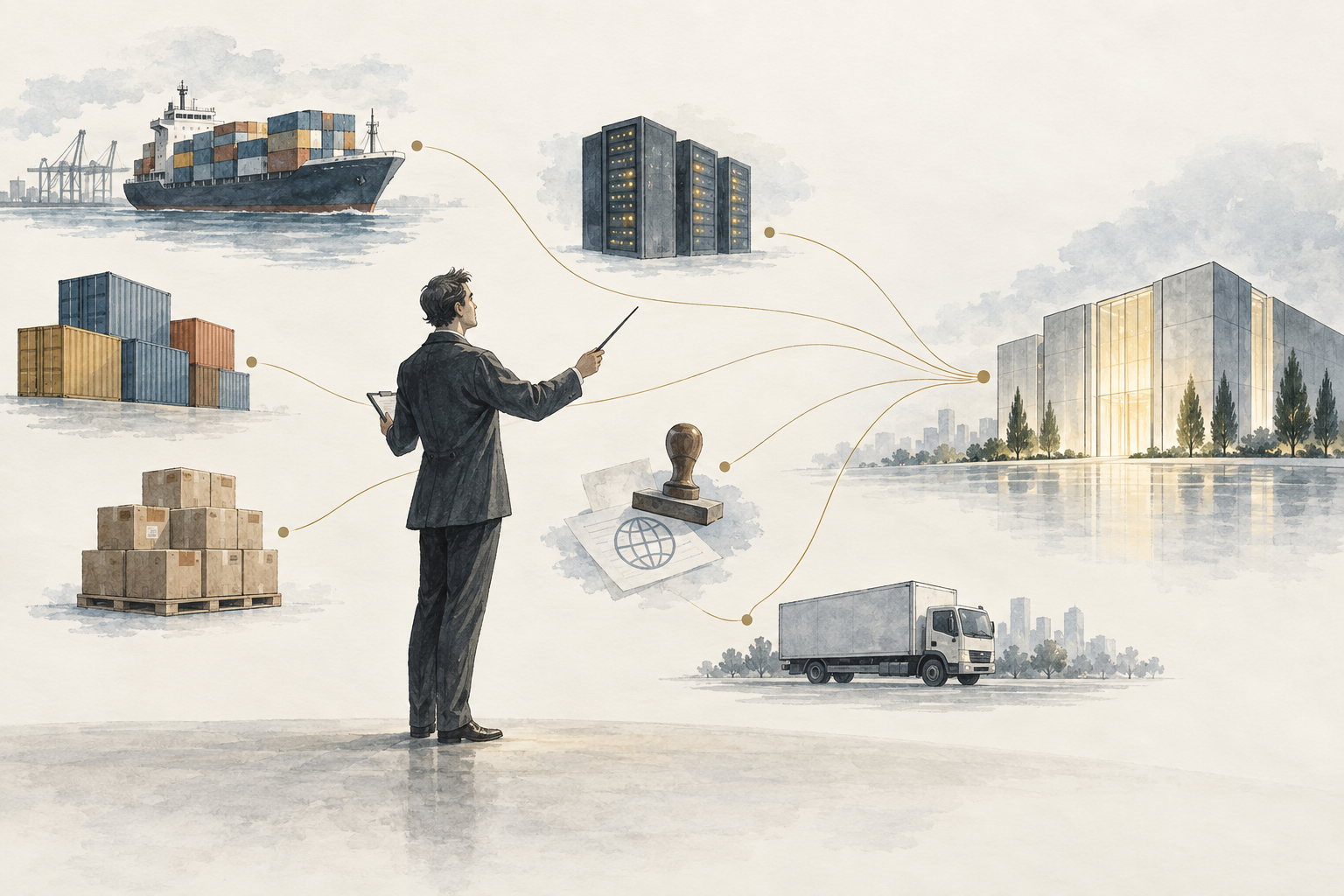
Traditional freight forwarding is often organized around lanes, modes and transactions: an ocean container, an airfreight shipment, a customs entry or a truck move. AI infrastructure logistics is more programmatic.
A data-center deployment may require a forwarder to manage suppliers across regions, stage equipment near a site, coordinate delivery windows with construction crews, clear goods through customs, track serial-numbered assets and respond to changes in build schedules.
That is why Kuehne+Nagel’s forecast matters. Paul said customers have provided enough visibility into future equipment requirements to support demand expectations for 2027 through 2029.2 In a sector where forwarders often have limited long-term volume certainty, multi-year infrastructure buildouts can make revenue more predictable — if logistics providers can meet the operational requirements.
The Amazon agreement points to that deeper relationship. Kuehne+Nagel and Amazon already generate hundreds of millions of dollars in business, with the potential for that relationship to grow into the billions, according to reports summarizing Bloomberg’s account.2 The agreement also includes incentives tied to volume thresholds and call options on Kuehne+Nagel shares, underscoring how strategic logistics capacity and execution have become for large technology customers.6
AI-related data-center logistics differs from standard electronics freight in several ways. Equipment is expensive, often time-sensitive and linked to tightly sequenced construction or commissioning milestones. Delays can defer compute capacity, affect customer commitments and raise carrying costs for infrastructure programs. That makes the cost of logistics failure larger than the freight bill itself.
As a result, hyperscalers are pushing more responsibility upstream to logistics providers. Vendor management matters because equipment flows may involve semiconductor suppliers, server manufacturers, rack integrators, power-equipment providers and construction contractors. Customs clearance matters because hardware may cross multiple jurisdictions before reaching a site. Direct-to-site delivery matters because many data-center campuses have limited laydown space and strict appointment controls.2
These requirements favor forwarders with global networks, customs expertise, technology platforms and local site-delivery capability. They also create switching costs. A provider embedded in vendor coordination, inventory planning and construction-site delivery is harder to replace than one moving a single shipment from airport to warehouse.
Market summaries of the Bloomberg report emphasized that site-level delivery, customs, inventory coordination and vendor management could create more durable relationships than transactional forwarding.4
Kuehne+Nagel’s position is strengthened by the scale of its technology customer base. Reports say the company counts six of the Magnificent Seven technology companies among its customers, giving it exposure to the largest AI infrastructure buyers.5 That customer concentration creates opportunity, but also raises expectations. Hyperscalers will likely benchmark providers on global consistency, milestone performance and the ability to absorb demand spikes.
The Amazon agreement may also become a template for how large cloud operators secure logistics capacity. Volume-linked incentives align the forwarder with the customer’s buildout cadence, while equity-linked economics suggest a strategic relationship that extends beyond ordinary procurement.6
For forwarders, such structures could help justify investments in dedicated teams, technology systems, compliance resources and specialized handling networks. For customers, they may secure priority attention in a market where multiple cloud and AI infrastructure programs are competing for similar logistics capabilities.
Kuehne+Nagel is not alone. DHL is also expanding data-center logistics operations as technology companies increase computing capacity.6 Competition is likely to intensify among global forwarders, contract logistics providers and specialized project-logistics firms. The winners will be those that can integrate transport procurement with customs brokerage, warehousing, inventory visibility, vendor coordination and site execution.
The broader demand backdrop is large. AI-related goods accounted for about 15% of global commerce in 2025 after export volumes reached $3.8 trillion, and their share has risen to about 20% this year, according to figures cited by Bloomberg and summarized by Investing.com.2 While those figures include more than data-center equipment alone, they point to the scale of trade flows tied to AI infrastructure and adjacent technology supply chains.
For freight forwarders, the opportunity is to become part of the infrastructure stack. That means selling reliability, compliance and orchestration rather than capacity alone. A forwarder that can prevent customs delays, keep build sites supplied in sequence and provide real-time asset visibility may be able to defend margins even when core freight markets are soft.
For hyperscalers, the decision is increasingly strategic. Logistics performance can influence how quickly new compute capacity comes online. In an AI market where speed to deploy chips, servers and power infrastructure affects competitive positioning, logistics partners are becoming part of the critical path.
The next phase of AI infrastructure logistics will likely be measured less by headline shipment volume and more by service depth. Key indicators include the number of multi-year logistics agreements signed by hyperscalers, the extent of direct-to-site delivery programs, the integration of vendor-management systems and whether forwarders can convert project complexity into margin expansion.
Kuehne+Nagel’s forecast through 2029 suggests the company sees AI data-center logistics as a sustained market, not a short-lived cargo surge.1 The larger implication is that freight forwarding is being pulled closer to infrastructure operations. As AI buildouts continue, the most valuable logistics providers may be those that can manage the entire equipment flow from supplier dock to data-center floor.






Comments