GE Aerospace’s $11.75 Billion CPP Deal Secures a Critical Supply-Chain Bottleneck
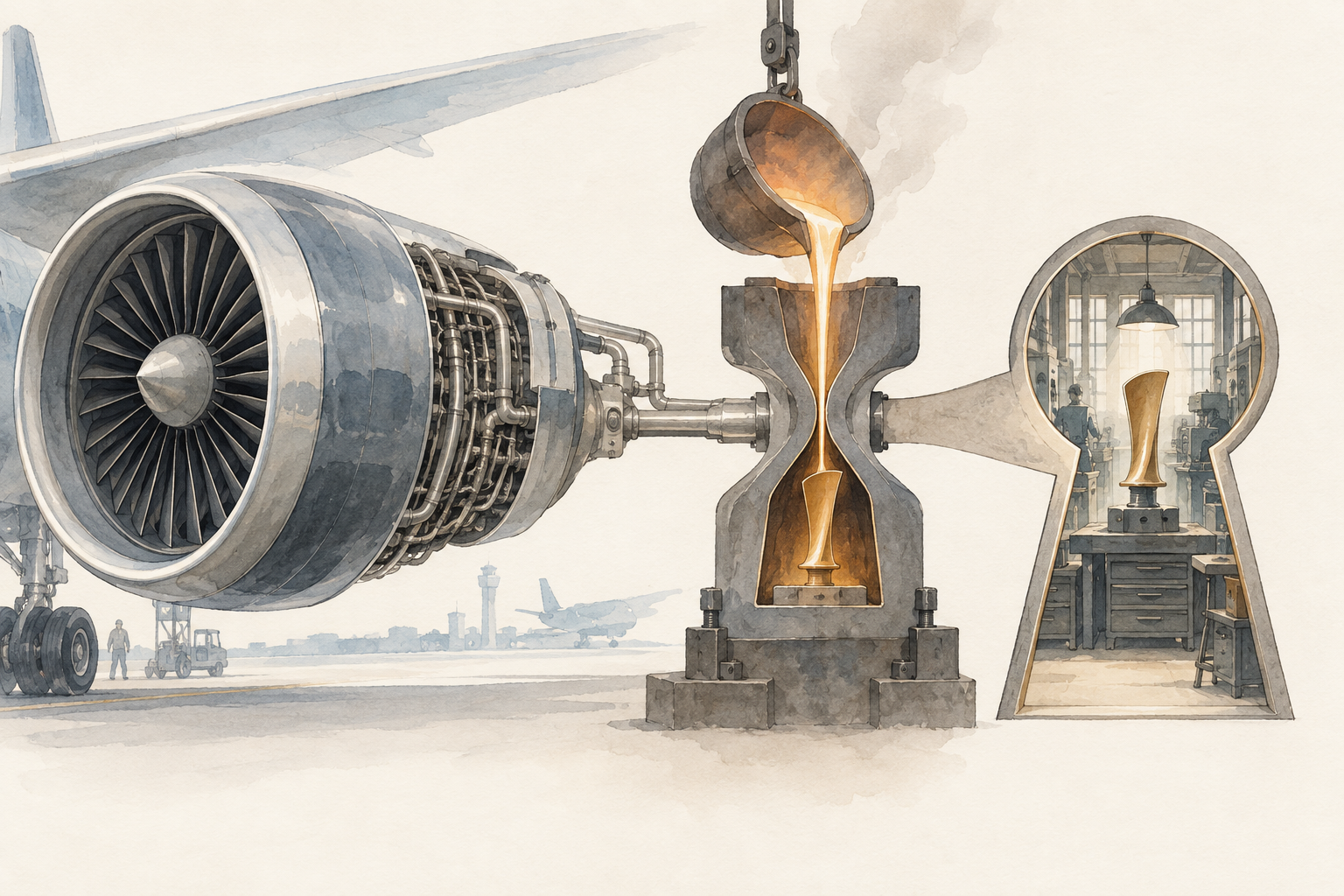
Vertical integration
A strategy in which a company brings suppliers, production steps or distribution capabilities under its own ownership to gain more control over costs, quality and timing.
Mission-critical castings
Specialized metal components made through casting processes for demanding applications such as jet engines, where heat resistance, strength and precision are essential.
Airfoils
Engine components, such as blades and vanes, shaped to manage airflow inside turbines and compressors; they are technically difficult to manufacture and qualify.
Aftermarket demand
Revenue and workload tied to maintaining, repairing and supplying parts for equipment already in service, rather than selling new equipment.
GE Aerospace
other
GE Aerospace to Acquire Consolidated Precision Products (CPP), Expanding Mission-Critical Castings Capacity
U.S. Securities and Exchange Commission / GE Aerospace
government
Form 8-K
GE Aerospace
other
GE Aerospace to acquire Consolidated Precision Products (CPP) — Investor Presentation
Deal value
GE Aerospace agreed to buy Consolidated Precision Products for $11.75 billion from Warburg Pincus and Berkshire Partners.
Capacity bet
GE’s investor materials point to airfoil demand growing more than 30% by 2030, making casting capacity a strategic constraint.
Supply control
The acquisition brings a key engine-supply-chain capability in-house while GE says it will continue relying on outside partners.
GE Aerospace’s $11.75 billion agreement to acquire Consolidated Precision Products from Warburg Pincus and Berkshire Partners is a decisive move to bring one of aerospace’s hardest-to-secure capabilities in-house: mission-critical castings for jet engines and other high-performance systems.1
The transaction, announced September 8, is expected to close in 2027 and will be financed with a mix of cash and debt, GE said.1 A same-day Form 8-K filed with the Securities and Exchange Commission formally disclosed the acquisition agreement, including the $11.75 billion purchase price, subject to closing adjustments.2
The strategic logic is clear. Commercial engine production, aftermarket demand and defense programs are competing for the same constrained base of specialized suppliers. GE is not merely buying revenue; it is buying control over capacity in a segment that has become a structural bottleneck. Reuters described the deal as a move to bring a key part of GE’s engine supply chain in-house as castings remain a pressure point for engine makers.6
CPP makes complex castings and related components for commercial aerospace, defense and industrial markets. For GE, the main prize is not diversification. It is control over production inputs that determine whether engines can be delivered, serviced and upgraded on schedule.
GE’s own framing emphasizes that point. The company said the acquisition would expand its mission-critical castings capacity and support demand across commercial engines, aftermarket services and defense programs.1 Its investor-relations note also said GE has been a CPP customer for more than 15 years, underscoring that the deal converts a long-standing supplier relationship into an owned manufacturing platform.5
That matters because modern engine production depends on highly engineered metal components that can withstand extreme heat, stress and durability requirements. These are not generic parts that can easily shift among vendors. Qualification cycles are long, process know-how is specialized, and capacity additions can require substantial capital investment, technical validation and customer approvals.
GE’s investor presentation gives the clearest indication of why the company is paying up. It points to airfoil demand growing by more than 30% by 2030 and identifies CPP as a supplier with roughly $2 billion of expected 2027 revenue.3 The SEC-filed version of the same presentation reinforces the capacity thesis, outlining GE’s view of the transaction’s industrial rationale, valuation and expected synergy opportunities.4
The acquisition reflects a broader shift in aerospace manufacturing. For years, large engine makers relied on global supplier networks to reduce fixed costs and preserve flexibility. That model works when capacity is abundant. It becomes fragile when a small number of highly specialized production steps constrain the entire system.
Castings and forgings have become two of the most visible constraints. Aviation Week reported that Culp pointed to supply stability, new airfoil development and additional capital spending as part of the deal rationale, while also describing castings and forgings as major aerospace and defense chokepoints.7
The problem is magnified by demand from several markets at once. Airlines need new engines for aircraft deliveries. They also need spare parts and shop-visit capacity to keep existing fleets flying. Defense customers are increasing demand for propulsion and related systems. Each market draws on overlapping industrial capacity.
For GE, CPP offers a way to reduce execution risk in that environment. Owning the asset does not eliminate all supply-chain exposure, but it can give GE more direct influence over capital allocation, production priorities, engineering coordination and delivery schedules.
At $11.75 billion, GE is paying a premium-sized price for a manufacturing asset. Bloomberg also confirmed the transaction value, the Warburg Pincus and Berkshire Partners sellers, and the financing structure, describing the deal as a major expansion of GE’s capacity for critical jet-engine castings.8
The size of the check suggests GE views casting capacity as a strategic scarcity rather than a commodity input. Under ordinary procurement logic, a buyer presses suppliers for lower prices and redundancy. In the current aerospace cycle, the risk is different: an engine maker can have demand, orders and pricing power, yet still fall short if constrained suppliers cannot scale.
That changes the economics of vertical integration. A supplier that appears expensive on near-term earnings may look more valuable if it protects engine deliveries, aftermarket revenue and customer commitments over a multiyear cycle. GE’s presentation also points to planned capital expenditure and expected synergies, suggesting management sees room to expand CPP’s output and integrate it into GE’s broader production system.3
Dow Jones coverage framed the deal as a large bet on advanced materials for hotter-running engines and highlighted CPP’s exposure to commercial aerospace, defense and power demand.9 That is important because next-generation engine performance depends heavily on materials and manufacturing processes that can tolerate higher temperatures and tighter specifications.
The CPP deal does not mean aerospace companies are abandoning outsourced supply chains wholesale. GE’s investor-relations note said the company will still need outside partners even as it integrates CPP.5 The more precise conclusion is that engine makers are becoming selective vertical integrators. They are willing to buy or control the few nodes that can hold back the whole system.
That selectivity matters. Bringing every supplier in-house would add complexity and dilute focus. Bringing a bottleneck supplier in-house can strengthen resilience if the asset is central enough, scarce enough and difficult enough to replicate.
CPP appears to fit that profile for GE. The company supplies components tied to engine hot sections and airfoils, areas where engineering tolerances, metallurgical expertise and certification barriers limit the number of viable suppliers. GE’s expected demand growth through 2030 makes the timing especially significant.3
The transaction also has a defense-industrial-base dimension. Aerospace supply chains are no longer shaped only by commercial aviation recovery. Defense programs, munitions demand, propulsion modernization and geopolitical rearmament have all increased pressure on suppliers serving both civil and military customers.
GE’s announcement explicitly links CPP’s capacity to defense demand as well as commercial engines and aftermarket requirements.1 That makes the deal part of a wider pattern: manufacturers with critical defense exposure are seeking more control over production steps that can affect readiness, delivery timelines and surge capacity.
For industrial strategy readers, the lesson is that capacity itself has become a competitive variable. The winners in aerospace may not simply be the companies with the strongest order books or most advanced designs, but those with the most reliable access to the manufacturing processes needed to convert demand into delivered hardware.
The transaction still carries risk. GE must close the deal, integrate CPP, retain technical talent and manage any customer concerns that arise when a supplier becomes owned by a major engine maker. The company also must continue investing, because the acquisition alone does not create immediate new capacity.
The legal path is also not complete. Paul, Weiss, Rifkind, Wharton & Garrison, which is advising GE, said the deal is expected to close in the second half of 2027, subject to customary conditions.10 Regulatory scrutiny and customer transition planning will be important given CPP’s role across multiple aerospace and industrial markets.
Still, the strategic message is clear. GE is using its balance sheet to secure a scarce production capability at a time when engine demand is strong and supply-chain fragility remains a central constraint. The CPP purchase is not just a bet on one supplier. It is a bet that, in aerospace, control of the bottleneck can be as valuable as control of the final product.






Comments