Germany’s Kyiv Visit Points to Defense Production Shift Inside Ukraine
Interceptor drones
Small unmanned aircraft designed to detect, pursue and destroy hostile drones, often at lower cost than missile-based air defense.
Co-production
A defense-industrial model in which companies from two countries jointly develop, manufacture or localize weapons production.
Jet-powered Shaheds
Faster variants of Russia’s long-range one-way attack drones, which create new challenges for Ukrainian air defenses.
Localization
The process of moving production, assembly or component sourcing into the customer country to improve supply resilience and speed.
Official website of the President of Ukraine
government
€1.3 Billion to Strengthen Ukraine’s Defense and Energy Sector: Results of the Meeting Between Volodymyr Zelenskyy and Friedrich Merz
Ministry of Defence of Ukraine
government
Ukraine and Germany discuss strengthening Ukrainian air defence
Federal Government of Germany
government
Pressekonferenz von Bundeskanzler Merz und dem ukrainischen Präsidenten Selenskyj: „Werden alles tun, um der Ukraine zu helfen“
€1.3B package
Germany’s new support package targets Ukraine’s defense and energy sectors, including air-defense and interceptor-drone needs.
€8.5B deals
Ukraine said the visit produced 15 agreements worth more than €8.5 billion across defense and industrial cooperation.
Local production
Germany and Ukraine are moving toward joint production inside Ukraine, including interceptor drones and long-range systems.
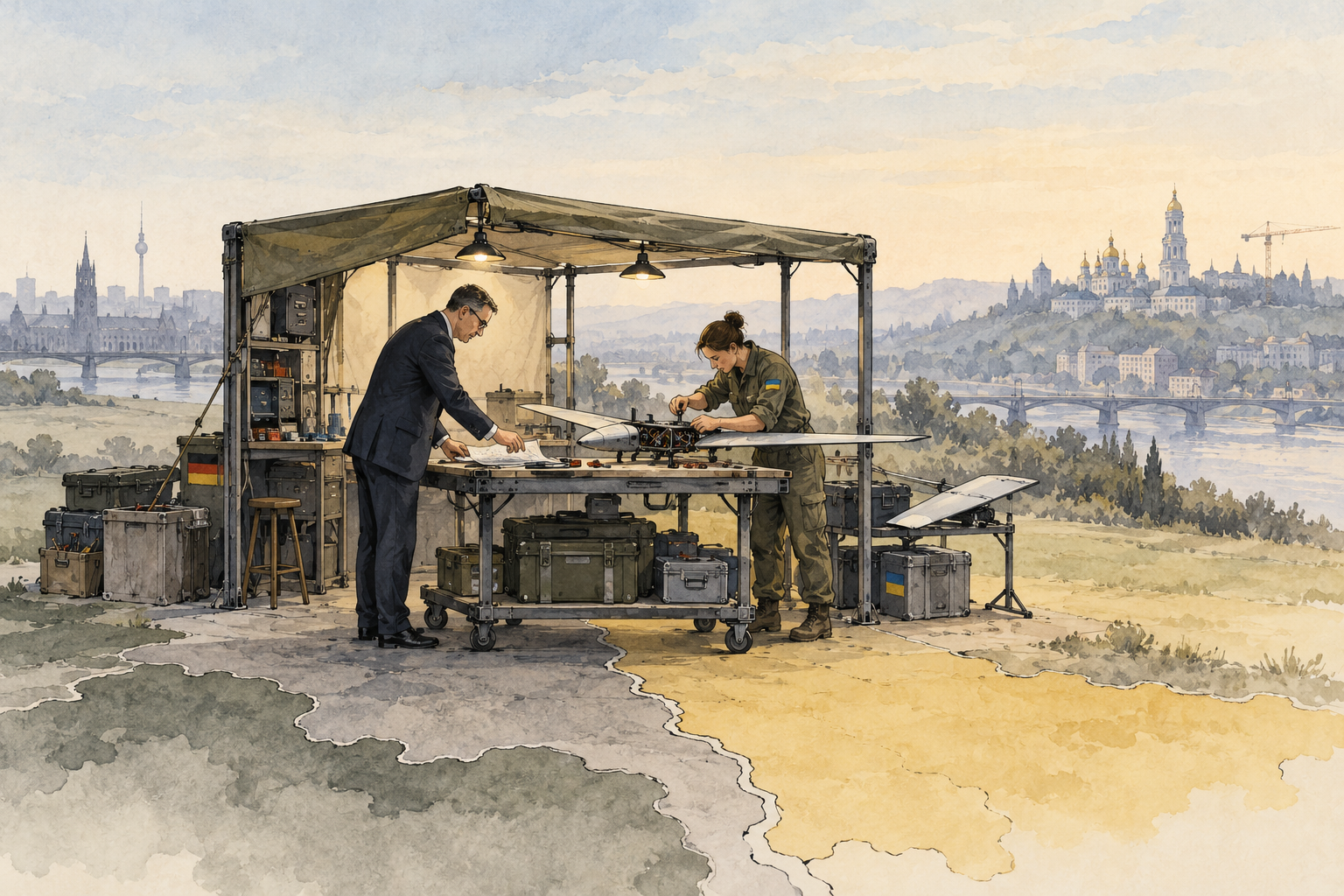
German Chancellor Friedrich Merz used an Oct. 4 visit to Kyiv to push a defense-industrial model beyond arms deliveries, pairing a €1.3 billion support package with agreements to build drones, air-defense systems and long-range capabilities closer to Ukraine’s battlefield demand.18
Merz arrived with Economy Minister Katherina Reiche and executives from German defense and energy companies, according to reports and official readouts. Berlin and Kyiv moved to formalize cooperation on interceptor drones, counter-unmanned aerial systems and long-range weapons production.58 Ukrainian officials said the visit produced 15 agreements worth more than €8.5 billion, including defense-industrial projects and energy support.19
For European defense industry leaders, the significance lies less in the headline aid figure than in the operating model behind it. Germany and Ukraine are moving from discrete procurement and transfer packages toward joint ventures, localization and serial production inside Ukraine, where systems can be adapted quickly against Russian drones and missiles.24
The Ukrainian president’s office said the €1.3 billion package would strengthen defense and energy resilience while supporting interceptor capabilities against Russia’s jet-powered Shahed-type drones.1 Germany’s government framed the visit as a long-term commitment, with Merz saying Berlin would continue helping Ukraine and emphasizing air defense as an urgent priority.3
The visit also showed how Ukraine is becoming a testbed and production environment for European defense firms. The German government said the partnership is “not a one-way street,” noting that developments by German and Ukrainian companies benefit both countries.4 That reflects a broader industrial logic: Ukraine provides operational urgency, rapid battlefield feedback and manufacturing need; European companies bring capital, engineering depth, certification pathways and scale.
Ukraine’s Defense Ministry said officials discussed moving from individual projects to systematic joint production and scale-up, with five documents signed with German defense companies during the Ukrainian-German Business Forum.2 The ministry also highlighted Ukraine’s need for more air defense against jet-powered drones and ballistic missiles, two threat categories shaping procurement priorities across Europe.2
The most immediate production focus is counter-drone defense. Germany plans to fund large numbers of interceptor drones for Ukraine, with production in Ukraine by Quantum WIY Industries, according to reports citing Quantum Systems.6 The program addresses a specific operational problem: Russia’s expanding use of faster, jet-powered Shahed-type attack drones that strain conventional air-defense inventories.12
The choice of interceptors shows how wartime demand is changing the economics of air defense. Ukraine needs systems that are cheaper and faster to produce than many traditional missile interceptors, but sophisticated enough to defeat higher-speed one-way attack drones. For contractors, that creates demand for modular sensors, autonomy, electronic-warfare resistance and scalable manufacturing.
Kyiv and Berlin also signed a counter-UAV cooperation agreement, according to Ukrainian state media, which reported that Merz said German industry is learning from Ukrainian battlefield experience.7 That learning loop is becoming a strategic asset: products are iterated against live threats, while production partnerships offer suppliers a compressed cycle from concept to combat feedback.
The Merz visit also included cooperation on long-range weapons production, according to Reuters and dpa reporting.58 Associated Press reported that the agreements included joint production of drones to intercept Russian systems as well as long-range strike weapons.9
Building long-range systems nearer to Ukraine’s theater of operations carries military and industrial implications. It can shorten delivery timelines, reduce dependence on cross-border logistics and enable faster modification based on mission data. It also moves European defense firms deeper into a wartime production environment, where infrastructure risk, intellectual-property protection, export controls and financing structures must be managed alongside engineering requirements.
That model is not limited to one manufacturer. Deal-level reporting cited memorandums involving companies including Diehl Defence, HENSOLDT and Quantum Systems, as well as agreements linked to drone localization, interceptor trials and cooperation among firms such as Quantum Systems, Fire Point, ARX Robotics, Roboneers, Helsing and Culver Aerospace.10 The range of participants points to an ecosystem approach rather than a narrow procurement channel.
For Germany, co-production in Ukraine also serves a domestic industrial purpose. European militaries are trying to rebuild inventories while absorbing lessons from high-intensity warfare, including mass drone attacks, electronic warfare, air-defense saturation and the need for affordable precision systems. Ukrainian production partnerships offer German companies access to operational data and user feedback that peacetime procurement cycles rarely provide.
The German government’s account of the visit explicitly linked Ukrainian and German industrial development, saying advances by companies from both countries benefit both sides.4 For contractors, that can translate into products that are more exportable across NATO and European markets, particularly as governments seek systems proven against Russian tactics.
The model also spreads risk. Rather than relying solely on donations from existing European stocks, Germany can fund Ukrainian-based output while encouraging German firms to form local partnerships. Ukraine gains industrial capacity and supply resilience; Germany gains faster delivery options and a path to strengthen its own defense-technology base.
Merz’s Kyiv trip fits a wider European shift from emergency support to defense-industrial integration. The political message was continued backing for Ukraine, but the industrial message was more structural: future aid is increasingly likely to be delivered through production networks, joint ventures and shared development pipelines rather than one-off transfers alone.
For decision-makers, that means Ukraine should be viewed not only as an end user but also as a production partner and development environment. The companies that succeed in this model will be those able to manage wartime manufacturing, integrate Ukrainian engineering and feedback, and scale systems fast enough to match threat evolution.
The Oct. 4 agreements suggest European defense strategy is becoming more distributed, more operationally driven and more closely tied to Ukraine’s battlefield requirements. If sustained, the approach could reshape how European contractors design, test and deliver the next generation of drones, interceptors and long-range systems.





Comments