Shell’s ARC Deal Shows Big Oil Buying Growth in Gas-Rich Basins
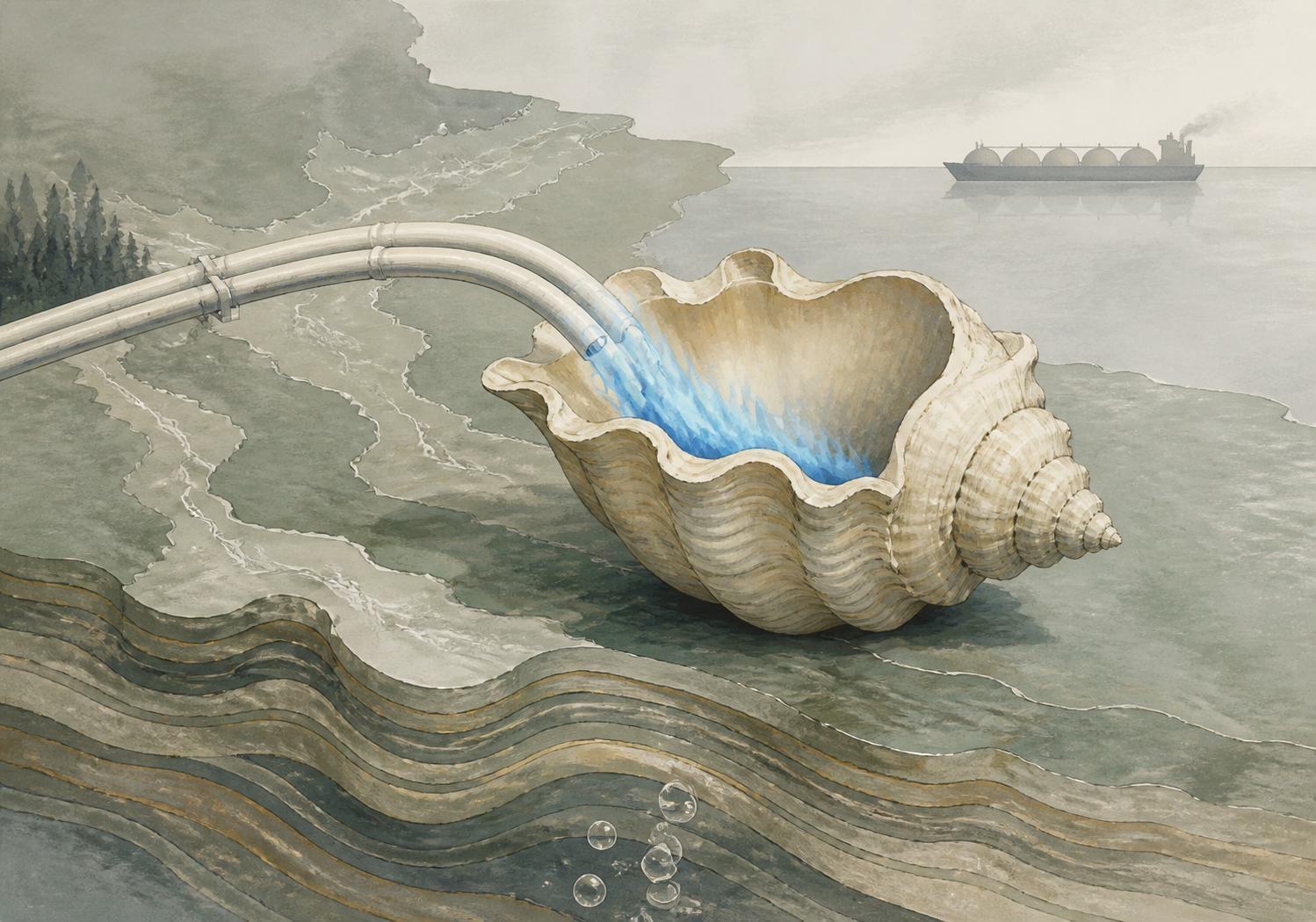
Montney basin
A major oil and gas formation in British Columbia and Alberta that produces natural gas, condensate and natural gas liquids.
boe/d
Barrels of oil equivalent per day, a common metric used to combine oil, gas and liquids production into one comparable figure.
Enterprise value
A transaction valuation measure that typically includes equity value plus assumed debt and other obligations.
Free-cash-flow accretion
A deal is accretive to free cash flow per share when it is expected to increase the cash generated for each share outstanding.
370 kboe/d
Shell’s acquisition of ARC Resources adds roughly 370,000 barrels of oil equivalent per day across liquids and gas.
$16.5B EV
The transaction carries an enterprise value of about $16.5 billion, including assumed net debt and lease liabilities.
2027 FCF
Shell expects the deal to be accretive to free cash flow per share from 2027 onward.
Shell’s $16.5 billion acquisition of ARC Resources gives the company an immediate production lift of about 370,000 barrels of oil equivalent per day and reinforces a familiar shift across Big Oil: growth is increasingly being bought in gas-rich basins linked to LNG and downstream systems, rather than pursued only through long-cycle greenfield megaprojects.1
The deal, completed after shareholder, court and regulatory approvals, expands Shell’s Canadian footprint in British Columbia and Alberta. It also supports the company’s target of roughly 4% compound annual production growth through 2030 versus 2025 levels.1
ARC’s assets are centered in the Montney, one of North America’s most important natural gas and liquids plays. The acquisition adds long-duration production that Shell expects to contribute to double-digit returns, stronger long-term cash flows and free-cash-flow-per-share accretion from 2027 onward.2
For energy executives and M&A investors, the transaction is less notable as a reserve-replacement deal than as a sign of how integrated majors are reshaping portfolios. Shell is not simply buying barrels. It is buying a low-cost resource base that can fit into a broader system spanning upstream production, LNG exposure, refining, chemicals, fuel marketing, aviation, lubricants and other customer-facing businesses.1
The most immediate effect is scale. ARC adds liquids and natural gas production as Shell tries to rebuild output growth without abandoning capital discipline.5
Market coverage of the closing put the enterprise value at about $16.5 billion, including roughly $2.5 billion of assumed net debt and lease liabilities. The equity value was about $13.9 billion.3
The structure also matters. ARC shareholders are receiving CAD 8.20 in cash and 0.40247 Shell ordinary shares for each ARC common share. The equity value is funded through about $3.3 billion in cash and $10.6 billion in newly issued Shell shares.1 That stock-heavy funding limits immediate cash leakage while giving ARC holders exposure to Shell’s larger global portfolio.
Strategically, the asset mix fits Shell’s stated preference for resilient cash generation. Gas and LNG remain central to Shell’s transition-era oil and gas thesis: gas can serve power, industry and heating demand, while LNG creates optionality across regional markets. Zacks noted that combining ARC’s resource base with Shell’s Canadian infrastructure could create additional opportunities across the upstream and LNG value chain.2
The Montney basin is the core industrial logic behind the deal. ARC brings technical capability and a large producing position in a basin known for scalable natural gas, condensate and natural gas liquids development.
Shell Chief Executive Wael Sawan said the company would build on ARC’s operational and technical expertise in Canada’s Montney basin while increasing Shell’s exposure to long-duration, low-cost liquids production.5
That matters because acquired production can be integrated faster than a new megaproject that must move through exploration, appraisal, permitting, construction and commissioning. It also gives Shell more optionality. Montney gas can support domestic markets, pipeline systems and LNG-linked value chains, while liquids-rich output can strengthen margins in an integrated portfolio.
The acquisition also appears designed to tighten Shell’s Canadian system around upstream supply and downstream demand. MarketScreener reported that the deal complements Shell’s existing LNG footprint and creates synergies with downstream operations, including refining, chemicals, fuel marketing, aviation, lubricants and low-carbon solutions.1
PlasticsToday highlighted the downstream relevance of added Montney gas and liquids for feedstock security in petrochemical supply chains, including ethane- and propane-linked uses.6
The ARC acquisition shows how production growth can be purchased when corporate balance sheets, equity currency and strategic fit align. For Shell, the transaction adds output, acreage depth and technical talent in one move. For investors, the test will be whether the acquired barrels translate into free cash flow rather than simply higher volumes.
That distinction is important. The industry has spent years rewarding capital discipline over production growth for its own sake. Shell’s messaging around ARC therefore emphasizes returns, cash-flow accretion and integration rather than volume alone.7
Hydrocarbon Processing reported that the transaction is expected to generate double-digit returns, bolster long-term cash flows and become accretive to free cash flow per share from 2027 onward.7
The company is also moving quickly on post-close financial housekeeping. ARC announced the redemption of all outstanding senior notes, with notices issued on September 3 and redemptions scheduled for September 14, 2026.4 ARC also described itself after closing as a Shell Group member and an indirect wholly owned subsidiary of Shell Canada Limited.4
That debt clean-up points to early integration work and gives Shell more control over the acquired company’s capital structure.
The Shell-ARC deal underscores a wider strategic pivot in large-cap energy: acquisitions in advantaged basins are becoming a preferred route to replenish inventory, add near-term production and preserve shareholder-return capacity.
Greenfield projects still matter, particularly in LNG, deepwater and advantaged oil. But M&A can compress timelines and reduce execution uncertainty when the target has existing production, infrastructure and development inventory.
ARC offers that type of platform: producing assets, technical staff, liquids-rich gas exposure and a location that can connect to Canada’s evolving LNG ambitions. The transaction gives Shell both immediate volumes and a longer inventory runway.
The deal also sits alongside other moves to strengthen downstream reach. Egypt Oil & Gas noted that Shell, through Equilon Enterprises, recently agreed to increase its stake in Tri Star Energy from 33% to 100%, expanding company-owned mobility and convenience retail operations in the southeastern United States.8
Taken together, the moves show Shell adding resource depth upstream while also reinforcing customer-facing and downstream channels.
The central question is whether Shell can integrate ARC without diluting the performance culture that made the target attractive. The company must preserve drilling efficiency, manage Montney cost inflation, maintain regulatory and Indigenous stakeholder relationships, and align the acquired portfolio with LNG and downstream opportunities.
Commodity risk remains another variable. Gas-linked acquisitions can create long-term strategic value, but cash-flow outcomes will still depend on North American gas prices, liquids realizations, transportation access and the timing of LNG-linked demand.
Shell’s stock-funded structure reduces cash pressure, but it also means shareholders will look closely at per-share value creation.
For now, the transaction gives Shell a clearer production-growth bridge through 2030 and a larger position in one of Canada’s most strategic gas basins. The larger message is that the next phase of Big Oil growth may be less about building every new barrel from scratch and more about buying scalable, infrastructure-linked resources that can feed integrated gas and downstream systems.






Comments