Uber’s Layoffs Point to Efficiency Push and Autonomous-Mobility Shift
Robotaxi
A ride-hailing vehicle that uses autonomous-driving technology; some services still include a human safety driver depending on regulation and maturity.
Management layers
The number of reporting levels between front-line employees and senior executives; reducing layers is intended to speed decisions and clarify accountability.
Micro-team
A very small team, often with only one or two direct reports, that can create management overhead without much operating scale.
Hybrid work policy
A workplace model requiring employees to spend part of the week in an office while allowing some remote work.
3,300 jobs
Uber is cutting about 3,300 roles, equal to roughly 10% of its workforce.
AV reinvestment
Uber says savings from the restructuring will support growth, innovation and its autonomous future.
London launch
Uber and Wayve launched supervised autonomous rides in London on the same date the restructuring was announced.
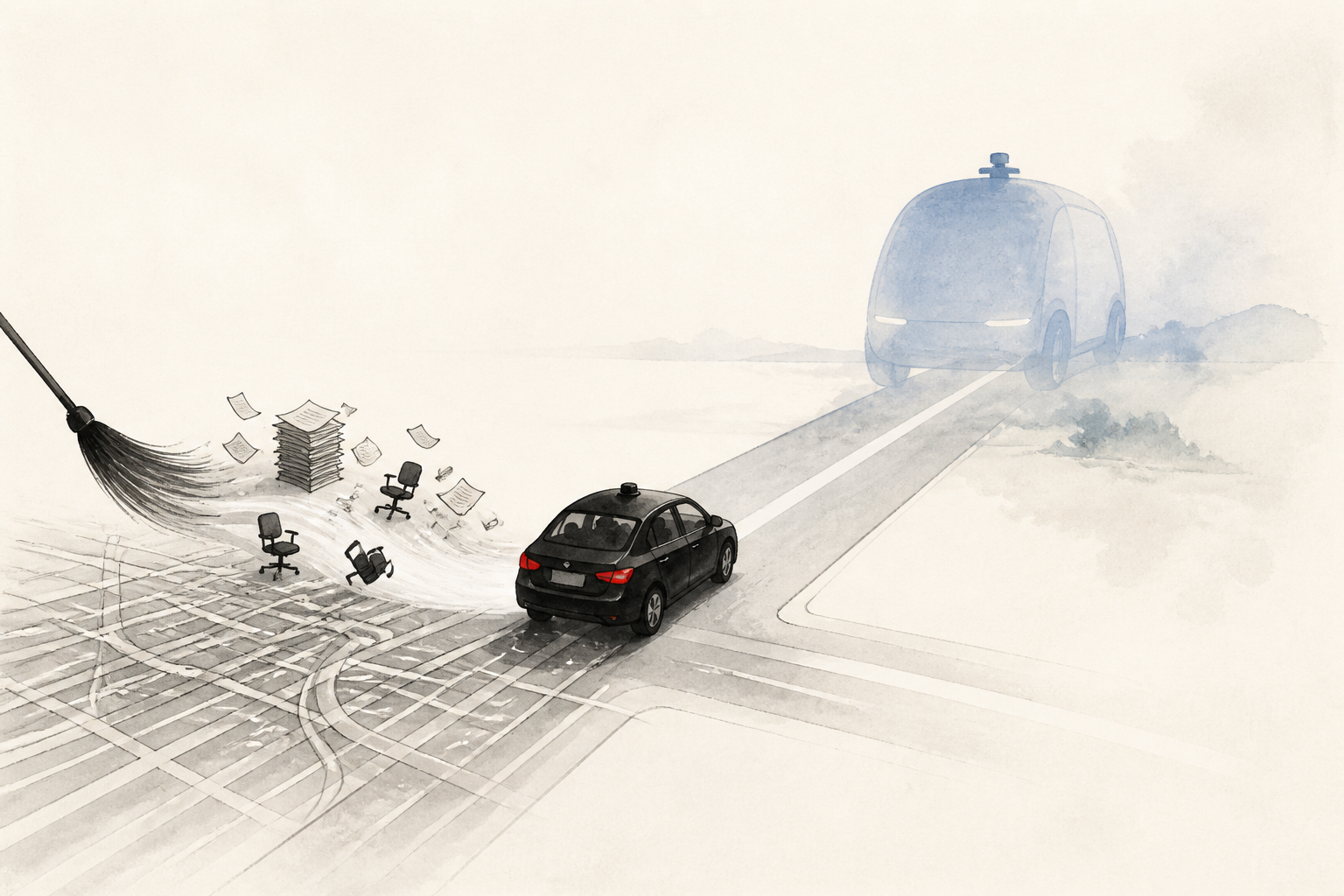
Uber is cutting about 3,300 jobs, or roughly 10% of its workforce, in a restructuring best understood as both an efficiency drive and preparation for a more capital-intensive autonomous-mobility phase.
The company’s stated rationale is straightforward: fewer management layers, fewer fragmented teams, more office-based work and faster decision-making. But the cuts also come as Uber accelerates autonomous-vehicle deployment and partnerships, suggesting it is reallocating management attention and financial capacity toward a future in which ride-hailing platforms may need to coordinate human drivers, autonomous fleets, vehicle partners, depot operators and regulators at scale.13
CEO Dara Khosrowshahi told employees that Uber is “removing layers,” simplifying team structures, refining its global location strategy and focusing people and investment on its largest opportunities. He said the reduction would affect about 10% of the company and create capacity to invest in growth, innovation and the “autonomous future.”1
That framing matters for mobility executives. Uber is not presenting the layoffs as a demand shock or a retreat from growth, but as an organizational reset after years of expansion.
The company’s business logic is that scale has created drag. Uber said revenue has nearly tripled over the past five-plus years, while its internal structure accumulated more coordination points, unclear decision rights and fragmented ownership.1 The company is targeting roles focused on coordination, reducing employees who sit seven or more layers from the CEO by 20%, and cutting micro-teams of one or two reports by nearly half.14 It is also combining teams, including delivery operations across restaurants, retail and direct delivery, and merging core services engineering and science teams.1
On the surface, the restructuring is a classic post-scale efficiency program. Uber is trying to reduce the number of people required to make and execute decisions. That fits a company that has moved beyond its earlier cash-burn phase and now has to defend operating leverage while investing across multiple businesses.
The office strategy reinforces that interpretation. Uber said it will concentrate global teams in major hubs such as San Francisco and New York, prioritize manager-team co-location, require most remote employees to move to an office and allow only about 1% of employees to remain fully remote. It also plans to keep enforcing a hybrid policy requiring three office days per week.16
For executives, the signal is that Uber views organizational latency as a strategic cost, not just an HR issue.
Bloomberg reported the cuts as a move to slash bureaucracy and reallocate spending into ridesharing, delivery and robotaxi businesses.3 TechCrunch similarly described the layoffs as an effort to reduce management layers while investing more in ridesharing, delivery and robotaxi divisions.4 Forbes reported that the cuts are Uber’s largest since the pandemic and noted investor attention to robotaxi competition from players including Waymo and Zoox.8
The more important question is whether the job cuts are only about internal efficiency or also about redirecting resources toward autonomous mobility. The answer appears to be both. Uber’s own message links the savings to future investment, including autonomy, while outside reporting places the restructuring in the context of robotaxi competition and partnership spending.156
The timing is difficult to separate from Uber’s AV activity. On the same date as the restructuring message, Uber and Wayve announced supervised autonomous rides in London, allowing some UberX, Uber Electric and Uber Comfort riders to be matched with an all-electric Ford Mustang Mach-E equipped with Wayve’s AI Driver.2 The launch is limited and supervised, with a trained, licensed driver in the vehicle, but it shows Uber turning AV partnerships into consumer-facing service, not just pilots or press releases.27
The Associated Press reported that the London rollout will start with a small number of vehicles and that U.K. rules still require a safety driver while approval for fully driverless taxi operations proceeds. It also noted that Waymo, Baidu, Zoox, Tesla and Chinese robotaxi firms are expanding across global markets, creating a competitive environment in which Uber must decide whether it is mainly a marketplace, a fleet coordinator or a deeper operator of autonomous mobility infrastructure.7
That is the crux of the reallocation thesis. Autonomous ride-hailing is not simply the current Uber model with the driver removed. It requires new capabilities in vehicle supply, hardware partnerships, fleet utilization, charging, cleaning, maintenance, insurance, safety case management, remote assistance, incident response and regulatory compliance.
Uber’s historical advantage has been matching riders and drivers through a liquid marketplace. Its autonomous future depends on whether that marketplace can become the orchestration layer for fleets it may not fully own but must help make productive.
If AVs scale, Uber’s operating model will become more complex in some areas even as it becomes simpler in others. Driver incentives, onboarding and churn may become less central on AV trips. But fleet uptime, depot logistics, partner economics and city-by-city regulatory approvals will become more important. A layered organization with duplicated teams and unclear accountability would be poorly suited to that transition.
Semafor tied the cuts directly to the robotaxi threat, noting that savings could support Uber’s autonomous-driving push as Waymo pressures the company’s position in ride-hailing.5 The San Francisco Chronicle reported that Uber plans to invest more than $10 billion in autonomous-vehicle partnerships and related initiatives in the coming years, while facing growing competition from robotaxi companies such as Waymo and Tesla.6
The company’s partnerships with autonomous and vehicle-technology players, including Waymo, Lucid and Nuro, point to a portfolio approach rather than a single internal AV stack.
That portfolio strategy creates a management challenge. Uber must avoid becoming too dependent on any one AV supplier while making its platform attractive enough for AV companies that may eventually want direct consumer relationships. If Waymo or other operators can own both the vehicle stack and the customer interface, Uber’s role could be compressed. If Uber can aggregate demand, manage utilization and provide operating infrastructure across many AV partners, it could remain central.
For technology and mobility leaders, Uber’s restructuring should not be read as a standalone layoff story. It is a signal that large platform companies are pruning organizational complexity before entering a phase in which AI-enabled physical operations will demand faster decision loops and heavier capital coordination.
The immediate savings may improve margins. The deeper test is whether a leaner Uber can make better allocation decisions across human-driven rides, delivery, autonomous partnerships and city operations.
The company is simplifying now because autonomous mobility may later require a more fundamental redesign of ride-hailing: from a labor-mediated marketplace into a hybrid network of drivers, vehicles, software partners and operating hubs.
That transition is not guaranteed, and supervised launches in places such as London remain far from mass driverless deployment.27 But Uber’s restructuring suggests management sees organizational speed as a prerequisite for the robotaxi era.
The cuts are therefore not just about doing the same work with fewer people. They are about deciding what work Uber needs to own as the economics of mobility begin to change.






Comments