Tesla and Rivian Delivery Beats Point to Firmer EV Demand, but Margins Remain the Test
Deliveries
The number of vehicles handed over to customers; investors use it as a demand indicator, but it does not show profitability.
Average selling price
The average revenue an automaker receives per vehicle, a key driver of automotive gross margin.
BEV
Battery electric vehicle, meaning a fully electric car with no internal-combustion engine.
Inventory drawdown
When a company delivers more vehicles than it produces during a period, reducing vehicles held in stock.
Tesla Investor Relations / Business Wire
other
Tesla Third Quarter 2026 Production, Deliveries & Deployments
U.S. SEC EDGAR / Tesla
government
Tesla Third Quarter 2026 Production, Deliveries & Deployments - Exhibit 99.1
Rivian Automotive / Business Wire via StreetInsider
news
Rivian Releases Q3 2026 Production and Delivery Figures and Sets Date for Third Quarter 2026 Financial Results
Tesla beat
Tesla delivered 486,532 vehicles in the third quarter, above the 456,896 Visible Alpha estimate reported by Reuters.
Rivian record
Rivian delivered a record 19,248 vehicles and reaffirmed its 65,000 to 70,000 full-year delivery target.
Fuel effect
UK BEV registrations hit a record 99,199 in September as model choice, incentives and high fuel prices supported demand.
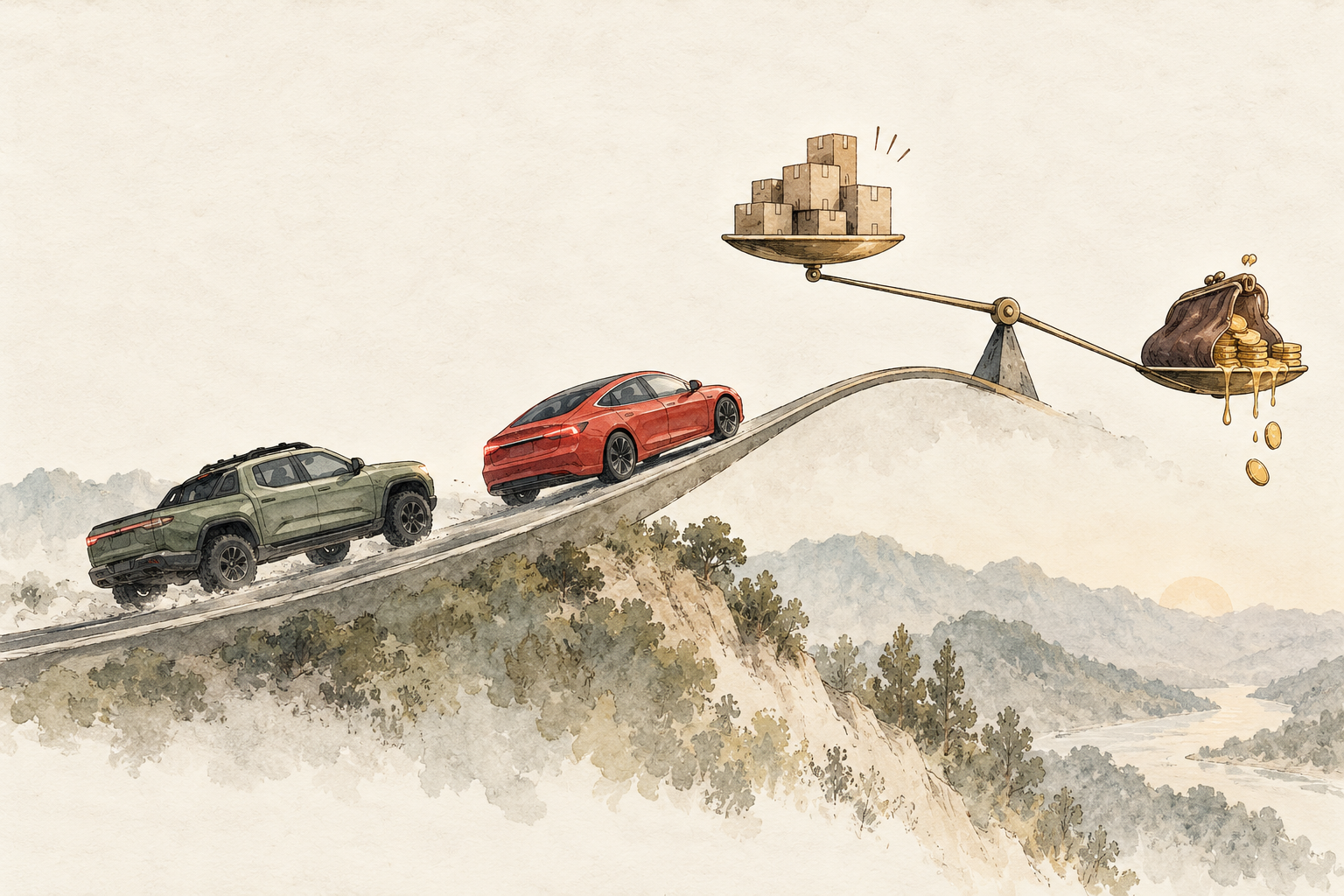
Tesla and Rivian gave global autos investors a clearer signal that electric-vehicle demand is stabilising. Their October earnings reports will show whether that rebound can translate into healthier profits, rather than just higher unit volumes.
Tesla delivered 486,532 vehicles in the third quarter, above the 456,896 average estimate compiled by Visible Alpha, putting the company on course to end two years of falling annual sales, Reuters reported.4 Rivian also beat expectations, delivering a record 19,248 vehicles against an 18,001 estimate, as its lower-priced R2 SUV broadened its addressable market.5
The combined message is that EV demand is not as weak as investors feared after the end of U.S. federal tax credits and a bruising period of price competition.
Still, the delivery data are only the first half of the story. Tesla cautioned that vehicle deliveries and energy-storage deployments “represent only two measures” of financial performance and should not be relied on as an indicator of quarterly results. Results will also depend on average selling prices, cost of sales and foreign exchange, among other factors.1 Tesla reports third-quarter results on October 21, while Rivian reports on October 29.23
That makes the latest figures a cleaner demand signal, but not yet a clean earnings signal. Higher petrol prices, more available EV models and renewed European momentum appear to be pulling buyers back into the market. The earnings test is whether automakers can convert that demand into margin protection, rather than leaning on discounts, incentives and inventory clearance.
Tesla’s quarter was strong on headline volume. The company produced 464,391 vehicles and delivered 486,532, including 478,237 Model 3 and Model Y vehicles.1 The gap means Tesla delivered 22,141 more vehicles than it produced, suggesting inventory drawdown helped the beat.
That is positive for working capital and dealer-style stock risk. But it also raises the key investor question: were those vehicles cleared at healthy prices?
Reuters said Tesla needs 311,448 more deliveries to match last year’s total, fewer than it has delivered in any quarter since mid-2022. That implies a return to full-year delivery growth is now well within reach.4 Analysts also raised 2026 delivery expectations to 1.82 million vehicles from a June consensus of 1.65 million, according to the Reuters report.4
The geographic mix matters. Tesla’s U.S. sales were expected to face a tough comparison after the $7,500 federal EV tax credit expired at the end of September 2025. But Reuters said European recovery helped offset that drag.4 EU registrations rose by about two-thirds in the January-August period from a year earlier. Tesla’s third-quarter European sales recovery also gathered pace in France, Denmark and other markets, aided by incentives, easier comparisons and rising EV interest.4
For a stock still valued heavily on artificial intelligence, robotaxis and autonomous-driving optionality, the car business remains the cash engine. The delivery beat lowers the risk that Tesla’s core auto franchise is structurally deteriorating. But the October 21 earnings release will need to show whether gross margin, average selling price and operating leverage improved alongside volume.
Rivian’s numbers add a second, more model-specific signal. The company produced 19,751 vehicles at its Normal, Illinois, factory and delivered 19,248 in the quarter ended September 30.3 It reaffirmed full-year 2026 delivery guidance of 65,000 to 70,000 vehicles, saying third-quarter production and deliveries were in line with its outlook.3
Reuters linked the record quarter to the R2, Rivian’s cheaper SUV. Deliveries began in June, and the model is aimed at a broader section of the mass EV market than the premium R1S SUV and R1T pickup.5
That matters because the R2 is the clearest test of whether Rivian can move beyond a niche, high-end customer base into a larger segment without breaking its cost structure.
The market reaction was more cautious than the delivery beat alone might imply. Reuters reported Rivian shares fell more than 2% in early trading as investors focused on management’s decision to maintain, rather than raise, full-year guidance.5 That response underscores the broader issue for EV makers: investors increasingly want evidence of disciplined scaling, not just higher deliveries.
Rivian’s reaffirmed target implies the company still has meaningful fourth-quarter execution risk. But the third-quarter data suggest the R2 ramp is at least moving in the right direction. If Rivian can lift output while limiting launch costs and preserving pricing, the record quarter could mark a more durable inflection. If not, it may simply confirm demand at price points that remain expensive to serve.
The macro demand picture is improving most visibly in Europe and the UK. The Society of Motor Manufacturers and Traders said the UK posted record battery-electric registrations in September, with 99,199 BEVs registered, up 36.3% from a year earlier and equal to a 28.3% market share.9
SMMT attributed the increase to greater model choice, manufacturer incentives and government grants. It also said high fuel prices were giving more consumers a reason to consider going electric.9
That supports the thesis that fuel economics are becoming a more visible demand driver again. When petrol prices are elevated, the operating-cost advantage of EVs becomes easier for consumers to understand, especially in high-mileage households and fleet use cases. But the UK data also show demand is not purely organic: incentives and discounts remain part of the equation.
Model availability is equally important. SMMT said the number of BEV models on the UK market has more than doubled since 2023 to 178, with electrified offerings now representing more than three quarters of new cars available.9 That wider choice reduces one of the main barriers to adoption. Consumers no longer have to accept a narrow range of body styles, price points or brands to go electric.
For Tesla, the European rebound helps counter concerns that brand fatigue, political backlash and Chinese competition had permanently weakened its position. For Rivian, the R2 suggests a path toward volume through a more affordable product. For European automakers, however, the message is mixed: the EV market is growing, but growth is increasingly contested by Tesla, Chinese entrants and newer U.S. models.
For automakers, the immediate read-through is positive for production planning. Stronger deliveries reduce inventory risk, support factory utilisation and may stabilise supplier schedules after a volatile demand cycle. Tesla’s 13.7 GWh of energy-storage deployments also point to continued battery demand beyond passenger vehicles, extending the relevance of the quarter for cell makers and storage supply chains.1
Battery suppliers should benefit if the delivery recovery broadens, because higher EV volumes translate directly into cell, cathode-material and pack demand. The margin implications are more complicated. If automakers rely heavily on incentives to move vehicles, they may push battery suppliers harder on pricing. Volume can rise while unit economics remain under pressure across the supply chain.
European carmakers face a sharper strategic challenge. A recovering EV market helps them meet regulatory targets and absorb their own battery investments, but it also raises the competitive bar. SMMT noted that UK year-to-date BEV share of 26.2% remained below both last year’s 28% target and the 33% required in 2026, highlighting the gap between policy ambition and current demand.9
If Tesla regains share in Europe and Rivian proves there is demand for new mid-priced EVs, legacy manufacturers may need to choose between protecting margins and defending share.
That tension is already visible across the sector. Manufacturers are expanding EV lineups, offering discounts and investing in battery platforms while also managing lower combustion-engine volumes. The latest delivery numbers suggest the demand trough may be passing, but not that pricing power has returned.
The decisive data will come later this month. Tesla’s October 21 results will show whether a 486,532-vehicle quarter carried better automotive gross margin, whether inventory drawdown required price concessions and whether energy storage provided a meaningful offset.2 Rivian’s October 29 report will show whether record deliveries narrowed losses and whether the R2 ramp is improving or pressuring unit economics.3
For investors, the delivery beats shift the debate. The question is no longer simply whether EV demand exists after subsidies fade. It does. The question is whether automakers can meet that demand profitably while fuel prices, incentives, model launches and regional competition pull in different directions.
The third-quarter data are therefore a constructive signal for autos and battery suppliers, and a warning for European incumbents. EV demand is recovering, but the next phase will reward companies that can convert volume into margin rather than those that merely chase deliveries.







Comments