Google Reframes Long-Form AI Video as an Orchestration Problem
Semantic drift
A failure mode where characters, objects or settings gradually change across generated shots even though the story requires them to stay consistent.
Multi-armed bandit
An optimization method that balances trying new options with reusing options that have already produced strong results.
Visual memory
A structured store of references for characters, locations and objects that a generation system can retrieve when a scene returns to them.
VQQA
Video Quality Question Answering, Google’s prompt-guided evaluation loop that asks targeted visual questions and uses critiques to generate improved candidates.
Four systems
Google’s approach combines Co-Director, CANVAS, A²RD and VQQA to manage planning, continuity, long-duration generation and revision.
Memory layer
CANVAS and A²RD use persistent visual or multimodal memory to reduce character, prop and environment drift across non-adjacent scenes.
Evaluation shift
Benchmarks such as GenAD-Bench, HardContinuityBench and LVBench-C test long-horizon constraints rather than only short-clip visual quality.
Google Research’s new work on coherent long-form video generation signals a shift in AI video: the hard problem is no longer just producing a sharp five-second clip. It is keeping a narrative world stable across many shots, revisions and minutes of screen time.1
Published September 24, 2026, and listed by Google Research under Generative AI and Machine Intelligence, the work presents a suite of systems — Co-Director, CANVAS, A²RD and VQQA — designed to automate the coordination work around a video model: scene planning, visual memory, segment-by-segment generation, critique and prompt-guided refinement.2
That makes the release materially different from a consumer-facing video demo. Google is not simply presenting a new model that makes prettier clips. It is describing an orchestration layer for long-horizon consistency built on top of foundation models such as Gemini and Veo.1
For AI builders and media technologists, the central takeaway is architectural. Long-form generated video is becoming a state-management and evaluation problem. The system has to remember who characters are, what they wear, where objects are located, how environments change and whether a late scene still matches the intended story. Without that infrastructure, high-fidelity clips can still collapse into discontinuity when chained together.
Google frames the problem around several failure modes familiar to anyone testing current video systems: semantic drift, feature drift, content collapse and cascading errors.1 A character’s clothing can gradually change. A prop can reappear with a different shape. A room layout can shift after a cut. An early asset error can contaminate later shots.
These are not just visual defects. They are failures of production memory.
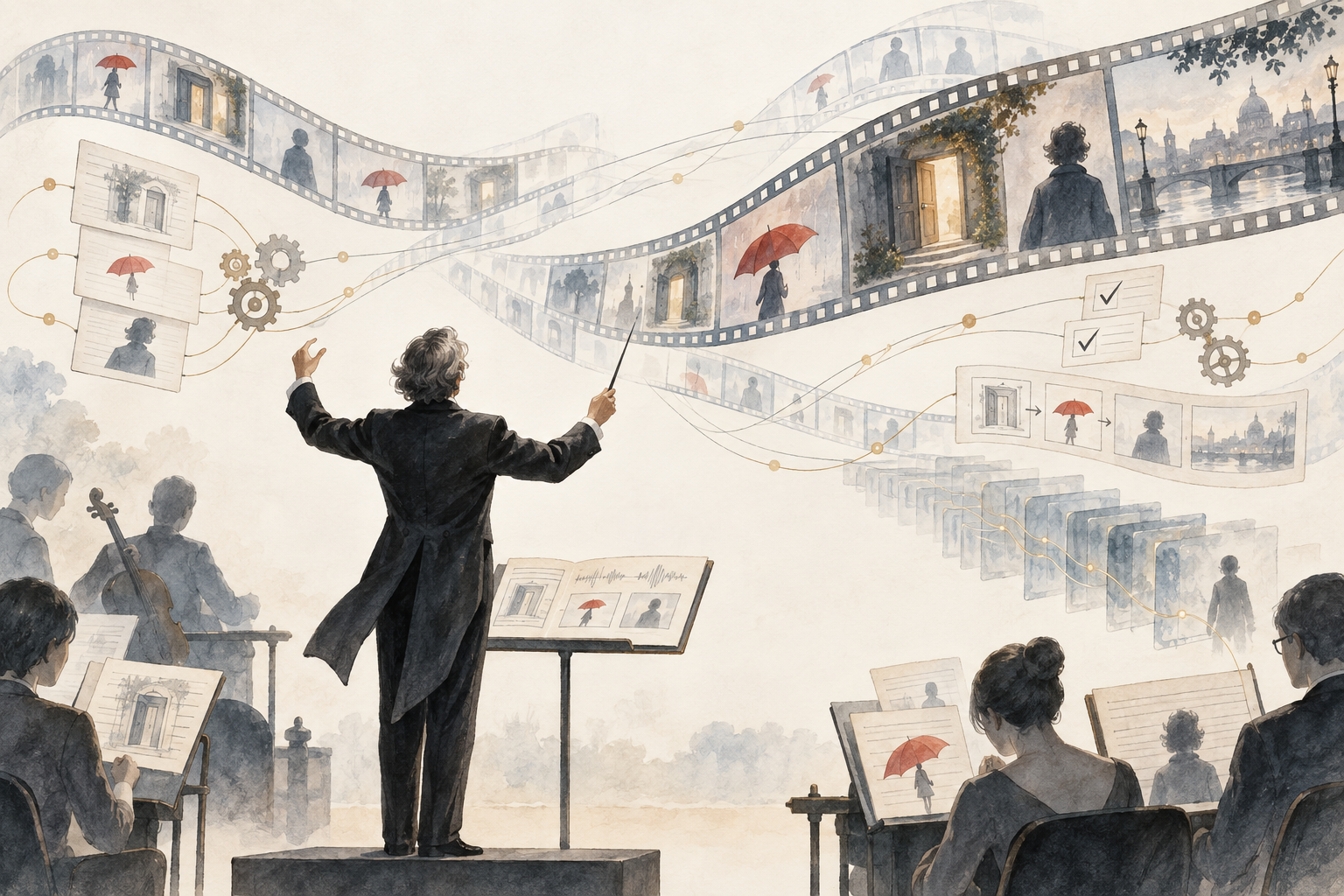
Google’s answer is to break long-form generation into specialized functions. Co-Director handles creative direction and production planning. CANVAS manages continuity-aware storyboarding. A²RD generates longer videos segment by segment with multimodal memory. VQQA evaluates candidate videos through targeted visual questions and uses the resulting critiques to revise prompts.1
Secondary coverage of the announcement emphasized the same distinction: the framework combines planning, visual memory, segment generation and revision rather than introducing a standalone consumer generator.4 METAL similarly described the release as a system that “plans, shoots and fixes” minutes-long video through four coordinated frameworks rather than one monolithic model.3
The first layer, Co-Director, treats video storytelling as a global optimization problem. Instead of chaining handcrafted prompts linearly, the system uses hierarchical parameterization: an orchestrator selects among creative strategies, narrative modes and aesthetic archetypes, then injects those choices into downstream agents.1
A notable engineering choice is the use of a multi-armed bandit approach to explore and exploit creative configurations. In practical terms, the system can try different high-level production directions, evaluate the resulting cut and feed a reward signal back into the planning loop.1 Web Pulse’s summary highlighted this as a move away from rigid prompt chains toward global creative search across a factored action space.5
The production hierarchy then separates pre-production, production and post-production functions. A pre-production agent synthesizes the brief, storyline and visual assets into a storyboard. A production agent delegates to keyframe, video and audio agents. A multimodal judge evaluates the assembled result and returns feedback for another loop.1
For builders, that is the important pattern: the model call is only one node in a larger control system. The differentiator is not whether one prompt can produce a perfect output, but whether the pipeline can identify where a long-form output failed and adjust the production plan accordingly.
CANVAS addresses a narrower but critical issue: how to preserve continuity when the camera leaves a character, room or prop and later returns to it. The system maintains structured representations of characters, locations and object states, using persistent visual memory to retrieve anchors or initialize new ones as the story evolves.1
That design targets a harder problem than adjacent-frame smoothness. A long-form system must handle non-consecutive continuity: a museum hall, costume, vehicle or object may disappear for multiple scenes, then return with the right identity and any story-driven changes intact. Google’s example contrasts CANVAS with direct generation and another agentic baseline in a museum heist sequence, where less structured approaches show prop and background drift.1
METAL reported benchmark improvements for CANVAS, including gains in background continuity, character consistency and prop consistency over a strong baseline.3 Even if those results require deeper inspection in the underlying papers, the engineering implication is clear: long-form video systems need an explicit representation of the visual world, not just a longer prompt.
A²RD is the long-duration generation component. It operates segment by segment, using multimodal video memory to track prior context and dynamics. For each segment, the system retrieves relevant memory, synthesizes a new video segment, refines it and updates the memory store.1
The key control decision is whether to extrapolate or interpolate. Extrapolation pushes the story into a new beat. Interpolation anchors a segment to existing entities, environments and prior state. That switching mechanism is meant to let a video progress narratively without letting its world mutate accidentally.1
Google showed a 10-minute film as a demonstration of A²RD’s ability to maintain consistency over a longer duration.1 Superpower Daily cautioned that the film demonstrates the segment-generation system in particular, not necessarily the fully integrated performance of all four systems across arbitrary stories.4
That caveat matters for evaluation: a compelling long demo is useful, but it is not the same thing as broad reliability.
The fourth component, VQQA, reframes evaluation as an active part of the generation loop. Rather than passively scoring a finished output, it generates visual questions tailored to the prompt, uses a vision-language model’s answers as semantic feedback, revises the text prompt and samples another candidate video.1
This is not pixel-level repair. VQQA does not paint over bad frames. It changes the prompt so the generator can produce a new candidate that better satisfies the original intent. A global selection mechanism then compares candidates against the original prompt to avoid local fixes that damage the broader scene.1
For production systems, this is a useful pattern because many video errors are semantic: the wrong person plays an instrument after a cut, a material is bound to the wrong shape, or two entities swap attributes. Those defects are often easier to describe and regenerate against than to edit directly at the pixel level.
Google also introduced or used specialized benchmarks aimed at long-form failure modes, including GenAD-Bench for marketing constraints, HardContinuityBench for spatial and environmental continuity, and LVBench-C for long-horizon temporal dynamics.1 The company reported a peak Co-Director quality score of 81.4 on GenAD-Bench and broader gains in multi-shot consistency, character persistence and long-duration temporal dynamics across its evaluations.1
That benchmark design is as important as the models. If the goal is coherent long-form video, evaluation has to test delayed reappearances, state changes, exact constraints and story progression — not just short-clip realism. In other words, the scoring system must reflect production continuity, not only perceptual quality.
The broader AI news ecosystem picked up the Google Research post quickly, with FLUX REPORT listing it as a primary research source in its September 25 feed.6 That rapid pickup reflects why the work matters to builders: it gives the industry a vocabulary for long-form video systems as pipelines with memory, judges and optimization loops.
Consumer AI video demos usually showcase visible output: motion quality, realism, prompt adherence or stylized cinematography. Google’s research post is more about the machinery around the output. It asks how a system plans shots, stores world state, chooses between creative directions, audits the result and loops back when something breaks.
That distinction changes how media technologists should evaluate future systems. A model that produces dazzling short clips may still be weak at long-form production if it lacks persistent state, structured scene plans and evaluation loops. Conversely, a less visually spectacular generator could become more useful in production if it is embedded in a stronger orchestration layer.
There are still open questions. The reported systems remain research frameworks, not a general creator product. Results shown in selected demos and benchmark settings may not generalize to all genres, visual styles or production constraints. Human-in-the-loop workflows will also matter: professional creators may want the system to automate continuity bookkeeping without taking over authorship, pacing or editorial judgment.1
Still, the direction is clear. Long-form AI video is moving from prompt-to-clip generation toward production architecture. The next competitive frontier may be less about who has the most impressive isolated shot and more about who can maintain a coherent world across hundreds of model decisions.







Comments