Hormuz mine sinking sharpens Iran’s test of maritime denial
Strait of Hormuz
A narrow waterway between Iran and Oman that links the Persian Gulf to the Arabian Sea and is one of the world’s most important energy transit routes.
Maritime denial
A strategy aimed at making a sea area too risky, costly or unpredictable for an adversary or commercial traffic to use reliably.
Naval mine
An explosive device placed in the water to damage or sink vessels, often forcing navies to conduct slow clearance operations before traffic can safely resume.
UKMTO
United Kingdom Maritime Trade Operations, a British naval reporting body that receives and distributes security alerts from commercial ships.
Associated Press
news
Iran says a ship sank after striking a mine in Strait of Hormuz, and other Middle East developments
Reuters
news
Iran shifting tactics to step up attacks on shipping before US vote, officials say
IRNA English
news
Ship carrying 2,500 containers hits mine, sinks south of Strait of Hormuz
Untracked bias
50% of tracked sources are High factuality
The Independent
Container ship sinks after hitting mine in Strait of Hormuz, Iran's Guards claim
MarketScreener
Iran's Guards say container ship sinks in Strait of Hormuz after hitting mine
Iran International
IRGC Navy says container ship carrying 2,500 containers sinks near Hormuz
Bias and factuality ratings from Media Bias Fact Check. Outlets without a rating are marked “Untracked.”
Mine sinking
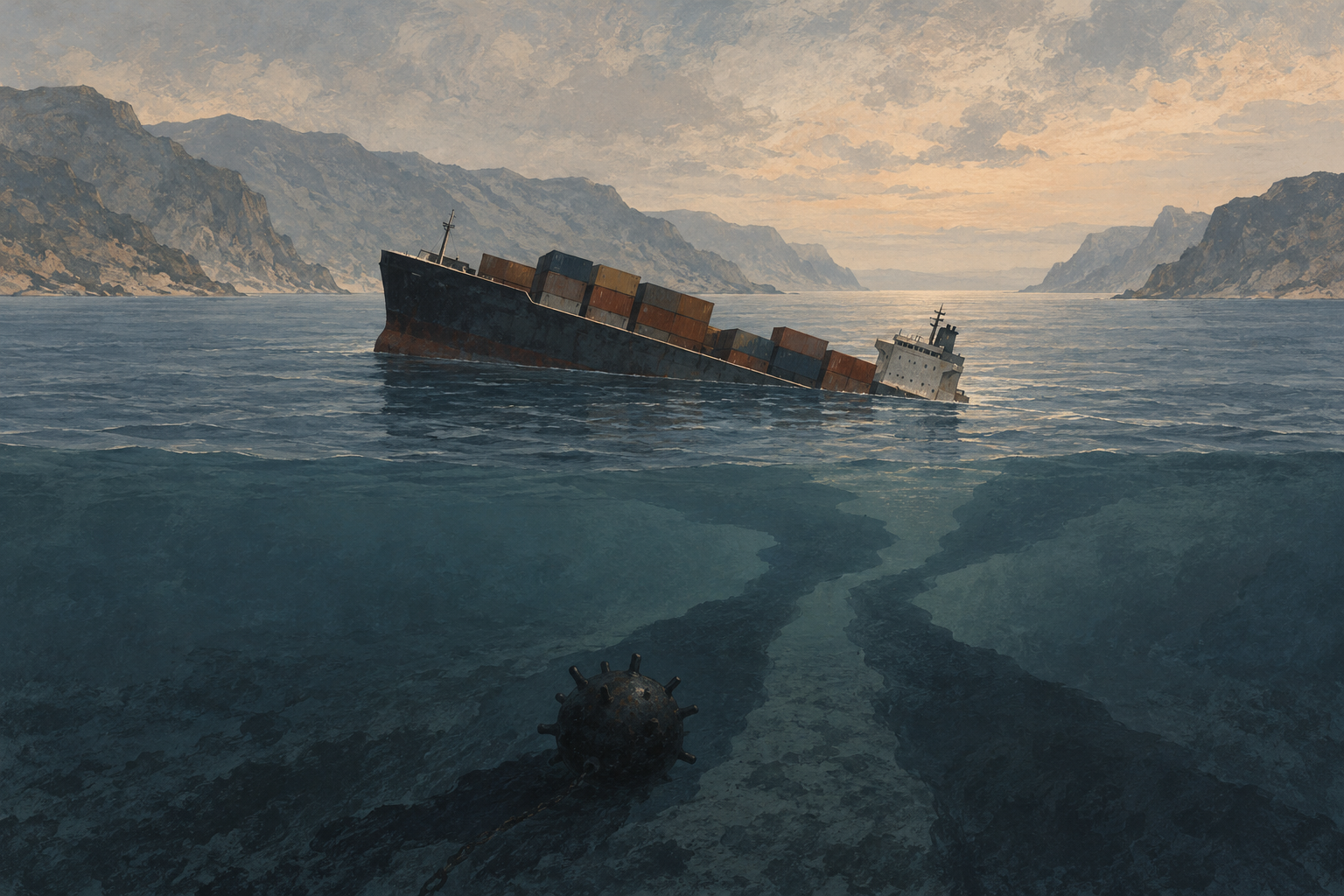
Iran’s Revolutionary Guard Corps navy said a 2,500-container cargo ship sank after striking a naval mine south of the Strait of Hormuz.
Chokepoint pressure
The Strait of Hormuz remains a critical route for Gulf oil and gas exports, making even limited disruption strategically significant.
Attack surge
Maritime reporting cited 18 October attack reports in the Hormuz region, including incidents involving tankers and a container ship.
Iran’s reported sinking of a cargo ship by naval mine near the Strait of Hormuz marks a potentially more dangerous phase in the maritime confrontation around the world’s most sensitive oil chokepoint: not a full blockade, but a widening campaign to make passage slower, riskier and more dependent on military protection.
The Islamic Revolutionary Guard Corps navy said on October 14 that a cargo ship carrying about 2,500 containers struck a naval mine south of the Strait of Hormuz, caught fire and sank, according to Iranian state media and the Associated Press.13 AP reported that it was the first mine-related sinking Tehran has announced during the current war. That distinction matters because mines are area-denial weapons: once present, they threaten not only one ship but also the confidence of all vessels using the route.1
The claim comes amid a broader pattern. Reuters reported the same day that Iranian officials, maritime-security data and a U.S. military official pointed to a deliberate rise in attacks and a shift in tactics against commercial shipping, including the use of spotters and the possible expansion of operations beyond the immediate Hormuz area.2
Maritime reporting also recorded multiple recent attack alerts in the region. Seatrade Maritime News said UK Maritime Trade Operations had issued four Hormuz attack reports involving three tankers and a container ship, bringing October attack reports in the area to 18.5 AFP, citing UKMTO, reported that a tanker and a container ship had been hit by projectiles of unknown origin in the Strait of Hormuz on October 13.7
Taken together, the incidents point to a shift from harassment — seizures, close approaches, warning shots, drone overflights and episodic projectile strikes — toward something closer to calibrated maritime denial. That does not necessarily mean Iran is trying to close Hormuz outright. It may instead be seeking to show that it can impose intermittent disruption, raise insurance and escort costs, expose the limits of U.S. and Gulf protection, and create political pressure without crossing a threshold that would invite a major military response.
Mines are strategically different from missiles, drones or small-boat harassment. A projectile attack can often be attributed to a launch point, tracked by sensors or framed as a discrete event. A mine, by contrast, can remain dangerous after deployment, create uncertainty over safe lanes and force navies into time-consuming survey and clearance operations.
That ambiguity serves coercive purposes. If shipping companies believe a mined area may exist, they may delay voyages, reroute where possible, demand higher premiums or wait for escorts even before any formal closure occurs. In a narrow chokepoint such as Hormuz, that uncertainty can have outsized effects because vessels have limited room to maneuver and the waterway is central to Gulf oil and gas exports.
Iranian state outlets framed the incident as enforcement rather than escalation. IRNA said the vessel struck a naval mine, caught fire and sank after moving through waters where the IRGC navy has asserted control.3 Mehr News Agency separately quoted an IRGC Navy commander warning that Iran would not hesitate to deal with vessels it says violate its rules in the Strait of Hormuz.4
That language is important. It presents maritime disruption as rule enforcement, not indiscriminate attack, and may be intended to preserve a legal and political narrative for Tehran’s domestic and regional audiences.
For commercial shipping, however, the distinction may matter less than the operational effect. If shipowners cannot reliably assess whether a transit could trigger an Iranian response — or whether mines, projectiles, drones or boarding teams may be used — Hormuz becomes a contested operating environment even without a declared blockade.
Iran has long used asymmetric naval tactics in the Gulf: fast attack craft, drones, limpet mines, seizures and shadowing operations. These tools allow Tehran to signal resolve while avoiding the conventional naval contest it would likely lose against the United States and its partners.
What appears different in the current pattern is density and coordination. Reuters reported that Iranian officials and maritime-security assessments described a stepped-up campaign before the U.S. vote, including altered methods and the use of spotters to support attacks.2 Seatrade’s tally of UKMTO reports suggests a tempo high enough to affect commercial planning, not merely individual crews.5 United Against Nuclear Iran’s October 13 shipping update, drawing on maritime tracking and institutional data, described pressure on Hormuz transits, U.S.-facilitated movements, Iranian-linked tanker activity and the effects of disruption on shipping behavior.6
That is the key distinction. Harassment aims to intimidate specific ships or send a political message. Maritime denial aims to make a sea lane unreliable for a class of users over time.
Iran does not need to sink many vessels to achieve partial denial. A small number of credible incidents, especially if they involve mines or unpredictable targeting, can alter risk models across the market.
A full closure of the Strait of Hormuz would be a high-risk move for Iran. It could trigger direct U.S. military action, alienate Gulf states whose energy exports depend on the waterway, and damage Asian customers that import Gulf crude. It would also interfere with Iran’s own maritime activity and the movement of vessels linked to its sanctions-evasion networks.
A calibrated denial campaign offers a more flexible option. Iran can claim it is targeting violators, responding to wartime threats or enforcing maritime rules. It can modulate pressure by choosing when, where and how to act. And it can create uncertainty for Washington and Gulf capitals: respond too little, and commercial confidence erodes; respond too forcefully, and escalation may widen.
The reported use of mines would fit that logic if confirmed. Mining or threatening to mine parts of the approaches to Hormuz can slow traffic and force naval countermeasures without requiring Iran to announce a blockade. It also allows Tehran to retain some plausible deniability in future incidents, particularly when damage occurs after deployment and away from visible launch platforms.
For the United States and Gulf governments, the immediate challenge is not only protecting ships but restoring predictability. Convoys, escorts, aerial surveillance and mine-countermeasure operations can reduce risk, but they are resource-intensive and politically visible. They also create more opportunities for miscalculation among Iranian forces, U.S. assets and Gulf militaries operating in close quarters.
A stronger response could deter further attacks but might validate Iran’s escalation narrative. A limited response could preserve diplomatic space but allow the perception to grow that Tehran can shape traffic through Hormuz at will. That dilemma is precisely what calibrated maritime denial is designed to exploit.
The commercial sector will respond to probabilities rather than declarations. If underwriters, charterers and ship operators conclude that the attack rate is rising and tactics are becoming less predictable, the economic consequences may accumulate before any government says the strait is closed. Higher war-risk premiums, delayed sailings, rerouting decisions and escort requests can all function as measures of denial.
The next indicators will be operational rather than rhetorical. A sustained rise in UKMTO alerts, further mine reports, attacks beyond the immediate Strait of Hormuz area, repeated targeting of the same flag states or owners, and greater reliance on U.S.-facilitated transits would all suggest the campaign is becoming more systematic.256
Conversely, a drop in incidents after the mine claim would indicate Tehran may have been using the sinking as a one-time signal rather than the opening move in a broader denial effort.
At present, the evidence points to controlled escalation. Iran appears to be testing how much disruption it can impose without provoking the kind of U.S. or Gulf military response that would transform a maritime pressure campaign into a broader regional war.
The reported mine sinking makes that test more dangerous because mines blur the line between warning and warfare. In Hormuz, even limited uncertainty can become strategic leverage.





Comments