Senate procedure tests House-passed data center power bill
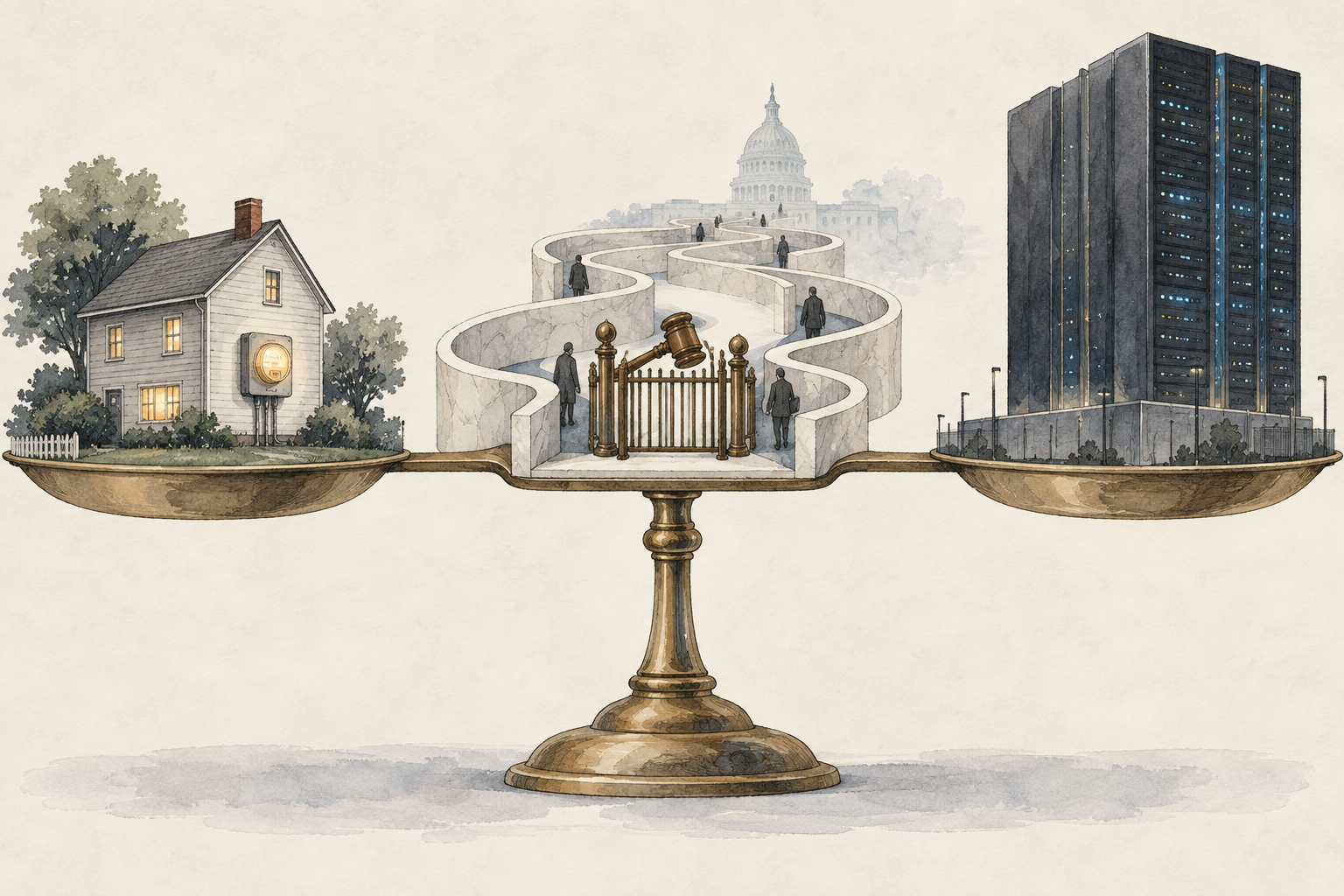
Unanimous consent
A Senate procedure that allows quick action if no senator objects; one objection can stop the request.
PURPA
The Public Utility Regulatory Policies Act is a federal utility law often used to require states to consider certain electricity policy standards.
Ratepayer protection
In this debate, the term refers to preventing ordinary electricity customers from paying for grid upgrades primarily driven by large data center demand.
100 MW threshold
Reporting on H.R. 9340 describes the bill as applying to large facilities at or above 100 megawatts of electric demand.
The Economic Times / Reuters
news
Trump is talking with Senate's Thune about bill to cut data-center electricity costs
Idaho Public Press
news
Senate Democrat Blocks 417-3 House Bill Meant to Stop Data Centers Raising Your Energy Bills
AI Tool Briefing
news
House Votes 417-3 to Make AI Pay for Power Grids
Untracked bias
100% of tracked sources are High factuality
Bias and factuality ratings from Media Bias Fact Check. Outlets without a rating are marked “Untracked.”
House landslide
H.R. 9340 passed the House 417-3 on Sept. 16 before stalling in the Senate.
Senate block
Sen. Martin Heinrich objected to Sen. Jon Husted’s Sept. 17 unanimous-consent request, preventing quick passage.
AI power costs
The bill targets whether large AI data centers should bear grid upgrade costs rather than shifting them to other ratepayers.
The Senate’s next move on H.R. 9340, the Ratepayer Protection Act, has become the central question after a rare 417-3 House vote on Sept. 16 and a failed unanimous-consent attempt a day later to speed the bill through the chamber.12
President Donald Trump said he was speaking with Senate Majority Leader John Thune about floor action on the bill, Reuters reported Sept. 19. The comment raised the stakes for whether Republicans can turn a broadly popular consumer-cost message into enacted legislation before the midterm calendar further tightens Congress’s schedule.1
The bill targets a politically potent concern: whether grid upgrades needed to serve large AI and data center loads will be paid by the companies creating that demand or spread across ordinary electricity customers. Supporters describe it as a ratepayer-protection measure. Critics and skeptics question whether Congress is moving too quickly and whether a different approach should govern cost allocation.37
Republicans are pressing for quick action because the House vote gave them a rare bipartisan win on an issue linking artificial intelligence, household energy bills and local backlash to data center growth. The House Energy and Commerce Committee said the bill passed 417-3 on Sept. 16, an outcome supporters are using to argue that the Senate should not slow it down.13
Sen. Jon Husted, R-Ohio, attempted to advance the bill by unanimous consent on Sept. 17, according to his office and subsequent reports. That procedure can move legislation quickly when no senator objects, but it also lets any single senator stop immediate passage.23
The fast-track bid failed when Sen. Martin Heinrich, D-N.M., objected. Reports said Heinrich pointed instead to an alternative Democratic proposal, the GRID Savings Act, setting up a dispute not over whether grid costs matter, but over which legislative mechanism should govern how those costs are reviewed and assigned.12
Heinrich’s objection turned the bill’s path from a quick unanimous-consent win into a leadership decision for Thune. If the majority leader wants to advance H.R. 9340, he can try to negotiate a time agreement, attach it to another legislative vehicle or bring it to the floor through more formal procedures. Each option consumes scarce Senate time.18
That timing matters. The midterm cycle is beginning to absorb congressional attention, and energy costs are likely to remain an accessible campaign issue for both parties. Republicans can argue that Democrats blocked a House-passed consumer protection bill. Democrats can respond that the Senate should not simply accept the House approach without considering broader grid-planning and cost-allocation alternatives.24
For Husted, the issue also carries political value. Reports have tied his push to the broader Republican effort to show responsiveness to electricity customers concerned that data center expansion could raise bills, especially in states where AI infrastructure and power demand are becoming more visible.24
H.R. 9340 would amend federal utility law to require state regulators and nonregulated utilities to consider rules designed to prevent large data center and AI loads from shifting certain grid upgrade costs onto other customers. Reporting on the bill describes a 100-megawatt threshold for covered facilities and a process under which states would have two years to consider the standard.7
That design matters because the bill does not appear to impose a single national rate structure. Instead, it would use the Public Utility Regulatory Policies Act framework to push state-level consideration of a federal policy standard, a familiar but sometimes slow-moving route for electricity legislation.7
Supporters see that as a way to respect state utility regulation while forcing action on a fast-growing cost issue. Critics may see it as too narrow, too rushed or insufficiently aligned with broader grid modernization and transmission-planning questions.28
The Senate fight is unfolding as data center disputes move from zoning meetings and utility dockets into national politics. Virginia, the country’s leading data center market, has become a focal point for debates over transparency, noise, backup generators and who pays for infrastructure tied to rapid load growth.56
Virginia Gov. Abigail Spanberger has announced a data center accountability proposal, while related state actions include limits on nondisclosure agreements and reviews of generator and noise issues. Those state-level moves reflect the same pressure facing Congress: communities want investment and digital infrastructure, but they also want clearer assurances that residents will not absorb the costs.56
Industry-focused coverage has also flagged ratepayer exposure and community resistance as central risks for data center developers, especially as AI demand increases the size and urgency of power requests.9
The political appeal of H.R. 9340 is clear: a lopsided House vote, a consumer-cost frame and a direct connection to AI infrastructure. The procedural problem is equally clear: the Senate rarely moves contested legislation quickly without unanimous consent or a leadership decision to spend floor time.
Trump’s comments that he is talking with Thune put additional pressure on Senate Republicans to show whether they can move the House-passed bill, negotiate changes with Democrats or fold the issue into a larger energy package.1
For now, the measure’s fate rests less on the 417-3 House tally than on whether Thune decides the bill is worth Senate floor time before campaign politics make bipartisan legislating even harder.





Comments