General Dynamics taps Danny Deep for CEO, betting on continuity after Novakovic
Executive chairman
A board leadership role that can allow a former CEO to remain involved in governance and strategic oversight without running daily operations.
Backlog
Contracted work that has not yet been completed or recognized as revenue; in defense, it can provide visibility but also creates delivery obligations.
Electric Boat
General Dynamics’ submarine-building business, a key supplier for U.S. Navy undersea programs and a major part of the company’s marine systems portfolio.
Gulfstream
General Dynamics’ business jet unit, whose aircraft development, certification and delivery performance remain important to the company’s commercial aerospace results.
Washington Business Journal
news
Phebe Novakovic to leave CEO spot at General Dynamics; Danny Deep named next chief exec
Providence Business First
news
General Dynamics taps new CEO to oversee $118 billion backlog and global operations
Intelligence Community News
news
Danny Deep named General Dynamics CEO
CEO transition
Danny Deep will become General Dynamics CEO on January 1, 2027, while Phebe Novakovic moves to executive chairman.
Operating focus
Deep brings roughly 25 years at General Dynamics, including experience across global operations, combat systems and land systems.
Backlog scale
The leadership change comes as General Dynamics manages a reported backlog of about $118 billion.
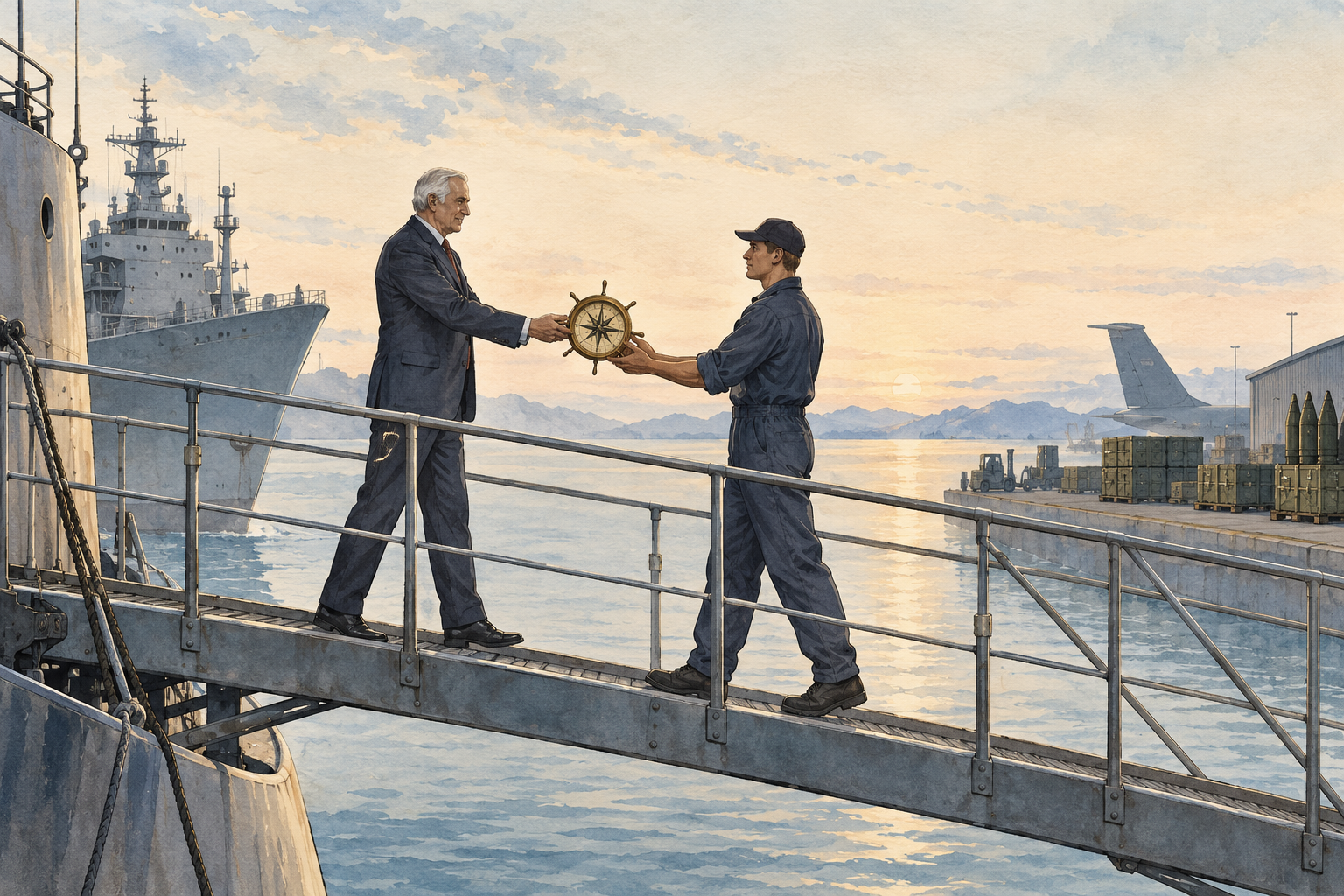
General Dynamics is choosing continuity at the top, naming company president Danny Deep as its next chief executive as Phebe Novakovic prepares to step aside after more than a decade leading one of the largest U.S. defense contractors.
Deep will become CEO on January 1, 2027, and Novakovic will become executive chairman. The move preserves senior leadership continuity while shifting day-to-day control to an executive whose career has been built inside the company’s production, combat systems and global operations network.1
For defense industry executives, the move is less a strategic reset than a succession plan designed to sustain the operating discipline associated with the Novakovic era as General Dynamics manages a more demanding defense production cycle.
That cycle is defined by elevated demand across shipbuilding, combat vehicles, munitions, information technology and business aviation. Coverage of the transition framed Deep’s appointment against a roughly $118 billion backlog, Electric Boat’s submarine work in New England, combat systems demand and continued focus on Gulfstream execution.2 Those priorities make the choice of an insider with operating depth especially significant.
Deep’s selection points to the board’s preference for an executive steeped in General Dynamics’ industrial base, rather than an outside leader brought in to reposition the portfolio. He has spent about 25 years at the company, with experience spanning global operations, combat systems and land systems.1 Trade coverage for the defense and intelligence community also emphasized his operating background and confirmed the timing of the succession.3
That background matters because General Dynamics’ central challenge is not a lack of demand. It is converting demand into delivered platforms, ships, vehicles, aircraft and systems while balancing strained supply chains, workforce constraints and customer urgency.
In that context, Deep’s mandate will be to preserve production discipline, protect margin quality and keep major programs moving through a higher-tempo defense environment.
Novakovic’s move to executive chairman also suggests that the company wants continuity in governance and customer confidence during the transition. She has led General Dynamics since 2013, a period in which the company maintained a reputation for financial discipline and operational control across a portfolio that includes aerospace, marine systems, combat systems and technologies.1
The marine systems business is likely to remain one of the clearest tests of the succession. Electric Boat’s submarine work is strategically important to the U.S. Navy and allied defense planning, and it anchors a major shipbuilding footprint in New England.2
For General Dynamics, that means the CEO transition comes as shipbuilding execution remains both a growth opportunity and an operational pressure point.
The backlog gives the company visibility, but it also raises the stakes for capacity, labor availability, supplier performance and production cadence. Defense executives will read Deep’s elevation through that lens: a leader with manufacturing and defense systems experience is being asked to keep complex programs moving, rather than reshape the business from the outside.
Local coverage also noted General Dynamics’ broader headquarters and workforce context, its revenue scale, shipbuilding contract history and concurrent leadership changes. That underscores that the CEO move sits within a wider management transition, rather than a single personnel announcement.5
Deep’s background in land systems and combat systems aligns with another major pressure point: rising demand for ground combat platforms, weapons, ammunition and related sustainment. General Dynamics’ combat systems business sits in a market shaped by replenishment needs, modernization plans and allied procurement.
That makes operating fluency valuable. The issue for the next CEO will be less about identifying demand than translating it into production output at acceptable cost and schedule performance. Deep’s history across global operations, combat systems and land systems gives him direct exposure to the execution problems now facing many defense primes.3
For customers, the continuity message is straightforward: General Dynamics is signaling that it does not intend to disrupt a portfolio already aligned with defense spending priorities. For suppliers and partners, the message is similar. The company’s next CEO is likely to emphasize delivery, program performance and capacity rather than a dramatic strategic pivot.
Although the succession has clear defense implications, General Dynamics’ aerospace business remains part of the leadership equation. Gulfstream is a major contributor to the company’s commercial exposure, and its performance affects the enterprise’s broader earnings profile.
Corporate Jet Investor placed Deep’s appointment in the context of General Dynamics’ aerospace, marine, combat systems and technologies businesses, and noted the aircraft-launch record associated with the Novakovic period.4
That context is important because Deep will inherit not only defense production challenges, but also the need to maintain momentum in a business aviation market where certification timing, production ramp-ups and delivery quality can influence investor confidence.
The result is a CEO transition that spans two execution environments: defense programs driven by government demand and long-cycle procurement, and Gulfstream’s aircraft business, where customers, regulators and production schedules can shape near-term performance.
The Deep appointment reinforces a familiar General Dynamics pattern: operational discipline, portfolio stability and leadership drawn from inside the company. Novakovic’s move to executive chairman provides continuity at the board level, while Deep’s operating career gives the company a CEO whose credibility is tied to execution rather than reinvention.
That does not make the transition low-risk. Defense demand is strong, but the production cycle is more complex. Shipyards, munitions lines, combat systems facilities and aircraft programs all face pressure to deliver more predictably. Backlog can support long-term growth, but it also exposes the company to execution scrutiny if schedules slip or margins compress.
For defense industry executives, the succession is best understood as a bet on managerial continuity in a constrained industrial environment. General Dynamics is not signaling a new identity. It is elevating an insider to protect the operating model Novakovic built, while asking him to run it through a more demanding phase of defense production.








Comments