Starbucks-Chipotle Deal Would Test Brian Niccol’s Operating Focus
Back to Starbucks
Starbucks’ turnaround plan under Brian Niccol, focused on improving store operations, customer experience and brand fundamentals.
Synergies
Financial benefits expected from a merger, such as cost savings, shared technology, purchasing power or new revenue opportunities.
Fast casual
A restaurant category between quick service and casual dining, typically offering higher-quality food with counter service and fast throughput.
Integration risk
The possibility that combining two companies disrupts operations, distracts management or fails to produce the expected benefits.
Turnaround first
Starbucks has emphasized that it remains focused on its Back to Starbucks turnaround while takeover speculation circulates.
Limited synergies
Analysts see fewer obvious revenue and cost synergies because Starbucks and Chipotle operate different formats, menus and dayparts.
Niccol factor
The strategic case rests heavily on Brian Niccol’s familiarity with Chipotle and his ability to scale an operating playbook across both brands.
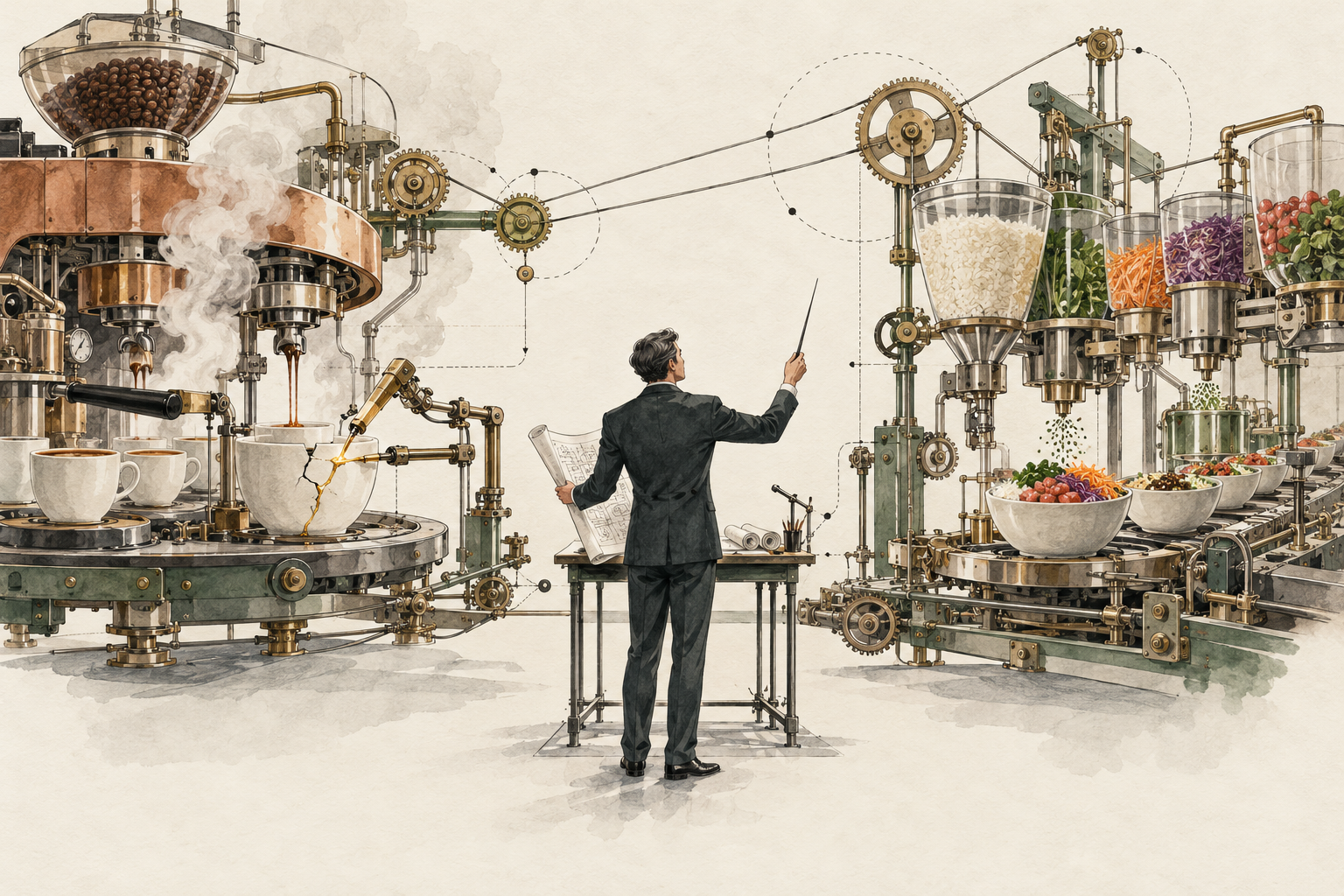
Reports from Reuters and the Financial Times that Starbucks explored a potential takeover of Chipotle raise a bigger question than whether the coffee chain wants another growth brand: whether Chief Executive Brian Niccol can fix Starbucks while also scaling the operating discipline he helped build at Chipotle.
The strategic case is clear enough. Niccol previously led Chipotle, where the burrito chain strengthened its digital business, simplified execution and expanded its restaurant base. A Starbucks-Chipotle combination could, in theory, pair Starbucks’ global reach, rewards infrastructure and real-estate expertise with Chipotle’s fast-casual model and international runway.1
The risk is just as clear. Starbucks is still in the middle of its own turnaround, and a megadeal could divert capital, executive attention and field leadership from the more urgent task of improving speed, hospitality and consistency inside Starbucks stores.4
That makes the rumored transaction less about conventional merger math than about management capacity. Wall Street’s skepticism reflects a practical concern: coffee shops and burrito restaurants may both sit inside consumer foodservice, but they run on different dayparts, labor rhythms, supply chains, menus and customer expectations. The real bet would be that Niccol’s operating approach — fewer distractions, better store execution, tighter digital ordering and clearer accountability — can move from one brand to another without weakening either one.
Starbucks has not confirmed an active deal path. Reports and follow-on analysis described the company as declining to comment on speculation while stressing that it remains focused on its turnaround, including Niccol’s “Back to Starbucks” plan.2 Barron’s reported similar messaging, saying Starbucks remained “laser focused” on the turnaround as investors weighed the potential distraction of a Chipotle pursuit.4
That response matters because Starbucks’ current problem is not brand awareness or store count. It is execution. The company has been working to restore the cafe experience, reduce complexity, improve throughput and win back customers alienated by long waits, high prices or inconsistent service. A large acquisition would arrive before that work is complete.
For shareholders, the sequencing is crucial. Simply Wall St. tied the takeover chatter to Starbucks’ valuation and capital allocation debate, noting that any deal speculation has to be weighed against the ongoing turnaround investment thesis.6 Investors are not only asking whether Chipotle is a good asset. They are asking whether Starbucks is in a position to buy it.
Many large foodservice mergers are sold on cost savings: overlapping headquarters functions, purchasing efficiencies, shared technology or combined marketing. A Starbucks-Chipotle tie-up would be harder to justify on those grounds.
The brands do not have a natural menu overlap. Starbucks sells coffee, tea, refreshers, breakfast and snacks across all-day cafe occasions. Chipotle runs a focused fast-casual model built around customized entrees, fresh food preparation and lunch-and-dinner traffic. Their labor models, ingredient handling and kitchen designs are different. That limits the scope for straightforward revenue synergies and makes the standalone performance of each company more important, according to investor analysis from 24/7 Wall St.3
The more plausible case would be platform-based. Starbucks could try to apply its loyalty, mobile ordering, consumer data and international real-estate capabilities to Chipotle. Chipotle could give Starbucks a growth asset with a strong digital base, a younger customer profile and room to expand abroad.1 From Chipotle’s side, analysts have framed the key question as whether its digital ecosystem, equipment rollout, international expansion and margin rebuilding would be better managed independently or inside a larger Starbucks consumer platform.5
That is a subtler thesis than “buy Chipotle and cut costs.” It says Starbucks would be buying a second operating engine — one Niccol knows well — and trying to compound that knowledge across a broader restaurant portfolio.
The idea has traction because of Niccol. Before joining Starbucks, he was closely associated with Chipotle’s recovery and growth strategy. That history gives Starbucks a rare form of buyer familiarity: its chief executive already knows Chipotle’s brand, culture, store model and strategic priorities.1
That familiarity could reduce some integration risk. A buyer led by a former Chipotle chief executive would likely understand what should not be changed. Chipotle’s appeal has long depended on a focused menu, visible food preparation, fast customization and a brand identity distinct from traditional quick-service restaurants. A heavy-handed integration could damage the asset Starbucks would be buying.
But Niccol’s credibility cuts both ways. If the deal depends primarily on his ability to oversee two complex systems, it increases key-person risk. Starbucks did not hire Niccol to become a conglomerate manager first; it hired him to repair Starbucks. Seeking Alpha argued that deal likelihood remains low and highlighted the strategic divergence between Chipotle’s expansion agenda and Starbucks’ profitability-focused turnaround.7 That divergence is central to investor unease.
Chipotle is not a passive target with no plan of its own. The company still has major standalone levers, including restaurant expansion, digital ordering, throughput improvements, kitchen equipment investments, international growth and margin recovery.5
Those priorities could fit inside Starbucks, but they could also compete with Starbucks’ needs. Starbucks’ turnaround requires store-level attention, capital spending, labor planning, menu simplification and customer experience work. Chipotle’s expansion requires disciplined site selection, food-safety execution, supply-chain management and continued investment in restaurant productivity. Both are execution-heavy agendas.
A combined company would have to avoid creating a headquarters strategy that looks elegant while making field operations harder. For restaurant brands, integration risk often shows up in small ways: slower decisions, diluted accountability, competing technology road maps and leadership teams spending more time explaining strategy than improving stores.
The market’s apparent discomfort is not surprising. Barron’s described Wall Street as viewing the combination as expensive, operationally challenging and potentially disruptive to Starbucks’ turnaround.4 24/7 Wall St. similarly emphasized that limited revenue synergies mean investors should evaluate both companies largely on their standalone fundamentals rather than assume a merger automatically creates value.3
Price would be a major issue. Chipotle is a premium restaurant asset, and buying it would likely require Starbucks to pay upfront for years of expected growth. That could strain capital allocation at a time when Starbucks may need to invest heavily in labor, store design, equipment, technology and customer value.
The opportunity cost could matter just as much as the purchase price. Every dollar and executive hour devoted to a takeover is a dollar and hour not devoted to making Starbucks stores faster, warmer and more reliable. If Starbucks’ core brand does not improve, owning Chipotle would not solve the underlying problem.
The strategic question is what Starbucks wants to be under Niccol. One path is to become a broader restaurant platform anchored by consumer data, digital ordering, global real estate and operating discipline. In that version, Chipotle could be a rare fit because Niccol understands it and because both companies have strong brands with large customer bases.
The other path is narrower but perhaps more urgent: make Starbucks feel like Starbucks again. That means improving the in-store experience, restoring confidence among employees and customers, simplifying operations and proving the company can grow profitably without adding a second major brand.
The rumored Chipotle exploration sits at the intersection of those choices. It is not irrational. Starbucks would be looking at a high-quality restaurant company with digital strengths, expansion potential and a chief executive who knows the asset well. But it would also be taking on one of the hardest tasks in consumer business: integrating a major acquisition while fixing the buyer’s own operating model.
For now, the strongest argument against a deal is not that Chipotle lacks value. It is that Starbucks’ highest-return acquisition may still be its own lost consistency. Until Niccol shows that “Back to Starbucks” is working at scale, a Chipotle takeover would look less like a clean strategic extension and more like a demanding second turnaround.






Comments