Cloudflare adds OpenAI Daybreak models to vulnerability remediation, with humans approving fixes
WAF
A web application firewall that can block or filter web requests before they reach an application.
Workers
Cloudflare’s serverless platform for running application logic at or near the network edge.
AI Gateway
Cloudflare infrastructure used to route, observe and govern requests from applications to AI model providers.
Daybreak models
OpenAI cyber-focused models and access programs intended for verified defensive security use cases.
Cloudflare Blog
other
Introducing context-aware vulnerability discovery and remediation with Cloudflare Managed Defense and OpenAI Daybreak models
Cloudflare
other
Cloudflare Partners with OpenAI Daybreak Models to Redefine Vulnerability Management with AI-Powered Edge Defense
OpenAI
other
Daybreak for Frontline Defenders: $1B to protect essential services
Early access
Cloudflare made Vulnerability Discovery and Remediation available by invitation through Managed Defense on September 3, 2026.
Human approval
Cloudflare says OpenAI Daybreak models can propose patches and WAF rules, but cannot apply them without explicit human approval.
$1B program
OpenAI committed $1 billion in subsidized Daybreak access, training, support and partnerships for frontline defenders.
Cloudflare on September 3 introduced an early-access Managed Defense service that uses OpenAI Daybreak models to find, prioritize and remediate software vulnerabilities in customer-authorized codebases. Investigations run through Cloudflare Workers and AI Gateway to OpenAI’s servers, while deployment decisions remain with human reviewers.1
The Vulnerability Discovery and Remediation service is designed to do more than generate findings. Cloudflare says it correlates code analysis with production traffic, Web Assets inventory, WAF configuration, Workers Observability data and security-event context to determine which issues are most exposed. It then proposes two responses: a code patch and, when supported by evidence, a scoped Cloudflare WAF custom rule to reduce exposure while engineers review the fix.1
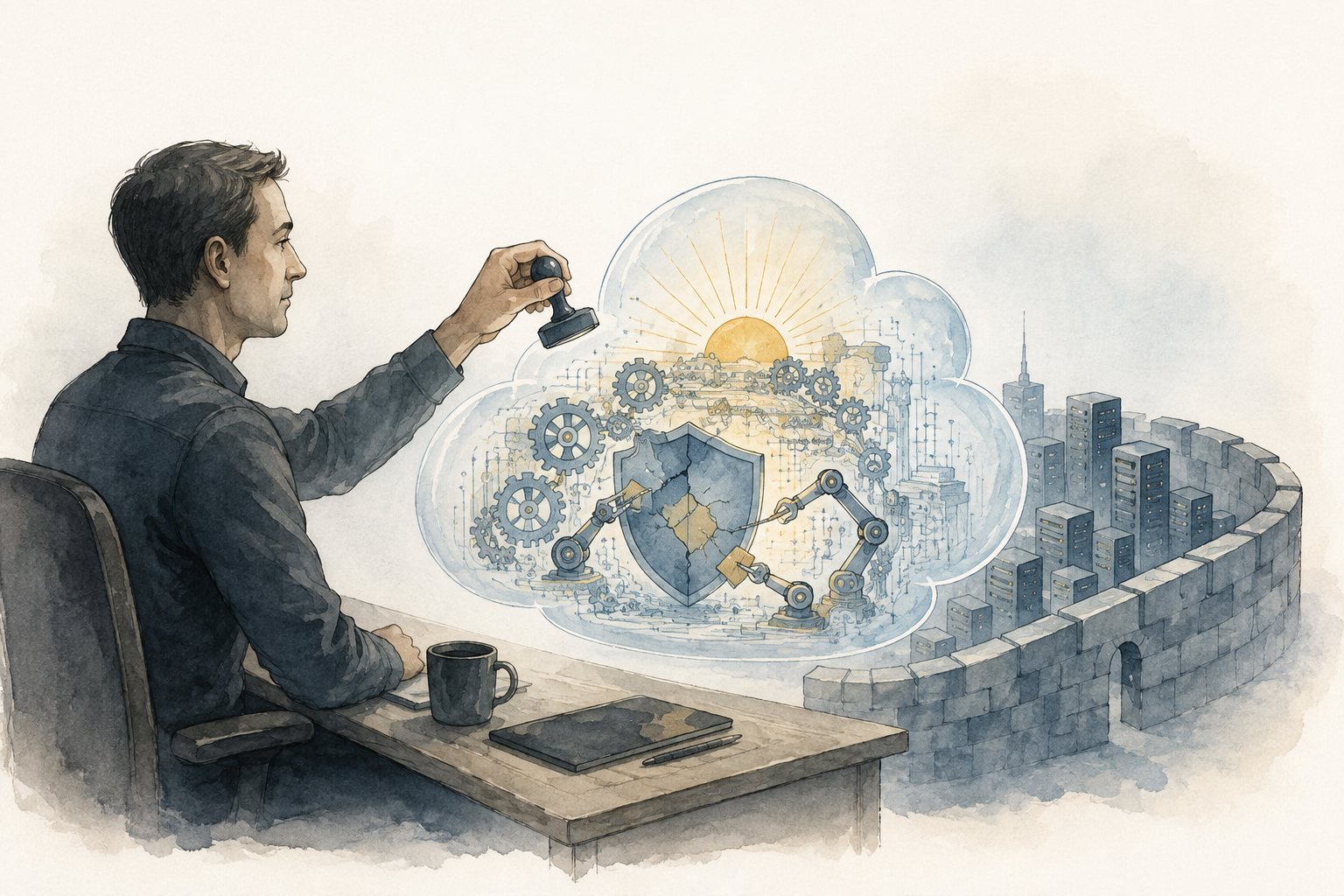
For security engineering leaders, the launch matters because it puts frontier cyber models inside a hosted remediation pipeline, rather than a standalone benchmark or analyst-assistance tool. It also defines where automation stops. Cloudflare says GPT-5.6 Cyber is used for reconnaissance, hunting and validation, but the model cannot apply patches or WAF rules. No code fix or edge rule takes effect without explicit human approval.2
The workflow begins with context collection. Cloudflare takes a snapshot from Web Assets and WAF data to identify active routes, traffic levels and recent security events. For Workers applications, the system retrieves the latest source version and route configuration, then links the code under review to production endpoints using Workers Observability and request metadata.1
That context changes triage. Instead of treating every scanner result as an isolated code defect, the service can raise a finding’s priority when the affected endpoint is live, heavily used or showing signs of probing. Cloudflare says every vulnerability still must be corroborated by source-code evidence; network context can increase risk, but does not establish a vulnerability by itself.1
The second automated function is exploit-context analysis. A reconnaissance agent maps request paths to code sections, and hunter agents investigate specific portions of the customer-authorized codebase. The validation stage checks proposed mitigations and assigns an initial risk rating based on the source-code finding, with production evidence used to adjust that rating.1 SiliconANGLE described a workflow in which findings are validated before rating, then elevated when production evidence indicates heavy traffic or active probing against the affected route.4
The third automated function is fix generation. If the system identifies a vulnerability, it prepares a recommended code patch and, when route and request evidence are specific enough, a WAF rule scoped to the HTTP method, path and other request attributes needed to reach the vulnerable code.1 Cloudflare says it will not suggest a rule if a route pattern contains only variables and wildcards, reflecting a preference not to overclaim weak evidence.1
Cloudflare’s architecture is also a model-risk control point. The company says investigations run on Cloudflare, but prompts are sent from Workers through Cloudflare AI Gateway to OpenAI Daybreak models on OpenAI’s servers. It says no model inference runs at Cloudflare’s edge.1
The access boundary is narrower than that of a general-purpose AI coding assistant connected to production. Cloudflare says each engagement begins with one customer-authorized application, and the service uses authorized read access to Web Assets, relevant WAF controls and Workers Trace Events Logpush where available.1 Before context reaches the model, Cloudflare says the system removes unnecessary information and applies engagement-specific redaction controls. The harness treats code, logs and request metadata as evidence to inspect, not instructions to follow.1
Those details matter because the service’s security value depends on production context, while its risk profile expands as more production context is exposed to a model. The model needs enough route, traffic and log evidence to distinguish a theoretical bug from an exploitable business risk. But the same information — live endpoints, vulnerable handlers and request patterns — could help an attacker if misused or overexposed.
Cloudflare is positioning the service as semi-automated, not autonomous. Tool calls are logged and checked against the investigation’s access policy, and every patch or WAF rule proposal must pass checks outside the model before customer review.1 For edge-defense suggestions, Cloudflare says it validates rule syntax and tests the rule against synthetic fixtures representing expected requests rather than customer traffic.1
The company’s announcement says eligible customers can use the service to triage issues under active attack, instruct Cloudflare to deploy custom WAF rules, and review model-assisted code patches. But it emphasizes that no rule or code change takes effect without explicit human approval.2 SiliconANGLE reported the same limitation, noting that Cloudflare said the models cannot apply patches or rules on their own.4
That division of responsibility is likely to be central to enterprise adoption. Security teams may welcome automated prioritization and draft remediation, but approval remains tied to change management, service reliability, regulatory obligations and application-owner accountability. A WAF rule that is too broad can break production traffic; a patch that is logically plausible can still introduce regressions or alter business behavior.
Cloudflare’s service is one of several September 3 announcements tied to OpenAI’s Daybreak Defense Network. OpenAI said it is committing $1 billion in subsidized Daybreak access, training, technical support and partnerships for frontline defenders protecting essential services, including water, electricity, local government and banking systems.3 Axios reported that the effort includes more than 35 technology and cybersecurity services embedding OpenAI’s advanced models into tools, services and workflows.5
OpenAI described the broader strategy as moving beyond model access toward operational workflows that help defenders review legacy code, analyze suspicious activity, validate vulnerabilities, prioritize serious risks, and develop and test fixes.3 That framing is important: the commercial contest is shifting from which model performs best in a cyber benchmark to which vendor can safely place models inside production-adjacent security operations.
Other Daybreak partners are following a similar pattern. Check Point said it is bringing OpenAI Daybreak models into exposure validation, attack-path analysis, security management and remediation workflows, while governing what the model can see, constraining what it can act on, and testing outputs before expanding automation within approved workflows.6 Proofpoint said its SOC Analyst Agent turns connected security data into traceable findings and recommended next steps, but does not independently make account changes, contain threats or initiate consequential remediation actions.7
For security engineering leaders, Cloudflare’s launch should be evaluated less as an AI scanner than as a constrained remediation system. The practical questions are how narrowly investigations are scoped, how customer data is redacted, how access policies are enforced, how non-model checks are implemented, how proposed WAF rules are tested, and how findings are traced back to evidence.
The appeal is clear: scanners produce large backlogs, exploitability changes with production deployment, and attackers can use AI to compress discovery and exploitation timelines. Cloudflare says the National Vulnerability Database had logged 60,475 vulnerabilities by September 2026, already above the 48,185 recorded during all of 2025.2 Context-aware triage could help teams focus scarce engineering time on vulnerabilities that are live, reachable and being targeted.
But the same context that improves triage also raises the stakes for governance. Hosted AI remediation pipelines will need strong tenant isolation, prompt and tool-call logging, approval workflows, redaction, least-privilege access to telemetry, and independent validation of model outputs. Without those controls, defensive tooling risks becoming a high-context exploitation aid.
Cloudflare’s answer is to keep the model away from direct deployment authority and require human review after external checks. The broader market test will be whether vendors can preserve those constraints as customers ask for faster, more autonomous remediation.








Comments