Antelope Reef runway turns China’s Paracels buildout into access concern
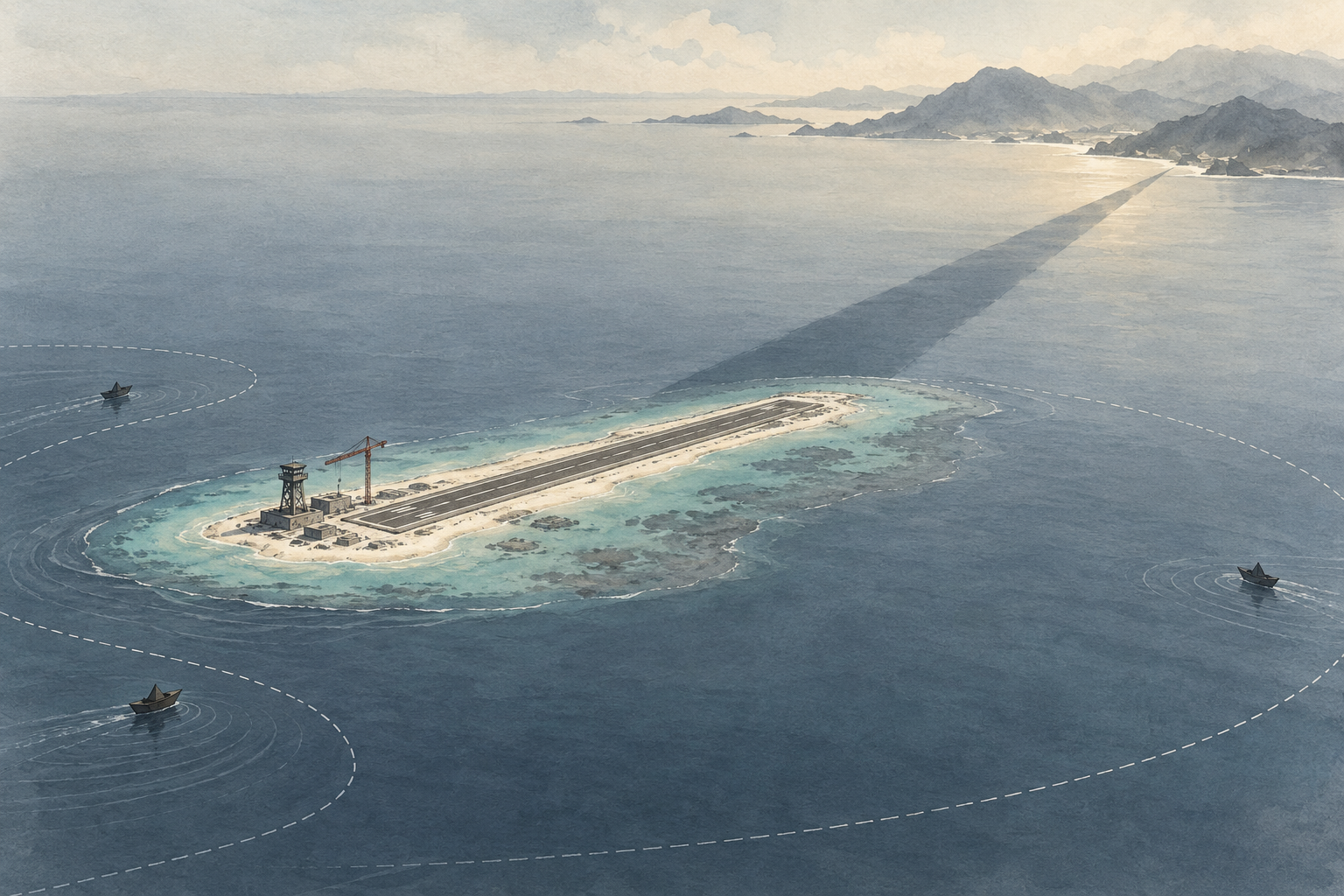
Antelope Reef
A disputed feature in the Paracel Islands, called Lingyang Reef by China and Đá Hải Sâm by Vietnam.
Paracel Islands
A South China Sea archipelago controlled by China and also claimed by Vietnam and Taiwan.
Dual-use infrastructure
Facilities described as civilian, such as ports, runways or weather stations, that can also support military operations.
Code of conduct
A long-running China-ASEAN effort to set rules for behavior in the South China Sea and reduce the risk of incidents.
Untracked bias
Bias and factuality ratings from Media Bias Fact Check. Outlets without a rating are marked “Untracked.”
Runway timeline
Analysts cited by Reuters estimate Antelope Reef’s runway could be paved in the first half of 2027, with a first landing by mid-2027.
Satellite evidence
Imagery showed grading work, gravel and concrete stockpiles, compaction cranes and a loaded barge heading to a new wharf.
Disputed claims
China controls the Paracels, but Vietnam and Taiwan also claim the island chain that includes Antelope Reef.
China’s accelerating runway work on Antelope Reef is turning a Paracel Islands reclamation project into a potential basing and access problem in the northern South China Sea. Analysts cited by Reuters estimate aircraft could begin landing there by mid-2027 if construction continues at the current pace.1
Commercial satellite imagery reviewed by Reuters showed grading work, gravel and concrete stockpiles, compaction cranes and a gravel barge moving toward a newly built wharf at Antelope Reef, also known as Lingyang Reef in Chinese and Đá Hải Sâm in Vietnamese.16 The work points to construction of a full-scale runway on a feature in the Paracel chain, which is controlled by China but also claimed by Vietnam and Taiwan.23
The strategic significance is not the runway alone, but its location. A completed facility would add another Chinese air and maritime operating point north of the Spratly Islands, closer to Hainan Island, the Gulf of Tonkin, the Luzon Strait approaches and sea lanes that would matter in a Taiwan or South China Sea crisis.16
That makes Antelope Reef part of a broader geography of access. It could support surveillance, logistics, patrol aircraft, naval deployments and, if later hardened, a more persistent Chinese presence between southern China and Southeast Asia.
Beijing has not acknowledged that it is building a new military base at Antelope Reef. Chinese state media has described the site as serving civilian functions, including weather forecasting, maritime research and scientific work.13 Reuters reported that China’s Ministry of National Defense did not immediately respond to a request for comment. Vietnam’s foreign ministry and Taiwan’s defense and foreign ministries also did not immediately respond to Reuters questions on the latest imagery.12
Antelope Reef lies in the Paracels’ Crescent Group, a cluster already central to China’s position in the northern South China Sea. Reuters-linked Vietnamese reporting said Antelope is about 300 kilometers from Sanya on Hainan and about 400 kilometers from Da Nang, underscoring its proximity to both China’s southern military infrastructure and Vietnam’s coast.6
That geography matters because Hainan is home to major Chinese naval facilities, including infrastructure associated with nuclear-armed ballistic missile submarines.14 A future airstrip and port on Antelope Reef could help protect routes into and out of Hainan, extend the operating depth of Chinese forces in the Paracels and provide additional coverage over the northern South China Sea.16
Reuters cited military attaches and security analysts saying the site could become one of China’s most important offshore bases in the region.12 Analysts have repeatedly compared it to Fiery Cross Reef in the Spratlys, where China built a roughly 3-kilometer runway in 2015.24 Ben Lewis, founder of the open-source platform PLATracker, told Reuters that if Fiery Cross is the guide, paving could be completed in the first half of 2027 and a first landing could occur by mid-2027, possibly earlier.2
Lewis also noted an important caveat: he had not yet seen signs of excavation for ammunition and fuel storage, which would normally be needed for a base of this scale.24 The current imagery therefore supports an assessment of rapid runway and port development, but not yet a full picture of how militarized the site may become.
For Taiwan-focused planners, Antelope Reef is not a Taiwan Strait base. It is farther south, in the Paracels. Its relevance lies in the wider battlespace around Taiwan’s southern approaches, the Bashi Channel, the Luzon Strait and the northern South China Sea.
In a regional crisis, Chinese forces would need to monitor and potentially pressure maritime and air routes used by the United States and partners moving between the Philippine Sea, the South China Sea and waters east or south of Taiwan. A more capable Antelope Reef could contribute to that network by hosting aircraft, sensors, logistics functions or maritime support facilities, depending on how the buildout develops.13
TaiwanPlus presented the Reuters imagery to Taiwan audiences as evidence of China expanding facilities in a disputed South China Sea area. It noted both runway and port development, as well as concern that the site could strengthen Beijing’s military control.35 Taipei’s direct equities are legal and strategic: Taiwan claims the Paracels, watches Chinese military activity in the South China Sea as part of a broader pressure pattern, and depends on open sea and air routes through the region.25
The most immediate diplomatic friction is with Vietnam, which calls the feature Đá Hải Sâm and the Paracels Hoàng Sa. Vietnamese-language reporting on the Reuters findings framed the project as a Chinese outpost in a disputed archipelago and noted Hanoi’s earlier objections to Chinese reclamation and construction at Antelope Reef and nearby features.6
The same report said Vietnam’s foreign ministry spokesperson Phạm Thu Hằng had opposed China’s activities in August and demanded they stop and not recur. China’s foreign ministry spokesperson Guo Jiakun later rejected Vietnamese criticism and said the Paracels were Chinese territory.6 That exchange shows why the runway complicates crisis management: each incremental stage of construction raises the cost for Hanoi of accepting talks that do not address facts being built into the water.
The project also lands awkwardly amid efforts by China and the Association of Southeast Asian Nations to negotiate a South China Sea code of conduct. A code is meant to reduce risk, manage encounters and prevent escalation. But a new runway in the Paracels would change the operating environment while talks continue, reinforcing a pattern in which infrastructure advances faster than diplomatic constraint.
For ASEAN claimants and non-claimants alike, the issue is not only sovereignty. It is whether any future code can meaningfully limit militarization, coast guard pressure, air and maritime incidents, or the use of artificial islands as enforcement platforms. Antelope Reef strengthens the argument that the code-of-conduct process risks being overtaken by physical changes at sea.
China’s stated or state-media framing of civilian functions does not remove the site’s military relevance. Weather stations, maritime research, port facilities, communications gear and runways can have dual-use value in the South China Sea.13 A runway that can land civilian aircraft can also support military transports, patrol aircraft, drones or emergency diversion operations, depending on dimensions, fuel availability, storage, sensors and defenses.
That dual-use ambiguity is central to the Antelope Reef story. The evidence publicly reported so far shows accelerating construction, runway preparation and port activity.12 It does not yet show every element required for a mature air base. But the strategic trajectory is clear: China is adding a potential operating point in a region where distance, persistence and logistics shape crisis outcomes.
The next indicators to watch are runway paving, lighting, hangars, fuel farms, hardened shelters, radars, air-defense systems, ammunition storage and regular aircraft or ship visits. If those appear, Antelope Reef will no longer be merely a reclamation file. It will be a basing issue with consequences for Hainan’s defense, Vietnam’s maritime position, Taiwan contingency planning and the credibility of regional rules talks.







Comments