Aoun visit puts southern Lebanon at center of U.S.-backed border test
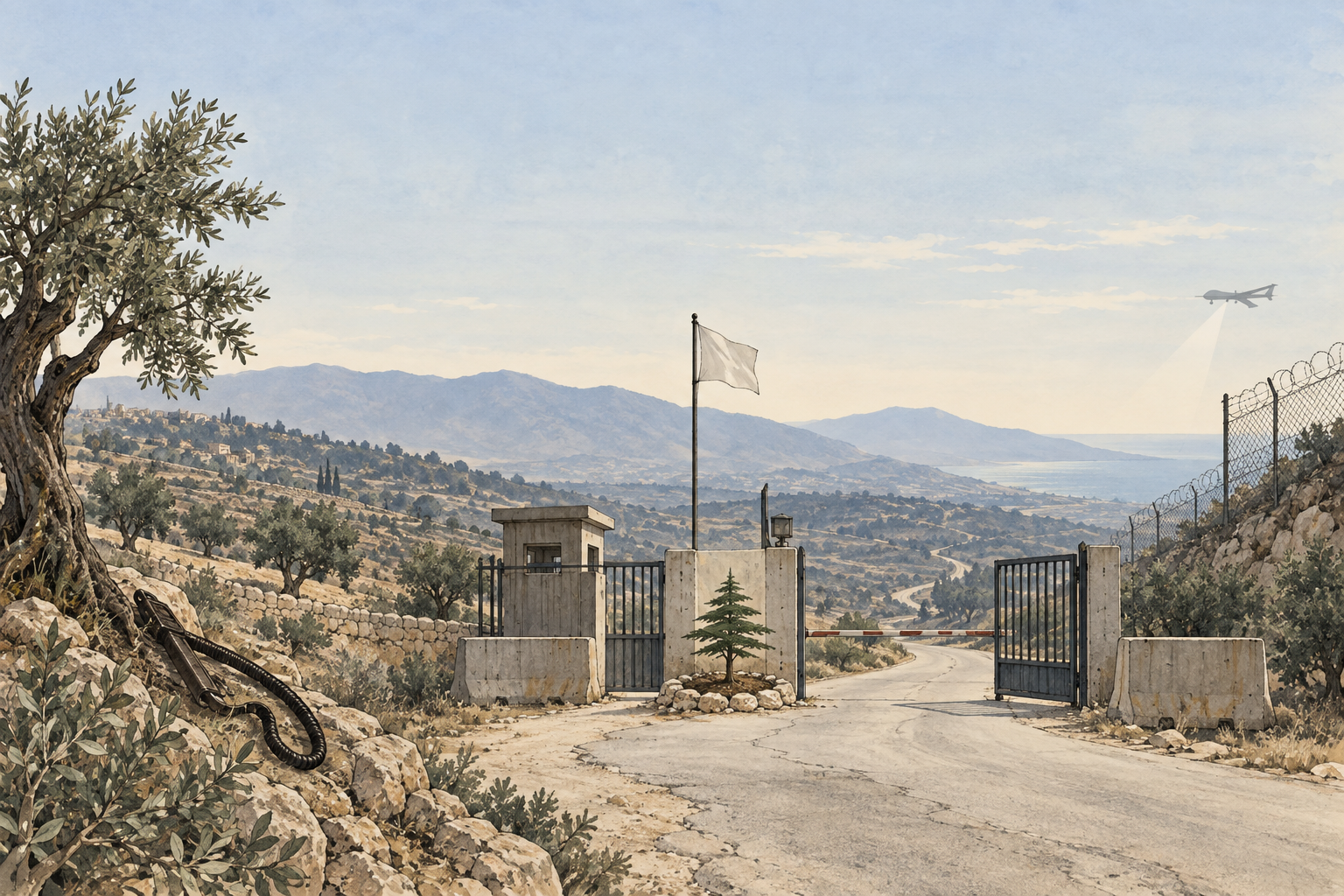
Pilot zones
A U.S.-backed model in which Israel would withdraw from specific areas of southern Lebanon in exchange for Hezbollah disarmament and Lebanese state deployment.
Ali Taher ridge
A strategic high ground near Nabatiyeh where Israel says it dismantled Hezbollah underground infrastructure after seizing parts of the area.
Yellow Line
An Israeli-designated line marking areas under Israeli control or fire control in southern Lebanon, according to Israeli and Lebanese reporting.
Trilateral Framework
The U.S.-backed framework for Lebanon, Israel and Washington to sequence Israeli withdrawal, Hezbollah disarmament and Lebanese state control.
Associated Press
news
Lebanon’s president makes a rare visit to southern city as fears of Israeli attacks grow
The Times of Israel
news
Upcoming round of Israel-Lebanon talks delayed from next week until October – US official
This Is Beirut
news
U.S. State Department to TiB: 'Constructive Dialogue' Between Lebanon and Israel is Ongoing
Aoun Visits South
Lebanese President Joseph Aoun visited Nabatiyeh and Zawtar al-Gharbieh on Sept. 12 after Israel’s Ali Taher operation.
Talks Delayed
A U.S.-mediated Rome round expected next week has been delayed until October, according to a U.S. official.
Pilot Zones Tested
The U.S.-backed model depends on Israeli withdrawal, Hezbollah disarmament and a stronger Lebanese state presence.
Lebanese President Joseph Aoun’s rare visit Saturday to Nabatiyeh and nearby Zawtar al-Gharbieh made southern Lebanon the visible test case for a U.S.-backed diplomatic model aimed at turning a fragile ceasefire into state control along the border.
The visit followed Israel’s seizure earlier this month of parts of the strategic Ali Taher ridge, where it said it destroyed Hezbollah tunnel networks. A U.S.-brokered ceasefire reached June 20 had largely halted active fighting between Israel and Hezbollah.1 The same area is now central to Washington’s “pilot zones” approach: limited areas where Israel would withdraw in return for Hezbollah’s disarmament and a stronger Lebanese state presence.1
That formula is under pressure from all sides. Israel says its military actions are needed to remove Hezbollah infrastructure and protect Israeli communities.4 Hezbollah rejects direct talks with Israel, has called for the June framework to be scrapped and has refused to disarm.1 The next U.S.-mediated round of Israel-Lebanon talks in Rome, expected next week, has been pushed into October, according to a U.S. official cited by The Times of Israel.2
Zawtar al-Gharbieh, which Aoun visited after Nabatiyeh, is part of the U.S.-brokered pilot zones agreement, according to the Associated Press.1 In principle, the model is meant to sequence security and political steps: Israel pulls back from defined areas, Hezbollah disarms there and the Lebanese state fills the vacuum.
In practice, Ali Taher has exposed the unresolved problem at the heart of the plan. Israel’s military said Sept. 11 that it had completed dismantling underground routes in the Ali al-Taher ridge area, describing the site as Hezbollah infrastructure that included rockets, missiles, UAVs, anti-tank weapons, mines and command facilities.4 The IDF said the infrastructure extended more than two kilometers and that Israeli troops would continue operating in what it calls the security zone in southern Lebanon, while saying it remains committed to the ceasefire.4
Lebanon-based reporting described a larger shock on the ground. L’Orient Today reported that Israel said it used more than 1,100 tons of explosives to destroy the Ali Taher network, causing a tremor comparable to a magnitude 4.1 earthquake, damaging vegetation and blocking roads with debris.5 The outlet also reported that Israeli Chief of Staff Eyal Zamir said the “Yellow Line” remained under Israeli control and that the Lebanese army would have to be effective on the ground for the agreement to advance.5
For residents, the issue is immediate, not procedural. AP reported that some Nabatiyeh residents have asked for a larger Lebanese army presence to avert a possible Israeli ground offensive, while one resident told Aoun in televised footage that families wanted to feel safe after displacement and humiliation.1 Aoun said the state would follow up on residents’ needs “so that you stay here,” according to AP.1
The delay in Rome talks narrows the diplomatic channel as developments on the ground move quickly. A State Department official said the next round, originally expected next week, would now be held in October, while the Lebanese and Israeli ambassadors were still expected to meet at the State Department about implementing the framework deal.2
The Times of Israel reported that an Israeli official attributed the delay to scheduling conflicts, but also noted slowing momentum amid Israeli elections and Hezbollah’s refusal to comply.2 The same report said Aoun confirmed there were “no new talks with Israel at the present time” during his south Lebanon trip. It also cited Lebanese concerns that Israeli strikes were undermining Beirut’s effort to disarm Hezbollah, while Israel argued the Lebanese Armed Forces were not yet capable of taking over.2
Washington has publicly framed the process as active but conditional. A U.S. State Department spokesperson told This Is Beirut that dialogue was continuing among Beirut, Jerusalem and Washington, and urged Lebanon to develop a comprehensive disarmament plan under the Trilateral Framework.3 The spokesperson also said the United States was monitoring calls from southern communities for the government to assert sovereignty and prevent Hezbollah from firing and storing weapons in their towns.3
That places the Lebanese state between two pressures: Israeli demands for verifiable security control and Hezbollah’s insistence on retaining its arsenal. It also raises the stakes for Aoun’s symbolism in Nabatiyeh. A presidential visit can signal state presence, but the pilot zones model requires state enforcement.
Civilian damage is becoming one measure of whether the ceasefire can become a durable border arrangement. L’Orient Today reported that residents of Nabatieh woke after the Ali Taher detonations to a changed landscape, with large sections of greenery gone across an estimated two kilometers.6 AP separately reported from Mansouri that displaced residents watched Israeli drones drop explosives on homes from a nearby vantage point, describing controlled demolitions in areas where Israel now occupies large parts of southern Lebanon.8
Some residents blamed both Israel and the Lebanese government. AP quoted displaced villagers saying the state had failed to protect their town, and reported that more than 300,000 people remained displaced in Lebanon despite the June truce allowing most displaced people to return.8
The result is a test not only of ceasefire management but of sovereignty. If the pilot zones can produce a visible Lebanese army role, reduced Israeli operations and credible limits on Hezbollah’s weapons, southern Lebanon could become the first proof that diplomacy can restore state authority at the border. If not, Ali Taher may become the precedent for a different pattern: Israeli military action continuing in contested zones, Hezbollah resisting disarmament and U.S.-backed talks chasing facts already imposed on the ground.






Comments