Fighting in Blue Nile opens new humanitarian pressure point in Sudan’s war
Blue Nile
A southeastern Sudanese region bordering Ethiopia and South Sudan; its capital, Ed Damazin, is a major receiving area for displaced families.
SPLM-N
Sudan People’s Liberation Movement-North, a rebel movement with factions operating in parts of Sudan, including Blue Nile and South Kordofan.
RSF
Rapid Support Forces, the paramilitary force fighting Sudan’s army since April 2023.
IOM DTM
The International Organization for Migration’s displacement tracking system, often used by humanitarian agencies to estimate new and cumulative displacement.
UN Office for the Coordination of Humanitarian Affairs (OCHA)
government
Today's top news: Lebanon, Occupied Palestinian Territory, Sudan, Rwanda, Central African Republic, Myanmar
Anadolu Agency
news
Over 4,500 displaced in Sudan’s North Darfur, Blue Nile amid worsening insecurity: IOM
Sudan Tribune
news
Displacement tops 175,000 in Sudan’s Blue Nile as famine threatens, civil group says
Untracked bias
Bias and factuality ratings from Media Bias Fact Check. Outlets without a rating are marked “Untracked.”
99,277 displaced
IOM-linked reporting says nearly 100,000 people were displaced in Blue Nile between Jan. 11 and Aug. 23, 2026.
Capital threatened
An RSF-allied SPLM-N faction has claimed advances toward Ed Damazin as the army reinforces positions around the Blue Nile capital.
Infrastructure hit
Local reports say drones struck fuel stations, Damazin airport and military areas, showing the front’s growing threat to civilian infrastructure.
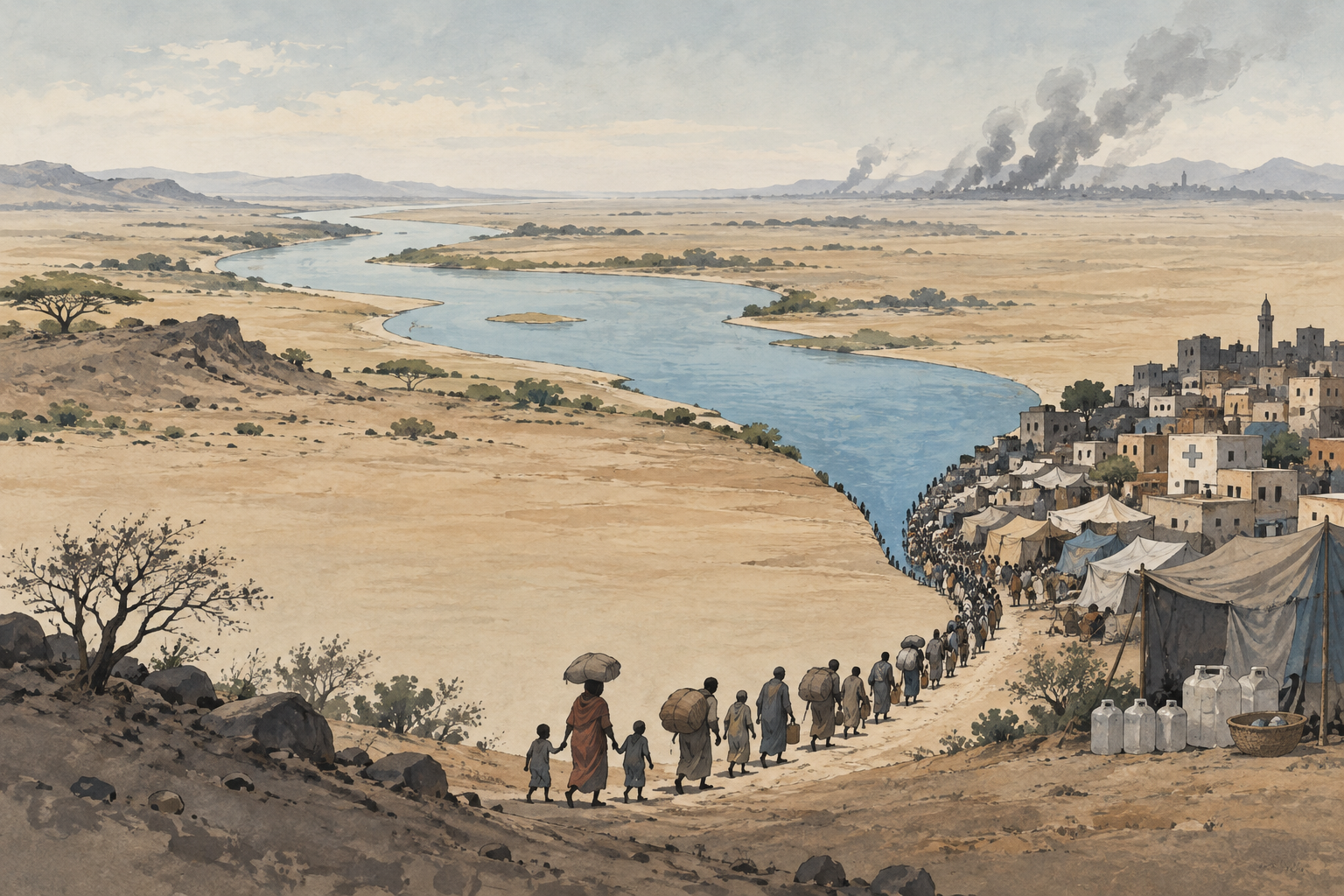
Ed Damazin, Sudan — Sudan’s southeastern Blue Nile region is emerging as a humanitarian flashpoint as fighting between the Sudanese Armed Forces and an alliance of the Rapid Support Forces and a faction of the Sudan People’s Liberation Movement-North moves closer to the state capital. The advance is pushing civilians into already crowded displacement sites and host communities.
The International Organization for Migration has recorded 99,277 people displaced across Blue Nile between Jan. 11 and Aug. 23, including 45,740 arrivals in Damazin, according to reports citing the UN agency.710 OCHA also cited IOM reporting that more than 3,300 people fled villages in Geisan locality on Sept. 7 alone, moving toward Wad Al Mahi as insecurity worsened.1 Anadolu, also citing IOM, reported the same one-day displacement of 3,315 people from Geisan and an earlier wave of 1,690 people from Kurmuk, underscoring how quickly battlefield shifts are driving civilian movement.2
Local monitors say the scale may be broader. The Blue Nile Civil Society Initiative told Sudan Tribune that more than 175,000 people — or over 35,000 families — had been uprooted by months of clashes, with many concentrated in Ed Damazin, Roseires, Wad al-Mahi and Baw.3 That figure is higher than the IOM-verified 2026 count and should be treated as a local assessment rather than a UN-confirmed total. But both sets of reporting point in the same direction: Blue Nile is absorbing a fast-growing displacement crisis as Sudan’s national emergency is already defined by mass uprooting and hunger.
The immediate trigger is a widening front in Blue Nile, where the RSF-allied SPLM-N faction has claimed new gains in Kurmuk locality and an advance toward Ed Damazin. Sudan Tribune reported on Sept. 11 that the alliance said it had captured several posts and villages in Kurmuk, while the army reinforced positions near the capital and its 4th Infantry Division.4 Radio Tamazuj separately reported the alliance’s claimed gains, while noting that the claims could not be independently verified and that local officials said fighting had damaged health facilities and water sources in Kurmuk-area communities.5
The front has since reached the capital’s civilian infrastructure. Darfur24 reported that a drone attack late Sunday hit fuel stations in Damazin, the airport and the 4th Infantry Division area, killing at least one person, according to eyewitnesses.8 Sudan Tribune reported multiple explosive drone impacts in Ed Damazin, including near a military hospital, airport and fuel station, amid air-defense fire and alarm among residents.9 Radio Tamazuj also reported explosions in the direction of the military hospital and airport and said civil society groups called for an immediate ceasefire, civilian protection and humanitarian corridors.11
Neither the RSF nor the SPLM-N faction had publicly claimed responsibility for the Damazin attack in the Radio Tamazuj report, and several battlefield claims from both sides remain difficult to verify independently.114 But the effect on civilians is clearer: towns receiving displaced families are also increasingly exposed to direct attack.
Blue Nile’s geography makes the escalation strategically and humanitarianly significant. The region borders Ethiopia and South Sudan and hosts the Roseires Dam, one of Sudan’s most important hydroelectric facilities.45 A broader contest for territory there would threaten civilians in frontline villages and complicate movement across border areas, trade routes and potential aid corridors.
For humanitarian agencies, the concern is that Blue Nile could become another fragmented access environment in a war already spread across Darfur, Kordofan, Khartoum, Al Jazira and other areas. OCHA’s Sept. 9 update reiterated calls for civilian protection and safe, unhindered humanitarian access after citing IOM’s displacement figures from Geisan.1 Local officials in Blue Nile have also warned that displaced people remain trapped in conflict-affected areas, particularly Kurmuk, Qaysan and Baw, while aid delivery varies sharply by location.6
That matters because the state’s main receiving areas are already under strain. Darfur24 reported that Blue Nile has 12 main camps and shelters, most of them in Damazin, with Al-Rusayris also hosting displaced people in camps and schools.6 IOM-derived figures reported by Darfur24 show that most newly displaced people are staying outside formal camp settings, including informal gathering sites, host-family arrangements and public buildings such as schools.10 Reports citing IOM differ on the exact breakdown between host families and public buildings, but they agree that informal sites account for the largest share of shelter.710
The displacement is converging with shortages of food, water, health care and funding. Sudan Tribune reported that the Blue Nile Civil Society Initiative warned of severe hunger and rising malnutrition in areas affected by clashes, especially where residents are trapped and aid supplies are blocked.3 Darfur24 cited Blue Nile’s humanitarian aid commissioner as saying inadequate donor support, returnees from South Sudan and growing displacement were increasing pressure on host communities.6
IOM-derived data reported by Darfur24 show why the response is fragile: 60% of displaced families said at least one household member had needed health services in the previous three months, while 95% reported rising prices for basic food and non-food items over the previous 30 days.10 More than a quarter of households reported borderline or poor food consumption, and large shares faced drinking-water shortages lasting from one day to more than a week.10
Aid access is also limited by information gaps, supply shortages, discrimination and documentation barriers, according to the IOM-derived assessment reported by Darfur24.10 Those obstacles are likely to worsen if fighting around Damazin intensifies because the capital is both a military target and the main hub for displaced families.
Sudan’s war began in April 2023 between the army and the RSF, but the conflict has increasingly splintered across local alliances and regional fronts. In Blue Nile, the involvement of an SPLM-N faction allied with the RSF adds another layer to a war already marked by shifting control, multiple armed actors and competing claims.
For humanitarian policy planners, the key risk is not only new displacement. It is the possibility that Blue Nile’s receiving towns, border corridors and basic infrastructure become part of an active battlefield. If that happens, civilians fleeing Kurmuk, Geisan and Baw may find fewer safe destinations, while aid agencies face tighter access to people already living with hunger, water shortages and overstretched health services.
The latest verified figures show nearly 100,000 people displaced in Blue Nile this year before the most recent September escalation.710 Local civil society says the cumulative toll from months of fighting could be significantly higher.3 With drone strikes now reported in Damazin and both sides preparing for further operations, Blue Nile is no longer a peripheral front. It is becoming a test of whether Sudan’s humanitarian response can keep pace as the war opens another pressure point in the southeast.






Comments