India’s BRICS consensus highlights New Delhi’s reach — and the bloc’s limits
BRICS
A grouping originally formed by Brazil, Russia, India, China and South Africa that has expanded to include additional emerging-market and Global South members.
New Delhi Declaration
The joint statement adopted at the 2026 BRICS summit under India’s chairmanship, setting out agreed positions on security, development and global governance.
Unilateral sanctions
Punitive economic or financial measures imposed by individual states or blocs rather than authorized by the United Nations Security Council.
Lowest-common-denominator diplomacy
A negotiating approach that secures agreement by using language broad enough for all parties to accept, often at the cost of specificity or stronger commitments.
Department of International Relations & Cooperation, Republic of South Africa
government
New Delhi Declaration: Building for Resilience, Innovation, Cooperation and Sustainability, New Delhi, India, 12 September 2026
Ministry of Foreign Affairs of the People’s Republic of China
government
President Xi Jinping Attends Session I of the 18th BRICS Summit and Delivers an Important Statement
Associated Press
news
BRICS leaders voice concern over Middle East, condemn unilateral sanctions at India summit
Untracked bias
100% of tracked sources are High factuality
The Indian Express
Terror to institutional reforms: BRICS to spell out common ground in declaration
Bias and factuality ratings from Media Bias Fact Check. Outlets without a rating are marked “Untracked.”
Consensus secured
India delivered a unanimous New Delhi Declaration despite sharp differences among BRICS members on West Asia, sanctions and global governance.
West Asia wording
The declaration urged maximum restraint in the Middle East while avoiding language that could split Iran, the UAE and other members.
China next
China will chair BRICS in 2027 and host the 19th summit, making Beijing the next steward of the bloc’s consensus model.
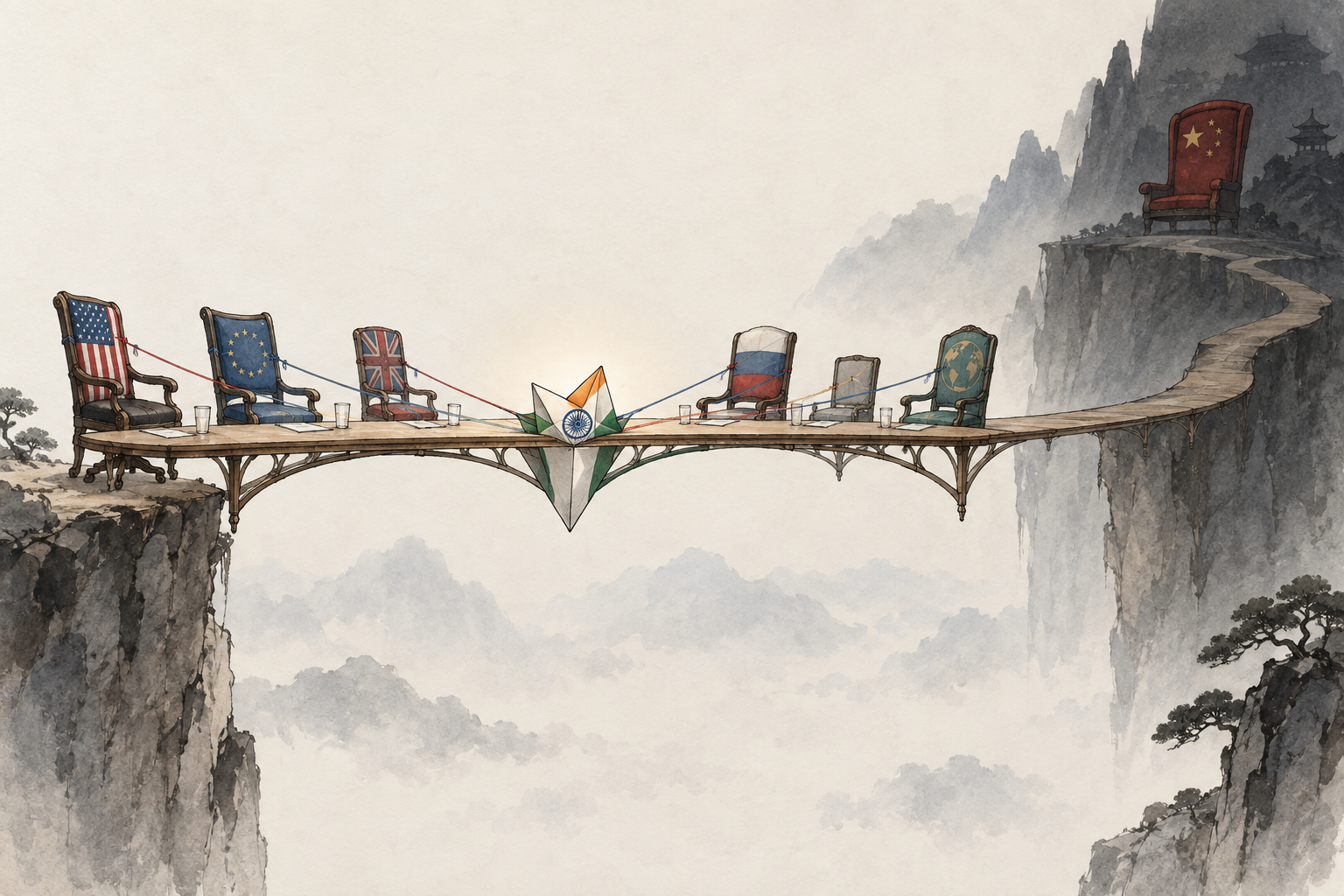
India used its BRICS chairmanship to deliver a consensus New Delhi Declaration at the September 12-13 summit, aligning an expanded bloc behind calls for multilateral reform, criticism of unilateral sanctions and concern over West Asia. The text avoided language that could have split Iran, the UAE, China, Russia and other members.135
The outcome gives New Delhi a diplomatic win: a unanimous declaration as BRICS seeks to present itself as a more representative platform for the Global South. But it also underscores the bloc’s central constraint. Its influence depends less on a shared strategic line than on wording broad enough to accommodate members with sharply different security alignments, regional interests and relationships with the United States, Russia and China.157
That trade-off was clearest in the declaration’s treatment of the Middle East, or West Asia. Leaders urged “maximum restraint” and voiced concern over regional tensions, while avoiding more polarizing language that could have alienated states on opposing sides of regional crises.156 Reuters reported that the wording was adopted unanimously despite the challenge of aligning Iran, the UAE and other BRICS members.5 The Times of India, citing government sources, reported that India-led negotiations ran until about 4 a.m. to reconcile positions among Iran, Saudi Arabia and the UAE.7
The New Delhi Declaration’s core message is that BRICS wants a larger say in global governance, especially on development, financial stability, security and institutional reform.1 It backs a stronger role for multilateral institutions and criticizes sanctions not authorized by the United Nations. That language resonates strongly with Russia, Iran and China, but is framed broadly enough for partners such as India and the UAE, which maintain more varied external alignments.13
That balance reflects India’s position as chair. New Delhi has sought to use BRICS to amplify developing-country priorities without turning the forum into a purely anti-Western bloc. Prime Minister Narendra Modi warned during the summit that geopolitical tensions and supply-chain shocks threatened global stability, while urging members to move from consensus language to implementation.4
India’s chairmanship therefore required New Delhi to preserve BRICS’ reformist message while preventing the declaration from becoming a vehicle for disputes that could fracture the expanded membership.
The result was a document heavy on shared principles and cautious on fault lines. The declaration condemned terrorism and included language on the Pahalgam attack, a point important to India, while embedding that condemnation in broader counterterrorism language acceptable to the wider group.6 On West Asia, it referred to civilian infrastructure, nuclear facilities and regional restraint, but avoided assigning blame in ways that would have made consensus harder.16
The summit showed the diplomatic burden that comes with BRICS expansion. A smaller BRICS could often paper over differences among Brazil, Russia, India, China and South Africa. The expanded format brings more regional rivalries and more varied security dependencies, making consensus harder even as the bloc claims broader global legitimacy.35
India’s challenge was especially complex. It had to manage its own rivalry and tentative reset with China, maintain its long-standing relationship with Russia, accommodate newer Middle Eastern members and keep the forum focused on institutional reform rather than intra-bloc disputes. Modi and Chinese President Xi Jinping also met on the summit sidelines as both sides sought to stabilize ties, underscoring how bilateral tensions among major BRICS players continue to shape the grouping’s internal diplomacy.8
For New Delhi, the successful declaration supports its argument that India can convene across geopolitical divides. But it also shows the costs of doing so. The more diverse BRICS becomes, the more its communiqués are likely to emphasize broadly acceptable positions — reform of global institutions, respect for sovereignty, development finance and opposition to unilateral sanctions — while softening or generalizing language on conflicts where members have incompatible interests.135
The declaration’s criticism of unilateral sanctions is one of its sharper geopolitical signals. It reflects a long-running BRICS concern that the dollar-centered financial system and Western sanctions architecture give a small group of states disproportionate coercive power.13
For Russia and Iran, both heavily sanctioned, the language is directly relevant. For China, it reinforces Beijing’s broader argument for a more multipolar international order. For India and the UAE, however, the same wording sits alongside deep economic and strategic ties with Western partners.
That makes the declaration less a sign of full strategic alignment than a statement of overlapping grievances. Members can agree that sanctions should not bypass the UN system, but they do not necessarily share the same appetite for confrontation with Washington or Brussels. This is the essence of BRICS diplomacy: the bloc can project dissatisfaction with the existing order more easily than it can define a unified alternative.
China’s official summit readout emphasized multilateralism and confirmed both the adoption of the New Delhi Declaration and China’s role as BRICS chair in 2027, when it will host the 19th summit.2 That transition matters because Beijing is likely to push for a more assertive agenda on global governance reform, development cooperation and alternatives to Western-led institutions. Whether the New Delhi consensus can survive a Chinese chairmanship with different priorities will be an early test of the bloc’s cohesion.
China inherits a BRICS platform that is larger and more visible, but also harder to steer. Beijing has an interest in presenting BRICS as a pillar of a multipolar order and a counterweight to Western dominance.2 Yet the New Delhi Declaration shows that the grouping’s credibility depends on keeping members with different threat perceptions inside the tent.
India’s summit management may offer a template: emphasize institutional reform, development and restraint; avoid language that forces binary choices; and give each major member enough recognition to claim a diplomatic gain at home. But that approach also limits the bloc’s ability to act decisively on crises.
The declaration can signal concern over West Asia and disapproval of unilateral sanctions, but it cannot easily impose a unified policy on wars, regional rivalries or sanctions evasion.
For geopolitics desks, the key takeaway is not simply that BRICS agreed on a declaration. It is that India secured agreement by keeping the text broad, disciplined and carefully balanced. That consensus is politically useful, but fragile. As China prepares to chair BRICS in 2027, the question is whether the bloc can move beyond shared dissatisfaction with the global order — or whether its expanded membership will continue to make lowest-common-denominator diplomacy the price of unity.24





Comments