Czech Senate runoffs test opposition’s hold on checks against Babiš
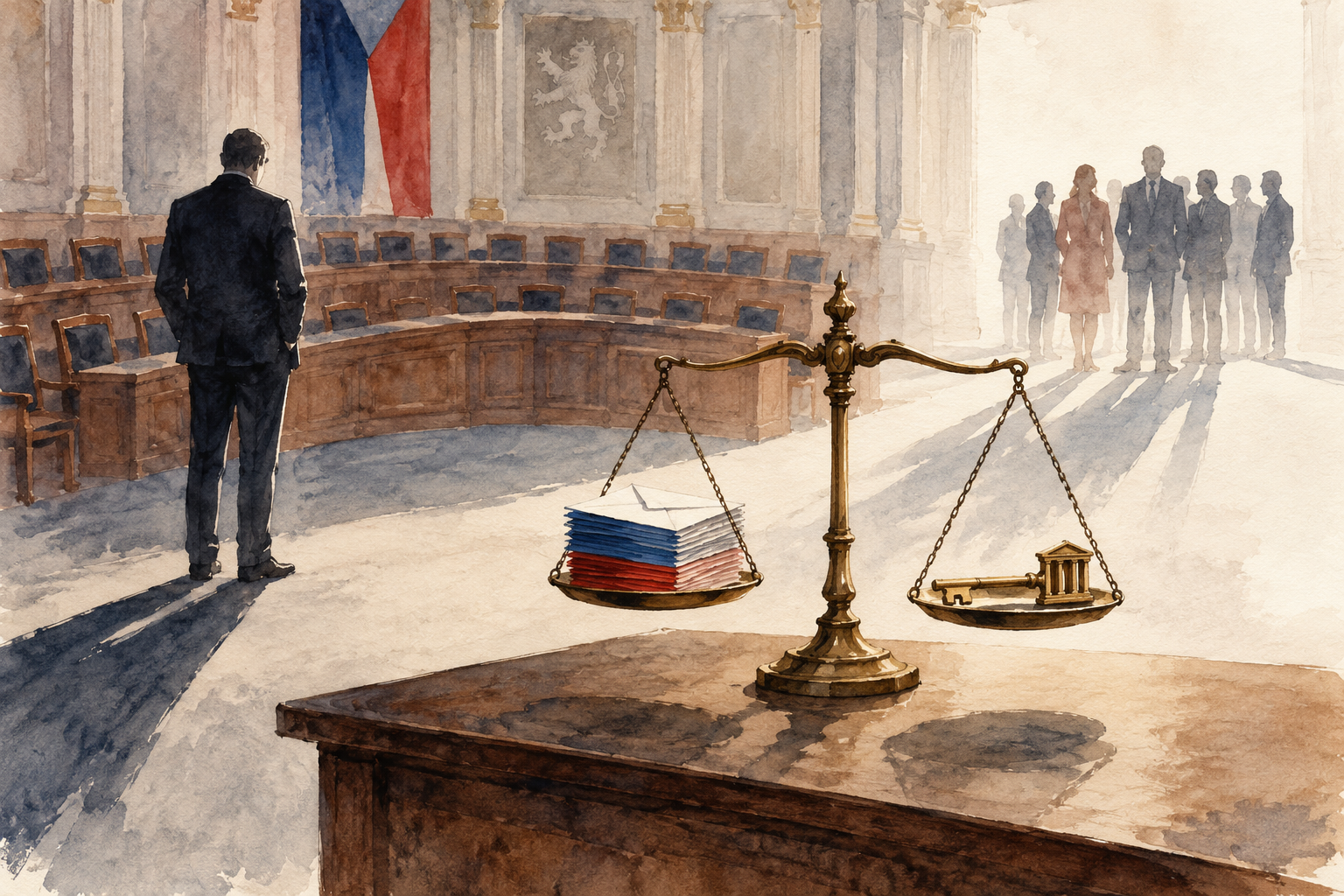
Czech Senate
The 81-seat upper house of Parliament renews one third of its seats at a time and can block or shape constitutional changes.
Runoff election
If no Senate candidate wins more than 50 percent in the first round, the top two candidates face each other in a second round.
ANO
The political movement led by Prime Minister Andrej Babiš; its name means “Yes” in Czech.
Constitutional Court appointments
The Czech Senate votes on nominees to the Constitutional Court, giving it leverage over the judiciary’s future composition.
Czech Statistical Office (CZSO)
government
Voters elected new councillors and five senators
Associated Press
news
Czech opposition outpaced the ruling party in first round of Senate election
Euronews
news
Czech PM Babiš's ANO faces strong challenge in first round of Senate election
Untracked bias
100% of tracked sources are High factuality
Spectrum News NY1
Czech opposition outpaced the ruling party in first round of Senate election
The Durango Herald
Czech opposition outpaced the ruling party in first round of Senate election
Tri-City Record
Czech opposition outpaced the ruling party in first round of Senate election
Laredo Morning Times
Czech opposition outpaced the ruling party in first round of Senate election
Radio Prague International
News
Daily Guardian Europe
Czech PM Babiš’s ANO faces strong challenge in first round of Senate election
Bias and factuality ratings from Media Bias Fact Check. Outlets without a rating are marked “Untracked.”
13 ANO runoffs
Babiš’s ANO movement advanced 13 candidates to the second round, the most of any single party.
26 opposition candidates
Pro-Western opposition parties and groups collectively advanced 26 candidates to the runoffs.
22 seats pending
Five senators were elected outright, leaving 22 Senate seats to be decided on October 16-17.
PRAGUE — Prime Minister Andrej Babiš’s ANO movement emerged from the first round of Czech Senate elections with 13 candidates advancing to runoffs. But pro-Western opposition parties and groups collectively sent 26 candidates into the second round and won four of the five seats decided outright, according to final results reported after the October 9-10 vote.12
The results make the October 16-17 runoffs less a straightforward popularity test for Babiš than a measure of whether opposition coordination can preserve the Senate as an institutional counterweight. The upper chamber, currently controlled by the opposition, has a limited role in ordinary lawmaking but is pivotal for constitutional amendments and the approval of Constitutional Court judges.2
The Czech Statistical Office said five senators were elected in the first round after clearing the 50 percent threshold, matching a historical high from 2024. The winners were Jan Grolich in Vyškov, Jan Grulich in Rychnov nad Kněžnou, Jan Sobotka in Trutnov, Tomáš Fiala in Strakonice and Zbyněk Linhart in Děčín.1 The remaining 22 seats will be decided in head-to-head contests this weekend.15
ANO’s 13 runoff candidates give Babiš’s party the largest single-party presence in the second round. But the broader opposition picture is stronger: AP reported that parties and groups in the parliamentary pro-Western opposition, often running in broad district coalitions, advanced 26 candidates in total.2
That gap reflects the structure of Czech Senate elections. Local alliances, well-known regional figures and tactical withdrawals can matter more than national party polling. Several second-round races are direct government-versus-opposition contests, while others pit opposition-aligned candidates against one another.57
The first round also exposed limits in ANO’s coalition ecosystem. Reflex’s analysis noted that ANO reached 13 runoffs but often entered them from behind, while SPD and Stačilo! failed to advance any candidates.6 That suggests Babiš’s governing camp may have difficulty converting a national plurality into upper-chamber gains without broader local coordination.
The Czech lower house dominates day-to-day legislation, but the Senate is harder for a government to bypass on constitutional questions. Constitutional amendments require Senate approval, and the chamber also votes on nominees to the Constitutional Court.2 For a government facing criticism over its stance toward the European Union and Ukraine, control — or denial of control — in the Senate can shape the legal boundaries of future policy.
Babiš’s government has distanced Czech policy from the country’s earlier strong support for Ukraine. ANO campaigned on domestic priorities such as energy prices, pensions and housing while arguing that too much money was being directed to Kyiv.3 President Petr Pavel and the parliamentary opposition remain supportive of Ukraine, leaving the Senate as one of the main elected institutions able to constrain or slow shifts away from that consensus.3
The political stakes are therefore larger than the 27 seats contested this year. Even if ANO gains seats, opposition parties are positioned to defend a chamber majority if they consolidate behind the strongest anti-government candidates in the runoffs.
The core question is whether the first-round pattern — cooperation where it held, fragmentation where it did not — repeats on October 16-17.
The first-round map showed both the value and fragility of opposition cooperation. In districts where opposition parties coalesced behind a single candidate, they often either won outright or entered the runoff in a strong position.6 Where multiple candidates from the same broad camp split the vote, ANO or local independents had a clearer path to the second round.6
Reflex highlighted Žďár nad Sázavou as an extreme example of fragmentation, reporting that one vote separated two candidates from the same political camp in the race for a runoff place.6 The same analysis argued that the Senate results showed a “recipe” for defeating ANO: district-level agreements that keep the anti-government vote from splintering.6
E15’s district-by-district rundown of all 22 runoffs underscored how localized the contests now become. Voters will choose between two finalists in each district, with polling stations open Friday, October 16, from 2 p.m. to 10 p.m. and Saturday, October 17, from 8 a.m. to 2 p.m.5
The Senate vote was held alongside local elections, which likely helped turnout. The Czech Statistical Office said voters chose 61,677 councillors from 189,896 candidates across 6,389 local councils. Turnout in the local elections reached 48.00 percent, up from 46.07 percent in 2022.1
The State Electoral Commission approved the municipal results on Monday, October 12, with official publication in the Collection of Laws expected Tuesday alongside the formal declaration of the five Senate contests settled in the first round, iDNES.cz reported, citing ČTK.4
For Babiš, the local and Senate results offer mixed evidence. ANO can point to the largest number of individual runoff berths for any single party. The opposition can point to a wider combined presence, four of five first-round Senate wins and a path to retaining the upper chamber as a check on the government.2
That makes the second round a test of discipline. If opposition voters transfer support efficiently to the strongest remaining anti-government candidate, the Senate is likely to remain an obstacle to major constitutional or judicial shifts. If they fragment, ANO could turn a first-round plurality into institutional gains at a moment when Czech policy toward Ukraine and the EU is already under pressure.






Comments