DOJ Election-Fraud Charges Show Broader Federal Push Before Midterms
Criminal complaint
A charging document that sets out probable-cause allegations; it is not proof of guilt.
Information
A formal criminal charge filed by prosecutors, often used when a defendant waives indictment or for certain lower-level offenses.
Voting by an alien
A federal offense involving a noncitizen voting in an election that includes federal offices.
N-400
The application form used to seek U.S. naturalization; false statements on it can trigger criminal charges.
U.S. Department of Justice, Office of Public Affairs
government
Four Aliens Charged With Election Fraud
U.S. Attorney’s Office, Eastern District of Pennsylvania
government
Four Aliens Charged With Election Fraud
U.S. Attorney’s Office, District of New Jersey
government
Aliens Charged with Illegally Voting in Federal Election and Making False Statements While Applying for U.S. Citizenship
Untracked bias
50% of tracked sources are Low factuality
Bias and factuality ratings from Media Bias Fact Check. Outlets without a rating are marked “Untracked.”
Six new cases
DOJ announced four Pennsylvania defendants and two New Jersey defendants on September 24 in election-related prosecutions.
16 earlier defendants
The September 24 charges followed a September 18 DOJ package involving 16 defendants across multiple federal districts.
Allegations only
The DOJ releases state that the charges are accusations and that defendants are presumed innocent unless proven guilty.
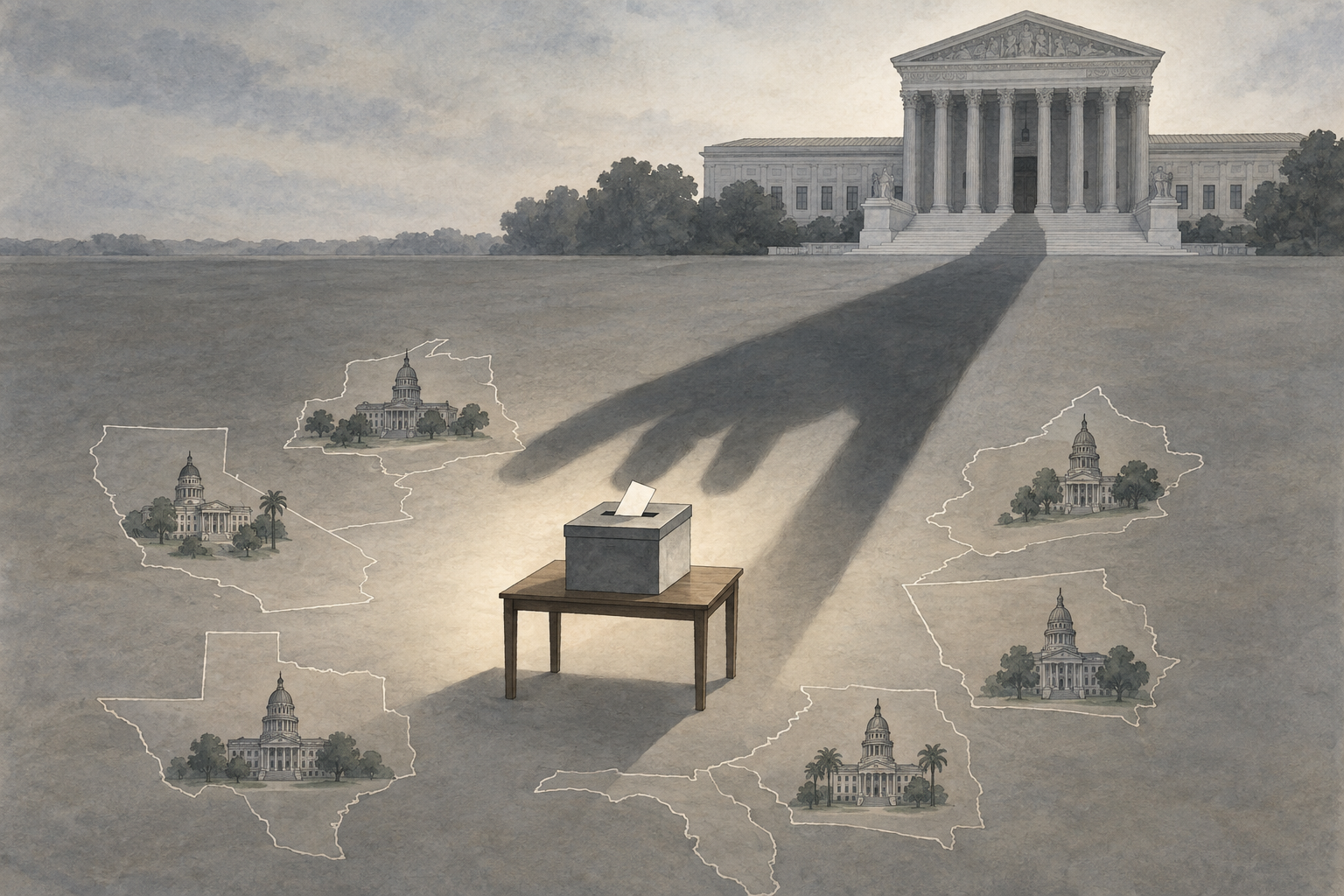
The Justice Department’s latest election-related charges, announced September 24 in Pennsylvania and New Jersey, extend a coordinated federal enforcement push that began with a September 18 package involving 16 defendants across multiple districts.
The legal allegations are specific and unresolved. The political significance is broader. The administration is using criminal enforcement, voter-roll reviews and public messaging to frame election integrity as a federal priority during the 2026 midterm voting period, even as the available charging documents do not establish widespread proven fraud.
In Pennsylvania, federal prosecutors charged four noncitizens with election-related offenses in the Eastern District of Pennsylvania. The defendants are Cliff Sanon, Dilea Ochoa-Perez, Sade Guppy and Eduardo Gallardo Maldonado. The alleged conduct is tied to Philadelphia County and Chester County voting or registration records from elections between 2022 and 2026.1
The local U.S. Attorney’s Office said Sanon was charged by criminal complaint with submitting a fraudulent voter-registration application. Ochoa-Perez, Guppy and Maldonado were charged by information with voting as noncitizens.2
In New Jersey, federal prosecutors charged Patrick Terrance Reid, a Jamaican national living in Orange, and Danubis Bernat, a Venezuelan national living in South Amboy, with voting by a noncitizen in a federal election and making false statements in naturalization applications. Prosecutors alleged Reid voted in federal elections in 2012, 2016, 2020 and 2024. Bernat allegedly voted in the 2024 general election. Both allegedly denied prior registration or voting when later filing N-400 naturalization forms.3
The September 24 cases followed DOJ’s September 18 announcement of charges against 16 people in districts including Northern and Western Texas, Idaho, Northern Georgia, Massachusetts, Western Wisconsin, New Jersey and Eastern Michigan. DOJ said that package involved illegal voting, illegal voter registration, false citizenship claims and related offenses, including naturalization fraud, passport fraud, wire fraud and unlawful firearm purchases uncovered during investigations.7
The cases are criminal allegations, not proof. Each DOJ announcement includes a presumption-of-innocence caveat, and none of the September 24 releases says the defendants have been convicted.
The Pennsylvania release states that the complaint and informations are accusations and that every defendant is presumed innocent unless and until proven guilty in court.1 The New Jersey release uses the same caveat for the complaints against Reid and Bernat.3
That distinction matters in election-law coverage. The charges describe alleged individual conduct: specific people, forms, counties and elections. They do not, by themselves, prove an organized scheme capable of changing an election outcome. Nor do they establish the prevalence of noncitizen voting nationally. They are evidence of federal enforcement priorities and of alleged violations prosecutors say they can pursue in court.
The Pennsylvania cases vary in alleged conduct and exposure. Sanon faces a charge tied to an allegedly fraudulent voter-registration application submitted before the May 2026 primary and an allegation that the application was among eight fraudulent voter-registration applications he submitted.1 Ochoa-Perez is accused of voting in Chester County in the 2022 and 2024 general elections. Guppy is accused of voting in Philadelphia County in 2022, and Maldonado is accused of voting in Philadelphia County in 2024.2
The New Jersey allegations combine voting offenses with statements in immigration files. Prosecutors said Reid and Bernat falsely certified citizenship on voter-registration forms and later falsely denied having registered or voted when applying for citizenship. The voting counts carry a maximum of one year in prison. The false-statement counts tied to naturalization applications carry a maximum of 10 years.3
The timing gives these cases significance beyond their individual facts. DOJ’s September 18 package was followed six days later by new charges in two politically important states, Pennsylvania and New Jersey.
The announcements also come as election administrators, courts and campaigns are already dealing with midterm procedures, voting disputes and early-voting timelines. Electionline’s September 24 roundup placed federal voter-data and election-litigation disputes alongside broader midterm concerns, including litigation over polling-place enforcement and voter-roll access.6
The administration’s broader posture is visible outside the criminal docket. Reuters reported on September 24 that the White House had pushed federal agencies to accelerate review of voter rolls from at least 47 states obtained by the Department of Homeland Security. The effort is intended to identify noncitizens among registered voters before the midterms.4 Reuters also reported that DHS had surged personnel under an “Unlawful Voter Initiative” and that officials were matching voter-roll data against immigration and other federal databases.4
That effort sharpens a long-running federalism dispute. States administer elections, while federal authorities enforce federal election crimes and civil-rights statutes. The administration is emphasizing the latter. States and courts are testing the limits of the former.
Electionline noted that a federal judge in Washington dismissed the administration’s lawsuit seeking state voter rolls, part of a pattern of DOJ losses in litigation over access to sensitive voter information.6
The Justice Department’s announcements use forceful language about election integrity, sovereignty and deterrence. U.S. Attorney David Metcalf said in the Pennsylvania announcement that people who vote illegally will be prosecuted for “corrupting our democracy.” Homeland Security Investigations framed unlawful ballots as damaging public confidence.1
In New Jersey, prosecutors said the cases were brought under the U.S. Attorney’s Office’s Election Integrity Task Force, described as a coalition of federal law-enforcement partners focused on preserving election integrity in the district.3
Those statements are politically potent, but they should not be read as judicial findings. Charging documents are one-sided allegations filed at the start of a criminal process. They can support probable cause or formal accusation; they do not establish guilt. That is why the presumption-of-innocence language is not boilerplate trivia, but a central fact for readers assessing the scale and meaning of the enforcement push.
Reuters’ reporting underscores the same caution at the system level. Its September 24 report said federal officials were using commercial and government data to identify possible noncitizen registrants. It also reported concerns about false positives, including citizens with similar names and U.S. citizens born abroad being swept into reviews.4 Reuters further reported that DHS had only “some degree of confidence” in certain flagged individuals and cited state pushback when federal claims were not fully substantiated.4
That does not mean individual allegations are insignificant. Illegal voting by a noncitizen is a federal crime, and false statements in immigration filings can carry serious penalties. But the public record currently supports a narrower conclusion: DOJ is bringing selected criminal cases and using them to amplify an election-integrity narrative, while courts, states and defendants still have major roles in determining what is proven.
The midterm backdrop makes the federal-state line especially important. The administration is pursuing voter-roll access and criminal cases through federal agencies, while state officials retain primary responsibility for registration systems, voting procedures and election administration. Litigation over voter data and polling-place enforcement shows how contested that balance has become.6
The September charges therefore operate on two tracks. In court, prosecutors must prove the elements of each offense against each defendant. In politics, the announcements give the White House and DOJ concrete examples to support a broader argument that federal intervention is necessary to protect elections.
For election-law readers, the key is to separate those tracks. The criminal cases may produce convictions, dismissals, pleas or acquittals. The broader enforcement campaign may influence public confidence, state cooperation and judicial rulings over federal access to election data. But as of the September 24 announcements, the record shows an assertive, timed and multi-district enforcement strategy — not adjudicated proof of widespread noncitizen voting.





Comments