EU budget talks test Parliament’s centrist control
Multiannual Financial Framework
The EU’s seven-year budget plan, setting spending ceilings and priorities for programmes such as cohesion, agriculture, research, security and external action.
Own resources
Revenue streams that fund the EU budget, distinct from direct national contributions by member states.
Cordon sanitaire
A political practice of refusing institutional cooperation with parties or groups considered far right.
Mid-term negotiations
Talks halfway through the Parliament’s five-year term over posts such as vice-presidents, quaestors and committee leaderships, as well as wider cooperation between groups.
2EU Brussels
news
Political groups set out red lines ahead of European Parliament mid-term negotiations
European Commission Audiovisual Service / European Parliament
government
EP News: An ambitious Multiannual Financial Framework 2028 - 2034 for a strong and resilient Europe
European Commission Audiovisual Service / European Parliament
government
EP Plenary Session: An ambitious MFF 2028 - 2034 for a strong and resilient Europe — opening statements
Untracked bias
Bias and factuality ratings from Media Bias Fact Check. Outlets without a rating are marked “Untracked.”
Budget test
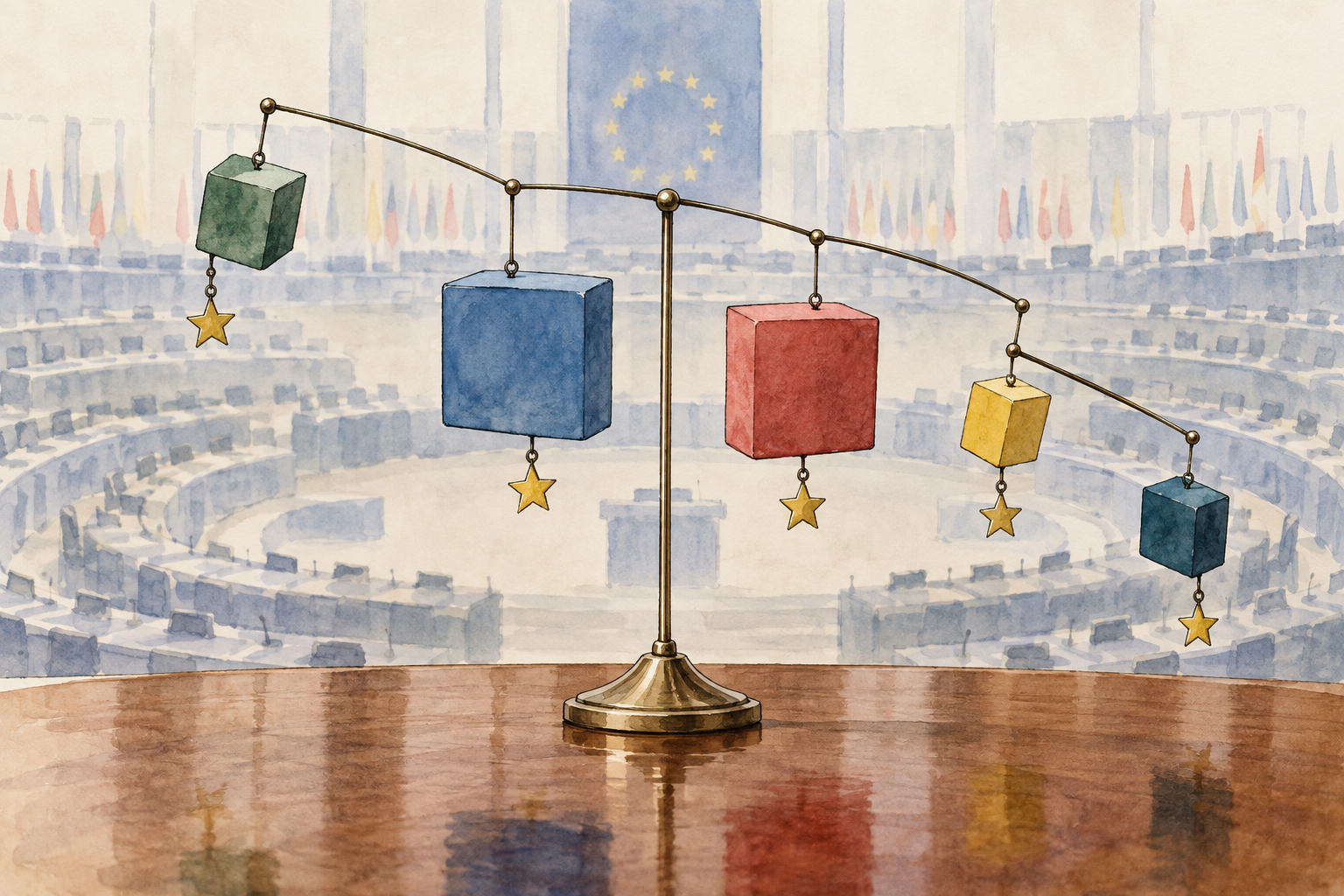
The 2028-2034 MFF is becoming the main test of whether Parliament’s centrist cooperation model can survive the mid-term negotiations.
Funding deadline
Commissioner Piotr Serafin warned that a 2026 agreement is needed if EU budget-funded investments are to begin in 2028.
Competing models
S&D, Renew and the Greens want a renewed pro-European framework, while the ECR is pressing for closer centre-right and right-wing alignment.
The European Parliament’s debate on the 2028-2034 Multiannual Financial Framework has moved beyond spending totals. It is becoming an early test of how the institution will be governed in the second half of its term: through a renewed centrist understanding led by the European People’s Party and the Socialists and Democrats, or through looser file-by-file majorities that let the EPP look both left and right.
The budget file is the clearest case for preserving the old model. Parliament must speak with enough unity to shape negotiations with the Council, and EPP and S&D co-rapporteurs have signalled that their cooperation on the MFF remains intact, despite recent committee votes in which groups assembled different majorities on separate files.1
But the politics around that cooperation are tightening. S&D wants a clearer and more transparent agreement among groups it describes as pro-European. Renew wants continuity in the existing pro-European framework. The Greens are making the maintenance of a cordon sanitaire against the far right a condition. The ECR is pressing for a more right-leaning alternative built around closer cooperation between centre-right and conservative forces.1
That makes the long-term budget the first major institutional stress test before mid-term talks on Parliament posts, committee leaderships and working arrangements. If the EPP and S&D can hold together on the MFF while bringing Renew, and where necessary the Greens, into a common negotiating line, centrist cooperation remains the default operating system. If not, the MFF may foreshadow a Parliament in which institutional deals become thinner and majorities are rebuilt issue by issue.
The 7 October plenary debate put the challenge in institutional terms. Council representative Thomas Byrne told MEPs that the presidency was entering a critical phase, with a revised negotiating box intended to move member states closer to agreement and Parliament’s consent ultimately required for the package.3 Commissioner Piotr Serafin framed the Commission proposal as a response to competitiveness, defence, security and long-standing EU policies, while defending new own resources as part of a credible financing model.3
The timetable raises the stakes. Serafin warned in the closing session that the EU needs an agreement in 2026 if investments funded from the European budget are to begin in 2028.6 Byrne ended the debate with a blunt institutional message: compromise will be needed on the budget’s volume, priorities and own resources because unanimity among the 27 member states and Parliament’s consent both have to be secured.6
That gives Parliament’s internal coalition question practical importance. A divided chamber can still adopt positions, but a coherent majority is more useful in talks with the Council. On the MFF, the EPP-S&D axis remains valuable because it links the two largest mainstream groups on a file that touches nearly every EU priority: agriculture, cohesion, defence, competitiveness, external action, research and repayment of common borrowing.
The official EP news package presented the 7 October debate as a discussion on an ambitious MFF for a strong and resilient Europe. That reflects how the institution wants the file to be seen: not as a technical budget exercise, but as a strategic argument over what the EU should be able to do between 2028 and 2034.2
The budget debate showed why the EPP and S&D still need each other. The centre-right wants a budget that can support competitiveness, security and defence without appearing to abandon farmers, regions or fiscal credibility. The centre-left wants to protect cohesion, social investment and a stronger EU budget while avoiding a situation in which the EPP can rely on right-wing partners whenever the centre-left becomes inconvenient.
That is why S&D’s mid-term position matters. Its demand is not simply for offices or committee posts. It is for political clarification: whether the EPP intends to treat the pro-European centre as its governing base, or whether cooperation with S&D is only one option among several.1
The MFF gives S&D leverage because it is one of the files where the EPP has an incentive to preserve a broad Parliament position. A budget mandate dependent on unstable or ideologically divergent alliances would be harder to defend in negotiations with the Council. It would also expose contradictions inside Parliament’s own demands: more defence, stronger competitiveness, protected cohesion, a viable Common Agricultural Policy and new revenue streams.
Those tensions were visible in the wider MEP debate. Speakers warned against cutting the EU budget at a time of war, technological competition and regional investment needs. Others criticised what they saw as excessive centralisation, bureaucracy or pressure for new taxes.5 Several interventions linked ambition to new own resources, arguing that without fresh revenue Parliament’s spending priorities would be harder to sustain.5
Renew Europe’s position is the clearest defence of continuity. It wants to maintain a pro-European majority and rejects cooperation with the far right.1 In practice, that means Renew is likely to support a renewed institutional deal if it keeps the EPP anchored to S&D, Renew and compatible partners on major files.
The Greens are aligned with Renew on the far-right boundary but are less automatic participants in a centrist bargain. Their condition is the preservation of the cordon sanitaire, meaning no institutional cooperation with parties they classify as far right.1 That matters because mid-term negotiations are not only about legislative votes. They also distribute symbolic and procedural power: vice-presidencies, quaestors, committee chairs and other posts that shape Parliament’s daily work.
For the Greens, a budget deal cannot be separated from the question of who is legitimised as a governing partner inside the institution. If the EPP maintains the budget partnership with S&D but simultaneously normalises a right-leaning institutional arrangement elsewhere, the Greens will see a breach of the political boundary they are trying to defend.
Renew’s calculation is different. It is less focused on ideological distance from the EPP and more on preventing fragmentation of Parliament’s pro-European core. But both Renew and the Greens are pushing in the same direction: they want the MFF to reinforce, not replace, the centrist cooperation model.
The ECR is trying to turn the same moment into an argument for a different Parliament. Its mid-term message is that a closer alignment between centre-right and right-wing forces would be more coherent than continued reliance on a centre-right and centre-left understanding.1
That approach also connects to the group’s policy priorities. In a 6 October statement ahead of the 15-16 October European Council, ECR co-chair Nicola Procaccini argued for energy sovereignty, industrial competitiveness, secure borders and a less decarbonisation-led approach to EU policy.7 Those themes map onto budget politics: the ECR can support spending on borders, security, defence, energy independence and competitiveness while resisting a larger, more centralised EU budget or new revenue instruments framed as burdens on companies and citizens.
This is not yet a new majority. The evidence so far points to positioning, not a formal EPP-ECR institutional pact.1 But the ECR’s offer is strategically important because it gives the EPP another source of pressure. Even if the EPP does not choose a full right-leaning arrangement, the possibility of assembling majorities to its right can affect how far it is willing to go in talks with S&D, Renew and the Greens.
The underlying question is whether Parliament is still governed by a recognisable majority or by variable coalitions. In legal and procedural terms, MEPs can already build different majorities on different files. A vote on an amendment, report or committee mandate does not automatically create a coalition.1
The political question is whether that flexibility remains tactical or becomes structural. Under the tactical model, groups may diverge on individual files while preserving an institutional arrangement for posts, flagship negotiations and the defence of Parliament’s role. Under the structural model, there is no stable governing centre; every major issue becomes an open negotiation among competing blocs.
The MFF sits between those two models. It requires broad compromise, but it also contains enough policy conflict to tempt groups into alternative alliances. Agricultural funding, cohesion policy, defence spending, competitiveness instruments, border management, repayment of NextGenerationEU borrowing and new own resources all cut across national and ideological lines.
That is why the EPP-S&D budget partnership can hold even as broader centrist discipline weakens. It may be strong enough to deliver an MFF mandate, but not strong enough to settle the wider mid-term question. Conversely, if the partnership breaks on the budget, it would be hard to argue that the traditional pro-European centre remains Parliament’s default majority.
The next test is whether the groups convert public red lines into a negotiated institutional package. S&D will look for guarantees that the EPP is not using two parallel majority strategies. Renew will press for continuity. The Greens will judge the arrangement by whether it excludes the far right from institutional cooperation. The ECR will keep arguing that the centre-right should stop treating the centre-left as its indispensable partner.1
The budget calendar will intensify that pressure. The Council is working toward a compromise among member states, while Parliament must preserve enough internal cohesion to influence the final package.3 The Commission and Council have both underlined that delay would risk disrupting funding from 2028, making the MFF both a policy deadline and a political forcing mechanism.6
For now, the most likely outcome is neither a clean collapse of centrist cooperation nor a fully formed right-leaning majority. It is a hybrid Parliament: a broad pro-European alignment on the MFF and other institutional files, alongside more frequent file-by-file majorities on contested legislation.
But hybrids are unstable. The 2028-2034 budget debate is showing that Parliament’s mid-term bargain will not be judged only by who gets which post. It will be judged by whether the EPP, S&D, Renew and the Greens can still make centrist cooperation meaningful — or whether the ECR’s argument for a new right-leaning operating model becomes the stronger description of how the chamber actually works.






Comments