EU-Moldova accession push shifts to sequencing before enlargement debate
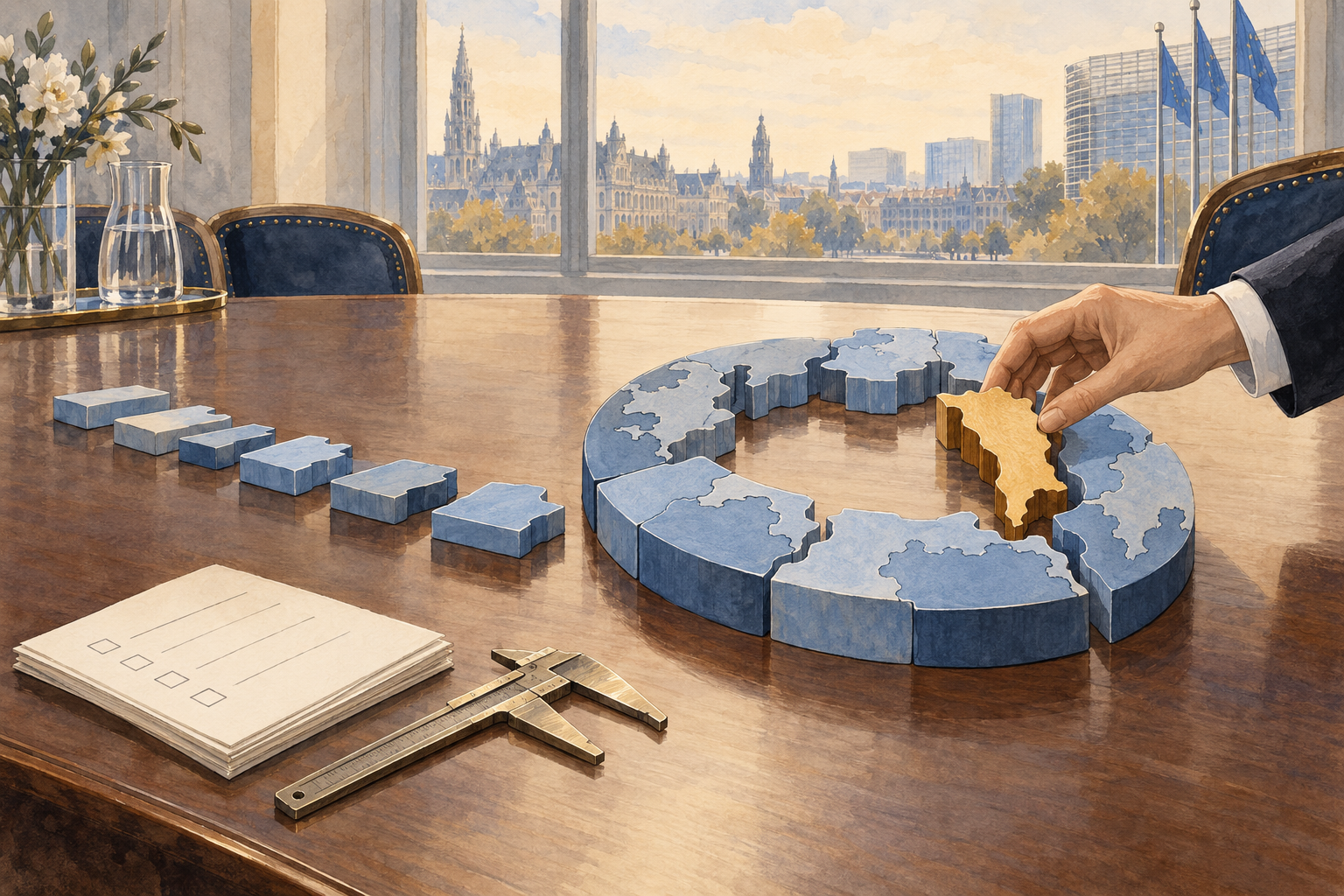
Association Council
A high-level EU-Moldova forum created under the 2014 Association Agreement to review cooperation and set priorities.
Negotiation clusters
Grouped areas of EU law and policy that candidate countries must negotiate, implement and eventually close before joining.
Fundamentals cluster
The accession cluster covering rule of law, democratic institutions, public administration and economic criteria; it sets the pace for the whole process.
Growth Plan
An EU financing package meant to support Moldova’s reforms, infrastructure, connectivity and economic convergence with the bloc.
European External Action Service
government
EU-Moldova Association Council: Joint press conference by High Representative/Vice-President Kaja Kallas, Prime Minister of the Republic of Moldova Vasile Tofan and European Commissioner for Enlargement Marta Kos
European Commission Audiovisual Service
government
EU-Moldova Association Council — Bilateral meeting Kaja Kallas with Vasile Tofan
European Commission Audiovisual Service
government
EU-Moldova Association Council — Roundtable
Untracked bias
The Kyiv Independent
Moldova aims to complete EU technical talks by 2028, join bloc by 2030
Moldova 1
Vasile Tofan la Bruxelles: O „foaie de parcurs” la Consiliul de Asociere Moldova-UE
Radio Moldova
Vasile Tofan la Bruxelles: O „foaie de parcurs” la Consiliul de Asociere Moldova-UE
Bias and factuality ratings from Media Bias Fact Check. Outlets without a rating are marked “Untracked.”
Cluster push
EU and Moldovan officials are now focused on whether the remaining accession negotiation clusters can be opened by year-end.
Fresh tranche
Brussels announced a new €157 million disbursement from the EU’s €1.9 billion Growth Plan for Moldova.
Security link
The EU tied Moldova’s accession momentum to resilience, air defence support and responses to Russian hybrid pressure.
BRUSSELS — The European Union and Moldova shifted their accession talks on Monday from broad political backing to a more technical debate over sequencing, as senior EU officials signalled fresh support for Chișinău while tying further progress to reforms, cluster openings and the bloc’s own enlargement-readiness debate later this month.
The 10th EU-Republic of Moldova Association Council, held in Brussels on October 5, was chaired by EU foreign policy chief Kaja Kallas. Moldovan Prime Minister Vasile Tofan led Chișinău’s delegation, and Enlargement Commissioner Marta Kos represented the European Commission.23 The agenda covered Moldova’s accession process, justice, freedom and security reforms, foreign-policy alignment, energy and trade, as well as regional challenges in a restricted session.45
For EU institutional observers, the meeting’s main significance was not confirmation that Moldova remains a favoured candidate. It was how Brussels is packaging support: immediate money, security assistance and market access in return for continued progress on rule-of-law and institutional benchmarks.
Kallas said after the meeting that EU-Moldova relations “have never been closer,” citing Moldova’s security and defence partnership with the bloc, its alignment with EU foreign-policy positions and its growing integration into the single market.1 She announced a new €157 million tranche from the EU’s €1.9 billion Growth Plan for Moldova, and said European Peace Facility support for Moldovan defence modernisation now stands at €317 million, including €120 million in 2026 for air defence.1
That is what Brussels is prepared to endorse now: budgeted economic support, defence-capacity assistance, gradual single-market integration and political protection for Moldova’s accession track, despite continuing pressure from Russia and the unresolved Transnistria question.
The Association Council did not decide Moldova’s accession timetable. EU membership remains conditional on adopting and enforcing EU law, meeting rule-of-law and economic criteria, closing negotiating chapters and securing unanimous approval from member states.8 But Monday’s messaging suggested that Brussels wants to preserve momentum before EU leaders discuss enlargement and institutional reform at the European Council on October 15-16.10
Kallas presented Moldova as both an accession candidate and a security partner. She said Russian missiles and drones had again violated Moldovan airspace over the weekend, called the incidents unacceptable, and said the EU would continue to support Moldova through capacity building, rapid-response measures and sanctions against actors seeking to destabilise the country.1
The security language matters because Moldova’s accession file is no longer treated only as a legal approximation exercise. The country borders Ukraine, faces Russian pressure and disinformation campaigns, and remains vulnerable on energy and territorial reintegration.8 As a result, accession has become part of a wider EU debate about resilience, defence and the costs of enlargement.
Brussels also used the meeting to emphasise tangible integration before membership. Kallas highlighted Moldova’s entry into the Single Euro Payments Area and the benefits of the EU mobile roaming area for Moldovan citizens and businesses.1 Moldovan public broadcaster Moldova 1 also cited Moldova’s participation in SEPA, “Roam Like at Home” and Creative Europe as signs of deeper alignment with EU structures.7
The next test is the sequencing of negotiation clusters. Moldova opened the Fundamentals cluster in June 2026 and the External Relations cluster in July, moving from the symbolic launch of talks to substantive alignment with EU law.8 The Fundamentals cluster, which covers rule of law, democratic institutions, public administration and economic criteria, is especially important because progress there sets the pace for the wider accession process.8
Moldova 1 reported that Moldovan authorities have met 95 percent of their commitments and that the Commission is preparing a concrete accession “roadmap” for Moldova and other advanced candidates, including Montenegro, Albania and Ukraine.7 The broadcaster also reported that Kos expects the four remaining negotiation clusters to be opened by the end of the year.7
That target raises the core sequencing question: whether Moldova can sustain its reform pace quickly enough for the Commission to recommend further openings, and whether member states are prepared to act on that assessment without holding Chișinău back over wider concerns about EU institutional reform.
Moldovan coverage of the meeting stressed that officials reviewed the previous 12 months of EU-Moldova cooperation and set priorities for the next period, with security, justice, the economy and energy among the areas under review.45 Independent outlet NewsMaker similarly reported that the Brussels meeting assessed cooperation and key reforms in security, justice, the economy and energy, while also covering Moldova’s European path.6
For Chișinău, the immediate deliverable is not membership but proof of sustained administrative capacity: laws passed, institutions functioning, justice reforms implemented and foreign-policy alignment maintained. For Brussels, the deliverable is a credible accession sequence that rewards performance without pre-empting the member-state debate on enlargement reform.
The €157 million disbursement gives the meeting a concrete outcome beyond statements of support. Moldova 1 reported that Moldova has already received about €504 million from the €1.9 billion Growth Plan, including earlier pre-financing and regular payments tied to reform indicators, with the new tranche announced on October 5.7
The funds are part of the EU’s effort to make accession more visible before membership. The Growth Plan is designed to support economic convergence, infrastructure and connectivity while linking disbursements to accession-related reforms.18
That approach reflects a broader institutional concern: the EU wants candidate countries to experience partial integration earlier, but it also wants evidence that they can absorb and apply EU rules. Moldova’s case is becoming a test of whether that model can work under security pressure and with limited administrative capacity.
The official imagery around the meeting underlined the message. EU audiovisual records placed both the Kallas-Tofan bilateral and the Association Council roundtable at the Europa building in Brussels on October 5.23 A Reuters Connect photo item showed Kallas, Tofan and Kos together in Brussels and described the meeting as covering accession, justice and rule-of-law reforms, energy and trade.9
The timing gives the Moldova file added institutional weight. The Council’s forward look for October 5-18 lists enlargement and reforms among the issues EU leaders are due to discuss at the European Council on October 15-16, alongside Ukraine, the next long-term EU budget, defence and security, migration and competitiveness.10
That agenda places Moldova inside a larger bargain. Candidate countries want cluster openings and roadmaps. The Commission wants to show that merit-based enlargement is functioning. Member states must decide how far the EU can move before settling questions about budget costs, voting arrangements, institutional capacity and safeguards for new members.
Moldova’s progress has therefore created a second-order problem for Brussels. If Chișinău continues to meet benchmarks, slow movement on clusters could weaken the credibility of the EU’s merit-based approach. But accelerated openings would also increase pressure on member states to clarify how the Union would operate with new members.
The October 5 Association Council did not resolve that tension. It made it more visible. Brussels endorsed money, security backing and deeper sectoral integration now. Moldova says it can keep moving through the reform track by year-end. EU leaders will soon have to decide whether the enlargement process can match that pace.






Comments