France and Germany push EU for faster market-access tool against coercion
Economic coercion
The use of trade, investment or supply-chain pressure by one country to force another government to change policy.
Anti-Coercion Instrument
An EU tool designed to deter and respond to economic pressure from non-EU countries, potentially including countermeasures.
Internal market
The EU’s common market, where goods, services, capital and people can move across member states under shared rules.
Trade defence tools
Legal measures such as duties, investigations or restrictions used to respond to unfair trade practices or market distortions.
European Commission Audiovisual Service
government
EC Midday press briefing of 07/10/2026
Associated Press
news
EU sends envoy to Beijing as rising exports from China raise economic anxiety
Euronews
news
EU trade chief heads to Beijing under pressure to deliver on Chinese imports
Untracked bias
100% of tracked sources are High factuality
Bias and factuality ratings from Media Bias Fact Check. Outlets without a rating are marked “Untracked.”
Franco-German push
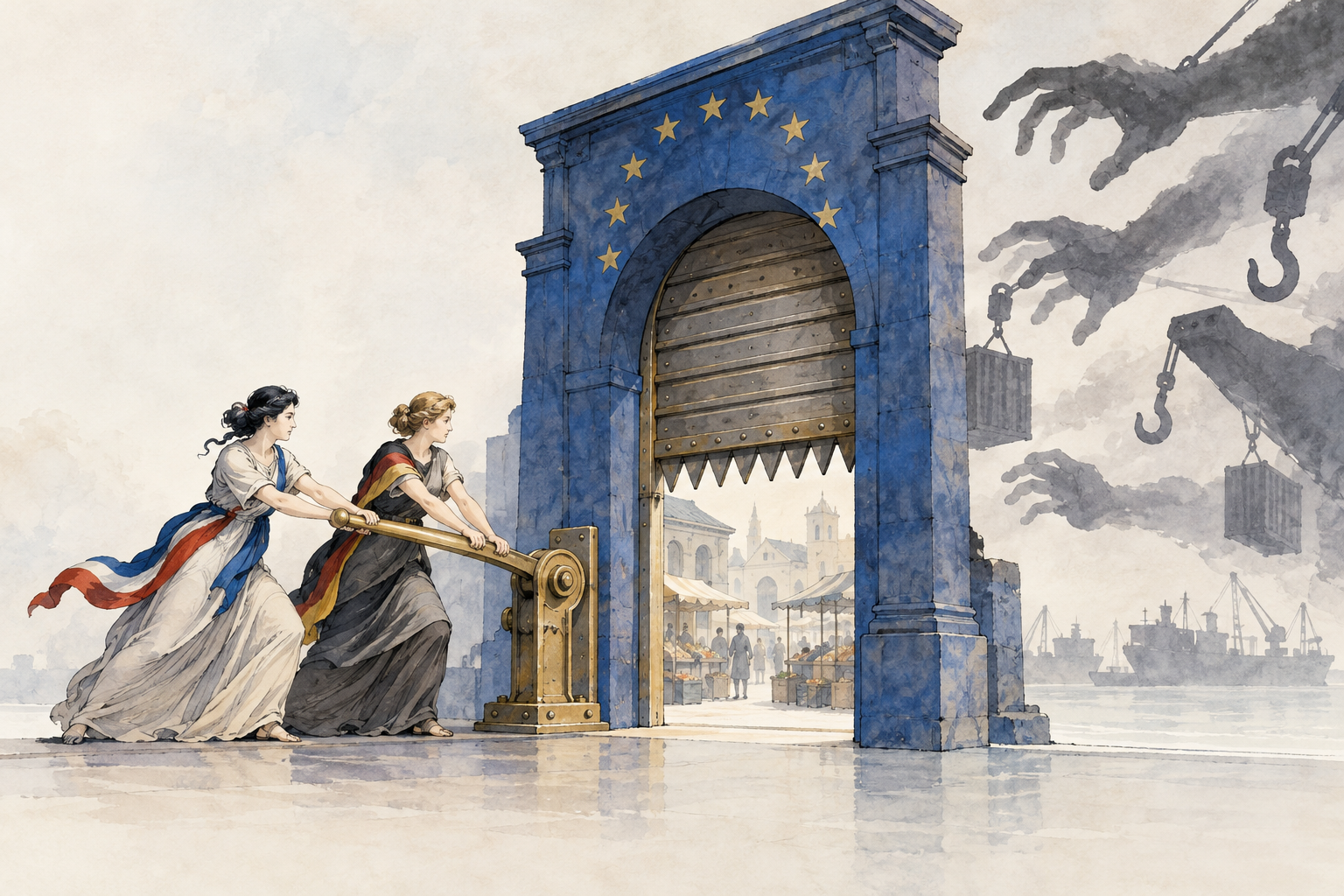
France and Germany have asked the Commission to examine a stronger legal tool to restrict EU market access in response to coercion and distortions.
Beijing deadline
The proposal lands as Trade Commissioner Maroš Šefčovič visits Beijing under pressure to return with concrete results for EU leaders.
Parliament backing
The European Parliament adopted a tougher China line by 454 votes to 86, with 110 abstentions.
France and Germany have asked the European Commission to consider a stronger legal route for restricting access to the EU market when the bloc faces economic coercion or market distortions. The move turns mounting concern over Chinese imports into a broader institutional fight over how quickly Brussels should be able to retaliate.12
The Franco-German initiative, reported as EU Trade Commissioner Maroš Šefčovič travelled to Beijing, seeks to move the debate beyond individual sectors and toward a standing instrument that could let the Commission act faster when foreign practices are judged to threaten the internal market.23 The proposal was prominent enough to feature in questions at the Commission’s October 7 midday press briefing, where officials faced scrutiny over both the letter and Šefčovič’s China visit.1
The timing is deliberate. Šefčovič arrived in Beijing under pressure to extract concrete results from Chinese counterparts before EU leaders take up the issue again, with several reports describing October as a political deadline for progress on trade tensions.38 The Franco-German letter gives that negotiating track a sharper edge: if talks do not produce movement, Paris and Berlin want the Commission to study whether the EU needs a faster mechanism to limit market access.25
The move matters because France and Germany remain central to EU trade politics. By writing jointly to the Commission, they are not only adding pressure on China policy. They are also trying to shape the Commission’s work programme and the legal options available before the next round of leader-level decisions.25
According to Associated Press reporting on the letter, the two governments want Brussels to explore stronger trade retaliation tools that would be easier for the Commission to deploy, including measures that could limit access to the EU market.2 Euronews reported that the demand reflects frustration with the pace of existing procedures and seeks a tool that could cut off access to the internal market more quickly than current instruments allow.3
That framing shifts the political question. Until now, many EU-China trade disputes have been handled through sector-specific investigations, duties or negotiations. The Franco-German proposal asks whether the Commission should have a broader legal instrument to respond when a pattern of economic pressure or subsidised overcapacity is seen as a systemic threat.23
The Commission has not publicly committed to such a proposal. But by allowing the issue to surface at the October 7 midday briefing, Brussels acknowledged that the idea is already part of the policy conversation around Šefčovič’s trip.1
The core issue is how far the EU can go in restricting market access while staying inside its own legal order and international trade commitments. The Franco-German push points toward a new or strengthened legal instrument, rather than ad hoc political retaliation.23
One reference point is the EU’s existing Anti-Coercion Instrument, designed to deter and respond to third-country economic pressure. Members of the European Parliament have urged tougher action and called for considering that tool when China weaponises critical dependencies, according to Euronews reporting on a Parliament vote held before Šefčovič’s Beijing visit.4
But the Franco-German letter appears to go further by focusing on a faster route to restrict market access in response not only to coercion, but also to distortions affecting the internal market.23 Al Jazeera reported that the proposal was being framed as a rapid measure that could allow an EU response within days, with discussion expected among leaders at the next European Council.5
Such a route would likely require the Commission to define clear triggers: what counts as coercion, what level of market distortion justifies action, and what evidence would be needed before access to the EU market could be restricted. It would also need to settle who decides, how quickly member states are consulted, and whether capitals could block or amend Commission action.
That governance question is the heart of the institutional test. A stronger instrument would not simply be another trade defence tool. It could shift power toward Brussels by giving the Commission more capacity to act before all member states have settled on a common political line.2
The proposal enters a political environment in which pressure for a tougher China policy is rising across EU institutions. The European Parliament adopted a firmer line on EU-China political relations on October 7, with Agence Europe reporting 454 votes in favour, 86 against and 110 abstentions.6 Euronews also reported that MEPs warned tensions had reached a critical point and urged the EU to consider tougher responses to coercive practices.4
Vote-level data compiled by Votemap show broad but not uniform support across parliamentary groups, including abstentions and opposition that indicate the limits of consensus even inside the Parliament.7 That matters because a legal instrument aimed at restricting market access would be more politically sensitive than a non-binding recommendation.
Among national capitals, support may be less certain. AP reported that the Franco-German push could face resistance from some EU member states, reflecting longstanding divisions between governments that favour a more assertive trade posture and those wary of escalation with China or of giving the Commission too much discretion.2
Those divisions are likely to shape the legal design. A tool that requires extensive member-state approval may reassure sceptical capitals but reduce speed. A tool that gives the Commission more autonomous powers may satisfy France and Germany’s demand for rapid retaliation, but provoke concern among countries with heavy trade exposure to China or a preference for negotiated solutions.
Šefčovič’s Beijing meetings now serve two purposes. Externally, they are a test of whether China will offer concessions on the trade concerns driving anxiety in Europe. Internally, they are a test of whether the Commission can show that negotiation remains effective before member states press harder for a new enforcement instrument.38
Euronews reported that Šefčovič landed in Beijing under pressure to bring concrete results back to EU leaders, linking the trip directly to the next stage of the EU’s political calendar.8 Al Jazeera similarly framed the talks as beginning amid escalating pressure, with the Franco-German proposal expected to feed into upcoming leader-level discussions.5
If the talks produce tangible commitments, the Commission may be able to slow the push for a new market-access weapon while keeping the option under study. If they do not, Paris and Berlin will be able to argue that the EU needs a standing mechanism that can be triggered faster than existing trade procedures.
For EU policy watchers, the significance is not only whether Brussels becomes tougher on China. It is whether member states are prepared to pre-authorise the Commission to move faster in a crisis. The Franco-German letter has therefore turned an import dispute into a test of institutional trust: how much retaliatory power capitals are willing to hand to Brussels, and how quickly they want it used.







Comments