Russian strikes test Ukraine’s civilian mobility before winter
Fortress belt
A chain of heavily defended cities and towns in Donetsk region, including Kramatorsk and Sloviansk, that supports Ukraine’s defense and remaining civilian population.
Emergency power outages
Unscheduled electricity cuts introduced when grid damage or instability makes normal supply impossible; they override planned outage timetables.
Patriot system
A U.S.-made air-defense system that can intercept some ballistic missiles, a capability Ukraine says it urgently needs against high-speed Russian strikes.
Cascading infrastructure failure
A chain reaction in which damage to one system, such as electricity, disrupts others, such as water supply, electric transport, communications or heating.
Associated Press
news
Strike on Ukrainian public bus kills 30 as blackouts worsen in Kyiv
Reuters via MarketScreener
news
Russian bomb kills 33 in street in east Ukraine stronghold
Reuters via MarketScreener
news
At least 32 killed in Ukraine, Zelenskiy condemns one of Russia's most 'vile strikes'
Untracked bias
100% of tracked sources are High factuality
Radio Free Europe/Radio Liberty
Dozens Killed In Russian Strike On Passenger Buses In Kramatorsk
Ukrinform
Death toll from Russian strike on two buses in Kramatorsk rises to 33, 18 injured
El País
Rusia mata al menos a 33 personas en un ataque contra la ciudad ucrania de Kramatorsk
Bias and factuality ratings from Media Bias Fact Check. Outlets without a rating are marked “Untracked.”
Bus strike
A Russian strike in eastern Ukraine killed at least 30 people, with Reuters reporting at least 33 dead in Kramatorsk where buses were operating nearby.
Grid pressure
Emergency outages in Kyiv disrupted electric transport and contributed to water-supply problems on the city’s right bank.
Air-defense gap
Zelenskyy said ballistic missiles remain Ukraine’s major challenge and appealed for more anti-ballistic air defenses before winter.
Russian strikes on October 7-8 killed dozens of civilians across Ukraine and exposed a widening vulnerability in the country’s wartime resilience: the systems that move people, power homes and sustain cities are increasingly interdependent targets.
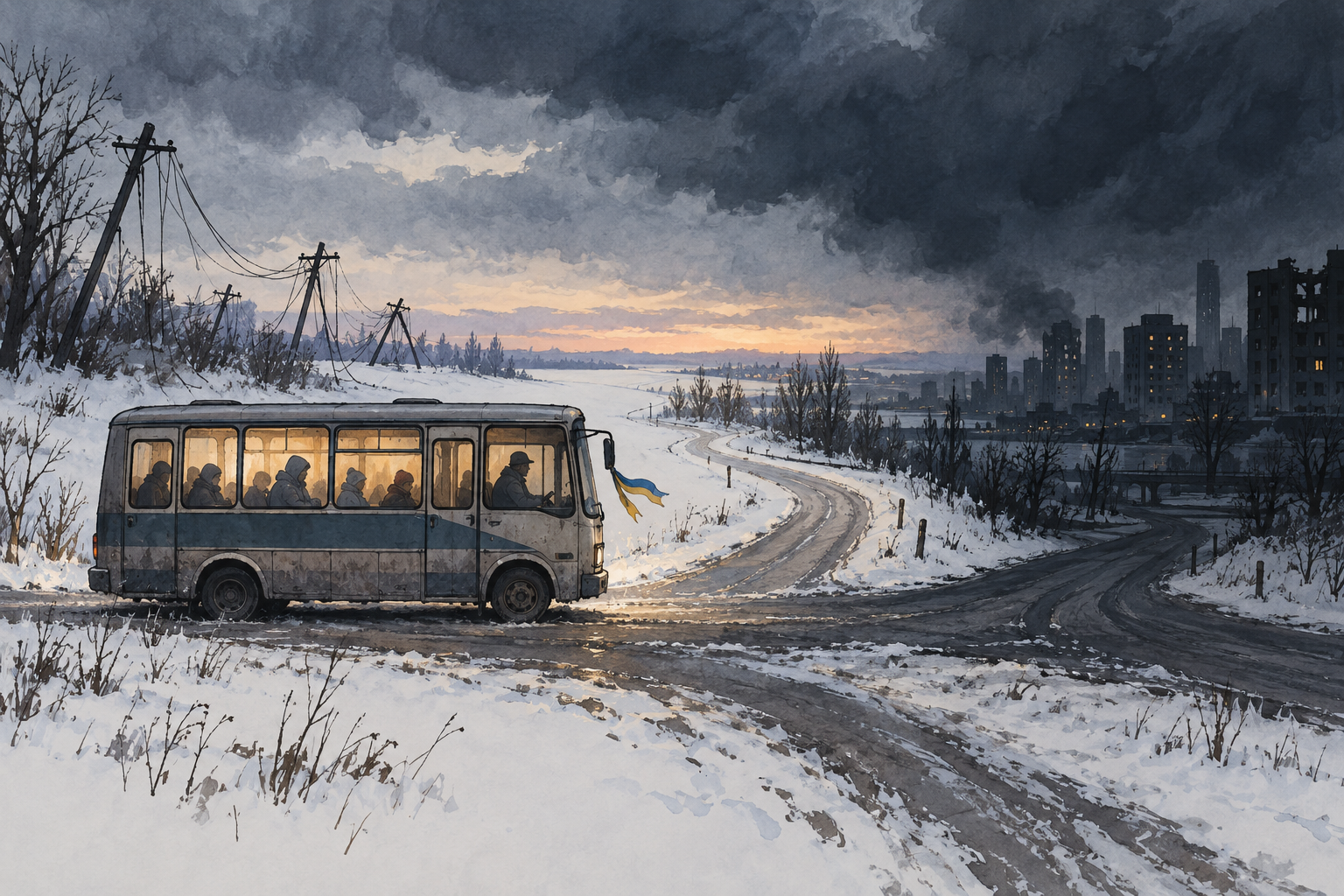
The sharpest example came in eastern Ukraine, where authorities said a Russian strike involving a public bus killed 30 people and wounded at least 18, according to the Associated Press. Reuters, citing authorities, reported at least 33 dead in Kramatorsk, where two city buses were operating near the strike site.12 Donetsk regional governor Vadym Filashkin ordered public transport halted in Kramatorsk and nearby Sloviansk, saying officials had no right to risk passengers’ and drivers’ lives.12
The decision underscores the pressure facing Ukrainian authorities before winter: keeping evacuation corridors, buses, metro stations, water pumps and electric transport running as Russia intensifies strikes on the energy grid and civilian areas. What looks like an energy campaign is also becoming a campaign against mobility — civilians’ ability to leave dangerous areas, commute to essential work, reach shelters and maintain basic services during blackouts.
Kramatorsk and Sloviansk are key cities in the Donetsk region’s defensive and humanitarian geography. They sit near the “fortress belt” of urban centers that Ukraine has relied on to slow Russian advances and support remaining civilians. Before the October 8 strike, the Donetsk Regional State Administration reported persistent shelling across the region, injuries in Kramatorsk district, damaged homes and the evacuation of 215 people, including 30 children, from frontline areas over the previous 24 hours.5
That makes the suspension of public transport more than a local safety measure. In frontline cities, buses can be lifelines for older residents, low-income households and people without cars. They also support evacuations by connecting neighborhoods to assembly points, train stations and aid hubs. But the Kramatorsk strike shows how routine movement can become a mass-casualty risk when buses, stops or crowded streets are exposed to guided bombs, missiles or drones.
Reuters reported that police said two city buses were operating at the scene and that images showed bodies in a debris-strewn street and the charred shell of what appeared to be a bus.2 AP reported that Filashkin accused Russia of deliberately targeting civilians and said transport in Kramatorsk and Sloviansk was halted because of a sharp deterioration in security.1
The dilemma is immediate: suspending public transport can reduce exposure to attacks, but it also limits mobility for people who need to evacuate, obtain food or medicine, care for relatives or reach work in hospitals, utilities and municipal services.
The transport attack followed a wider Russian missile-and-drone barrage on October 7 that hit cities across Ukraine. Reuters reported at least 32 people killed nationwide, including children, with the heaviest losses in Pryluky in Chernihiv region, where a missile destroyed a five-storey residential building.3 AP reported that the Pryluky death toll rose to 22, including five children, with at least 54 people injured.1
Residential destruction complicates evacuation choices. Some survivors in Pryluky were forced to sleep in heavily damaged apartments because they had nowhere else to go, AP reported.1 That detail captures a recurring problem in Ukraine’s struck cities: evacuation is not simply a matter of telling people to leave. It depends on transport, shelter capacity, family networks, power, communications and a credible route out.
Kyiv also came under attack. The State Emergency Service’s Kyiv unit reported fires and destruction after the overnight October 7 Russian attack, including two bodies found during firefighting in the Darnytskyi district and additional fires in Podilskyi district.4 Suspilne Kyiv reported that a daytime Russian attack on October 7 killed two people and injured 13, damaged a residential building, disrupted water supplies and affected electric transport on the city’s right bank.9
Those incidents show how Russia’s strikes can create simultaneous demands on emergency services: search and rescue at housing blocks, firefighting, unexploded ordnance response, transport rerouting, water restoration and shelter management.
The October 7-8 strikes also hit urban systems that depend on electricity. Ukrainska Pravda reported that emergency power outages were introduced in Kyiv and Kyiv Oblast on orders from Ukrenergo, and that electric public transport on Kyiv’s right bank was temporarily suspended because of insufficient voltage in overhead lines.6 In a separate report, it cited Kyiv Mayor Vitali Klitschko as saying water pumping stations had partially lost power, disrupting water supplies on the right bank.7
Suspilne Kyiv reported further transport effects: the temporary suspension of electric transport on parts of the right bank, the funicular’s suspension and altered metro service on the red line.9 Kyiv Post reported that water pressure dropped in several right-bank districts after energy-grid strikes affected water facilities, while blackouts had already become a concern months ahead of winter.8
UNN, citing Ukrenergo, reported that hourly outage schedules would apply on October 8 in some regions, with limits for industry and business, because of Russian missile-and-drone attacks on energy infrastructure.10
The cascading effect matters for civil defense. A strike on power generation or distribution does not only darken apartments. It can slow electric trams and trolleybuses, reduce water pressure, affect sewage systems, interrupt communications, complicate hospital operations and make shelters harder to heat or ventilate. In a winter campaign, those second-order effects can become strategic.
Ukraine’s air-defense problem is no longer only about protecting military sites or major power plants. The October strikes show that air-defense priorities now overlap with civilian mobility and basic urban resilience. Bus corridors, dense residential districts, substations, water pumps, heating infrastructure, metro systems and evacuation nodes all compete for protection.
Reuters reported that Russia fired 70 missiles overnight on October 7, many of them high-velocity ballistic munitions, along with dozens of Shahed drones.3 Ukraine’s air force said it downed just over 80% of 46 jet-powered drones, Reuters reported, but President Volodymyr Zelenskiy said ballistic missiles remained the major challenge and that Ukraine was seeking Patriot missile-interception systems.3
AP reported that Zelenskyy warned Russia would likely escalate daily missile and drone attacks as winter approaches and appealed for additional NATO defense support, including anti-ballistic capabilities, aircraft ammunition and interceptor investments.1
For Ukrainian planners, air defense must be judged not only by interception rates but by what remains exposed. A single missile or guided bomb that reaches a crowded street, apartment block, substation or pumping station can kill civilians and force authorities to shut down services across a city district.
Russia has repeatedly targeted Ukraine’s energy system during cold-weather periods, aiming to increase the civilian cost of resistance. The latest strikes suggest a broader form of pressure: hit power systems, then let the consequences spread into transport, water, shelter access and evacuation planning.
Kyiv Post reported that concerns are growing over the coming winter as Russia intensifies energy-grid attacks and blackouts spread in the capital.8 UNN cited Ukrenergo’s warning that the power-system situation could change because of new Russian shelling and urged consumers to use electricity sparingly when it is available.10
For frontline cities, the pressure is even more acute. If buses stop running in places like Kramatorsk and Sloviansk, civilians may be safer from one type of attack but less able to leave before the next one. If buses keep running, they remain potential casualty points in a battlespace where Russia has increased strikes on cities near the front.2
That trade-off is now central to Ukraine’s civil-defense problem before winter: resilience requires movement, but movement itself is becoming dangerous.








Comments