Gaza rebuild plan advances as ceasefire terms remain unresolved
Board of Peace
A U.S.-backed body chaired by Donald Trump that was designed to oversee the Gaza truce and reconstruction process.
Demilitarisation
In this context, the proposed removal or surrender of Hamas weapons as part of a postwar security arrangement.
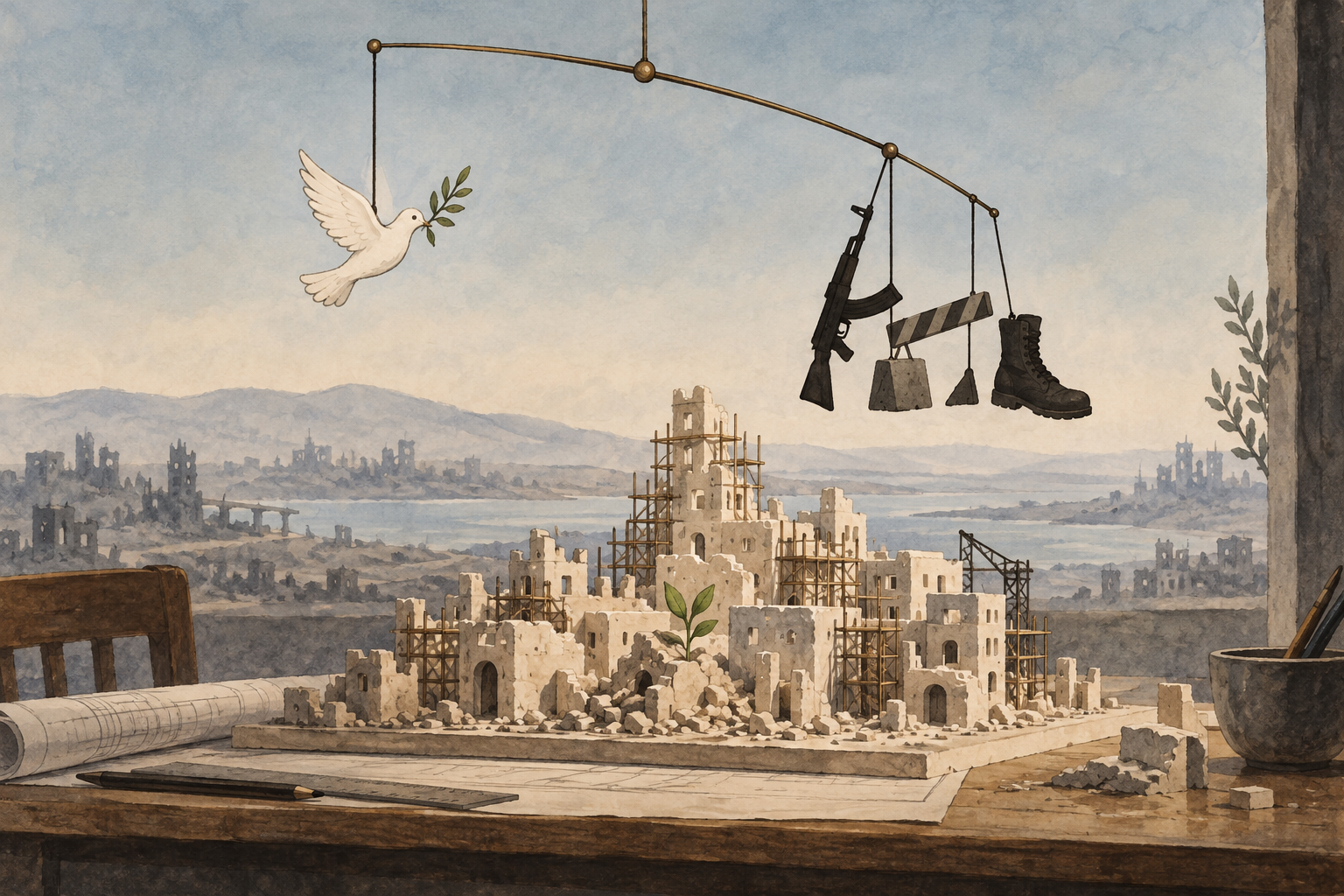
Inverted sequencing problem
A policy dilemma in which reconstruction plans are prepared before the security and governance conditions needed to implement them are in place.
Recovery needs
The estimated cost of restoring infrastructure, housing, services, livelihoods and public institutions after conflict-related destruction.
UN Trade and Development (UNCTAD)
government
UNCTAD: Gaza reconstruction needs reach $71.5 billion as Palestinian economy and public finances face severe strain
UN Trade and Development (UNCTAD)
government
Report on UNCTAD assistance to the Palestinian people: Developments in the economy of the Occupied Palestinian Territory
Al Jazeera
news
Gaza $2.45 billion reconstruction plan. Who decides its future?
Untracked bias
Bias and factuality ratings from Media Bias Fact Check. Outlets without a rating are marked “Untracked.”
Security gap
The Gaza recovery plan is advancing while Hamas disarmament and Israeli troop withdrawal terms remain unresolved.
$2.45bn plan
The Board of Peace proposal covers 66 projects over six months, including shelter, rubble removal and infrastructure.
$71.5bn need
UNCTAD estimates Gaza’s total recovery and reconstruction needs at $71.5 billion.
Trump’s Board of Peace has advanced a $2.45 billion first-phase plan to begin Gaza’s recovery, even as the security bargain needed to make reconstruction viable remains unsettled. Hamas disarmament, Israeli withdrawal terms, access controls and Palestinian governance authority all remain unresolved.347
Unveiled in New York on September 23 on the sidelines of the UN General Assembly, the plan is structured as a six-month package of 66 projects covering temporary housing, debris removal, infrastructure, public services and economic recovery.48 But its rollout highlights a central sequencing problem for diplomats and donors: Gaza’s reconstruction framework is being designed before the ceasefire’s core military questions have been settled.56
The gap between planning and implementation is stark. UN Trade and Development estimated Gaza’s recovery and reconstruction needs at $71.5 billion, making the Board of Peace proposal an initial tranche rather than a comprehensive rebuilding program.1 Board-linked estimates cited in reporting put physical damage at about $35.2 billion and full recovery at nearly $71.4 billion over the next decade.48
The Board of Peace proposal assumes demilitarisation and reconstruction can proceed in parallel. In practice, the political dispute remains over which comes first.
Hamas has linked disarmament to a process that would include Israeli troop withdrawal, while Israel says Hamas must give up its weapons before a broader pullout.7 Reports on the plan also note disagreement over whether weapons surrendered by Hamas would remain under Palestinian control or be removed entirely from Gaza. Israel opposes leaving them in Gaza, fearing they could return to militants.6
Those unresolved terms have direct operational consequences. Large-scale reconstruction requires secure movement corridors, reliable border access, clearance of unexploded ordnance and tunnels, and guarantees that rebuilding materials will not be diverted for military use.47 Without agreement on those issues, the plan functions more as a donor and governance blueprint than a start order for construction.
The Board of Peace is seeking donor support for a package that includes temporary shelter, rubble removal, humanitarian initiatives, infrastructure repair and the rebuilding of a police force.6 One report said the six-month plan includes about $275 million for rubble removal, while pledges toward wider Gaza recovery total around $18 billion.6 Jewish News, citing the BBC, reported that only $280 million had been handed over so far despite those pledges.7
That funding gap is only one constraint. Israel has continued to restrict the entry of equipment that international groups say is needed before reconstruction can begin, even after a U.S.-brokered ceasefire in October 2025.4 Hürriyet Daily News reported that 5,000 mobile units donated by Egypt and Qatar remained on the Egyptian side of the border because Israel had refused to allow them into Gaza.8
The result is a governance dilemma for donors. Money can be pledged and projects can be sequenced, but implementation still depends on decisions by parties controlling territory, weapons, crossings and policing authority.
The reconstruction push is unfolding amid continued Israeli military action in Gaza. Dawn reported that an Israeli strike hit a vehicle in western Khan Younis on September 23, killing two men and wounding two others. Israeli officials described one of the dead as a senior Hamas finance official.5 The same report said negotiators have failed to agree on Hamas disarmament and Israeli troop withdrawal, while airstrikes have continued since the ceasefire.5
CNA reported that the Board of Peace plan envisions demilitarisation in Gaza and an Israeli military pullback, but also noted that Israel has continued airstrikes and restrictions on reconstruction equipment.4 For policy planners, the recovery plan is tied not only to funding and governance design, but also to whether the ceasefire can be converted from a partial pause into an enforceable security arrangement.
UNCTAD’s latest assessment frames Gaza’s reconstruction as part of a wider Palestinian economic and fiscal crisis. The agency said recovery needs had reached $71.5 billion and cited severe strain on the Palestinian economy and public finances.1 Its related report on the occupied Palestinian territory documents damage, fiscal pressure and immediate recovery priorities, placing Gaza’s rebuilding bill within a broader economic collapse.2
CNA reported that UN figures showed 84% of Gaza’s structures had been damaged or destroyed by October 2025.4 Hürriyet said one component of the Board of Peace plan would provide caravans for about 400,000 Palestinians living in tents, while most people outside that initiative would likely remain in tents for the foreseeable future.8
That scale increases pressure to begin visible reconstruction, but it also raises the stakes of governance. Housing allocations, rubble clearance, policing, border management and infrastructure repair will all confer authority on whoever administers them. Al Jazeera described the core question around the $2.45 billion plan as one of control: how much authority Palestinians will have, and how Israeli withdrawal and Hamas disarmament will be handled.3
For now, the Board of Peace proposal gives donors and diplomats a project list, a cost frame and a political signal that Gaza’s recovery is being prepared. It does not yet resolve who will guarantee security, who will police reconstruction zones, who will control weapons surrendered under any deal, or when Israeli forces would withdraw.
That leaves the plan exposed to the same weakness that has limited the ceasefire itself: reconstruction depends on a military and governance settlement that has not been reached. Until that settlement exists, the $2.45 billion package is less a reconstruction launch than a test of whether donors, Israel, Hamas and Palestinian institutions can align money with enforceable authority on the ground.



Comments