Gaza ceasefire line hardens into postwar map
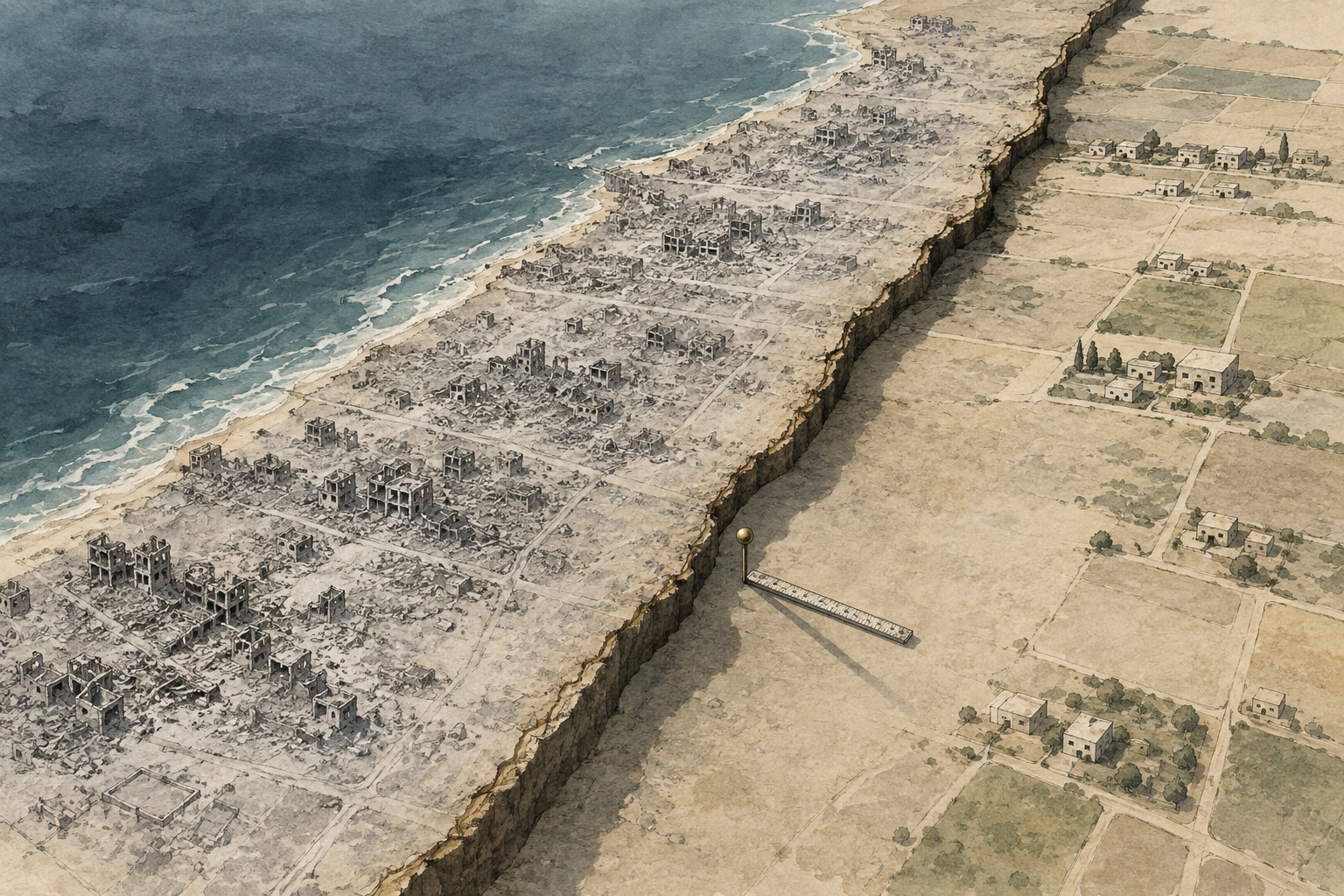
Yellow line
The ceasefire boundary behind which Israeli forces were expected to remain during the first phase of the Gaza plan; its practical position is now central to control of territory.
Facts on the ground
Physical or administrative changes — such as bases, demolitions or road networks — that can shape future negotiations by becoming difficult to reverse.
Dual-use materials
Civilian goods such as cement, steel, fuel or machinery that can also have military applications, often making them subject to security restrictions.
International Stabilization Force
A proposed temporary force intended to help secure Gaza as Hamas disarms and Israeli troops withdraw; Reuters reported it has not yet been assembled.
Associated Press
news
Israel is still demolishing towns across Gaza
Reuters via MarketScreener
news
One year on, Trump's Gaza plan has not stopped Israeli fire or disarmed Hamas
Associated Press
news
Israelis mourn Oct. 7 attack as Palestinians in Gaza languish in ruins of the war it sparked
Untracked bias
100% of tracked sources are High factuality
Bias and factuality ratings from Media Bias Fact Check. Outlets without a rating are marked “Untracked.”
Territory held
Israel controls just over 60% of Gaza, according to AP satellite analysis, while Reuters puts effective control at around two-thirds.
Rafah erased
Satellite imagery shows Rafah and other Gaza districts have been systematically razed, with demolitions continuing after the October 2025 ceasefire.
Rebuild stalled
Large-scale reconstruction remains blocked because Israel and Hamas have not reached a deal on Hamas disarmament and Israeli withdrawal.
Israel’s continued demolition of Rafah and other Gaza districts is turning the October 2025 ceasefire line into a durable postwar geography, even as large-scale combat remains reduced. An Associated Press satellite analysis published Oct. 7 found that Rafah, once home to about 250,000 people, has been largely erased. Bulldozing and explosive demolitions have continued after the ceasefire, while Israel retains control over just over 60% of Gaza.1
Israel presents the military logic as a security requirement: preventing Hamas from reusing buildings, tunnels and launch areas. But the cumulative effect is political as well as tactical. Land that is cleared, depopulated, cut by military tracks and punctuated with outposts becomes harder to return to civilian life, harder for any Palestinian authority to govern and harder to include in a near-term reconstruction plan.
The result is a ceasefire that has stopped the war’s heaviest phase while allowing the physical terms of Gaza’s future to keep changing.
Reuters reported a similar picture on the first anniversary of the ceasefire framework: President Donald Trump’s Gaza plan has stalled, Israeli forces occupy around two-thirds of the enclave, and the central bargain — Hamas disarmament in exchange for Israeli withdrawal and reconstruction — remains unresolved.2 That stalemate is giving facts on the ground time to accumulate.
The ceasefire’s practical boundary began as a security line. Reuters reported that the initial phase of the plan envisaged Israeli forces holding 53% of Gaza along the so-called yellow line, but that Israeli effective control has since expanded to around two-thirds of the territory.2 AP’s satellite analysis, which puts Israeli control at just over 60%, documents the same broad trend: the Israeli-held side is not merely occupied; it is being reconfigured.1
In that zone, AP found that most buildings in the Israeli-held part of Gaza have been bulldozed or blown down, much of it after major fighting ended. Planet Labs imagery reviewed by AP also showed at least 50 Israeli military outposts in the Israeli-held area, including at least 18 built after the ceasefire began.1
Those outposts matter because they turn a ceasefire deployment into infrastructure. Even if formally temporary, bases, cleared approaches and demolished surroundings create military depth and surveillance corridors that can outlast the diplomatic language that produced them.
Rafah is the clearest case. Much of the city was razed before the ceasefire, but AP reported that Israeli troops have continued demolishing remaining structures. Similar patterns appear in Bani Suheila, Jabaliya, Beit Hanoun and Shijaiyah, where former neighborhoods are now described through satellite imagery as rubble fields, dirt paths and cleared space.1 AP’s regional roundup on Oct. 7 also highlighted Rafah’s destruction, noting that demolition with bulldozers and explosives has continued since the ceasefire deal was reached a year earlier.6
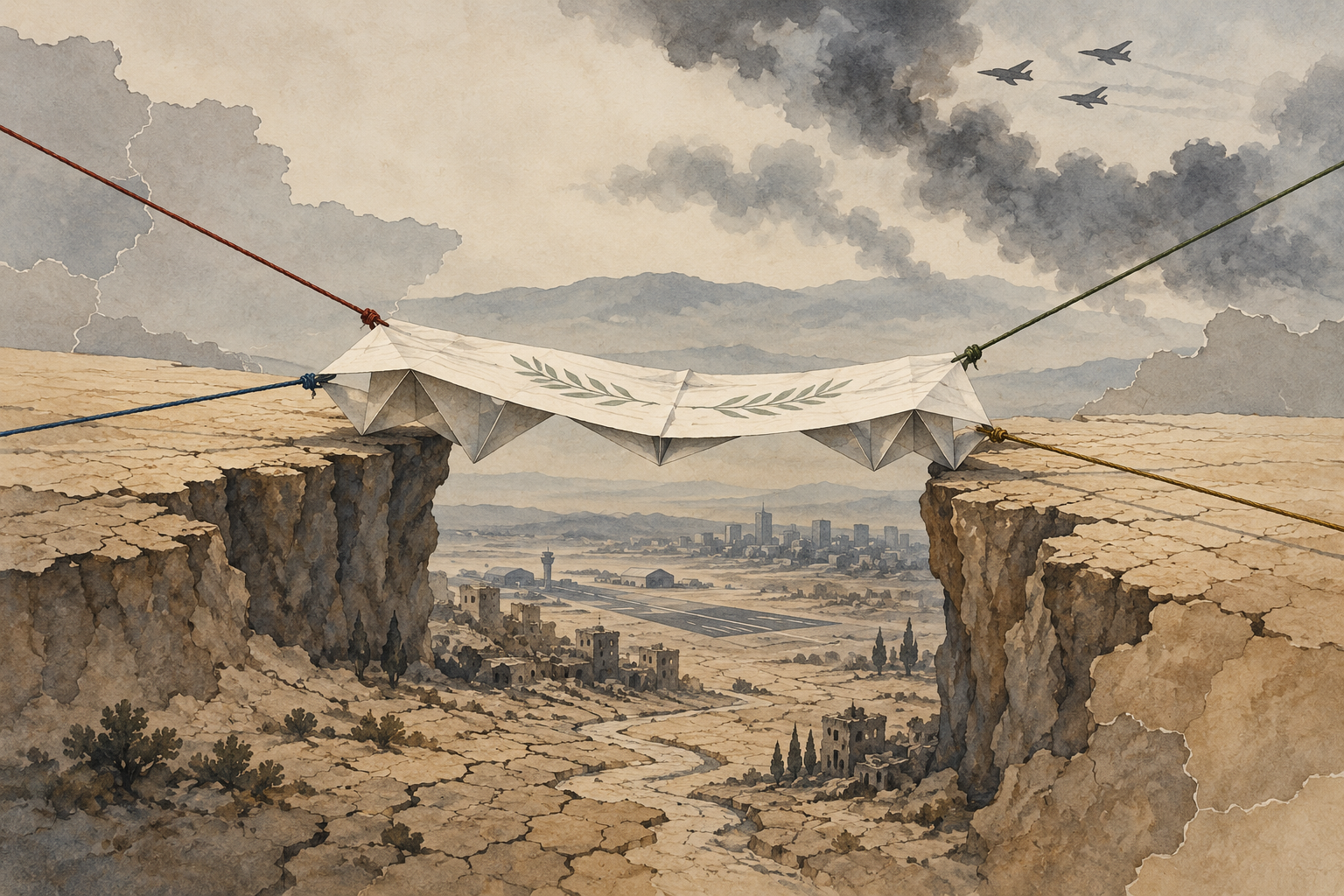
The key diplomatic bottleneck is not only the scale of destruction. It is the sequencing problem at the center of the ceasefire plan: Israel says Hamas must fully disarm before it withdraws; Hamas has signaled willingness to place weapons under a U.S.-backed Palestinian technocratic government but rejects the term disarmament; and the international force meant to secure Gaza has not yet been assembled.2
That deadlock has frozen reconstruction. AP reported that few Palestinians can rebuild because Israel bars most construction material from entering Gaza. The ceasefire agreement’s large-scale reconstruction plan has not started because Israel and Hamas have failed to reach a disarmament deal.1 Reuters reported that a $2.45 billion initial rebuilding plan announced in September is only a fraction of an estimated $71.4 billion in recovery and reconstruction needs over the next decade.2
The dispute has immediate material consequences. Reconstruction requires cement, steel, machinery, fuel, engineers, access routes and predictable security. Israel views many of those inputs as dual-use items Hamas could exploit militarily. Palestinians and aid agencies argue that without them Gaza remains unlivable. In practice, the unresolved arms question has become a veto over rebuilding civilian space.
The United Nations framed the same transition failure in its Oct. 6 anniversary message. Secretary-General António Guterres said the 2025 ceasefire had brought relief but had not delivered security, adequate humanitarian assistance or a credible path to recovery and peace.7 That assessment captures the current paradox: the ceasefire is real enough to reduce the intensity of war, but not strong enough to launch a political or physical recovery.
For Gaza’s roughly 2 million Palestinians, the emerging map is one of compression. AP reported that the population is squeezed into about 40% of the territory while Israel controls the rest.1 Reuters described the advancing line as uprooting more Palestinians and pushing them into a narrowing coastal strip of tents and damaged buildings.2
The humanitarian consequences are visible across multiple reports. AP’s Oct. 7 anniversary coverage said most Palestinians in Gaza remain displaced, many living in tents amid widespread destruction, and that more than 74,000 Palestinians have been killed since the war began, according to Gaza’s Health Ministry.3 The same report said the Oct. 10, 2025, ceasefire halted the heaviest fighting, but Israeli strikes have continued. According to the ministry, 1,460 Palestinians have been killed since the ceasefire; five Israeli soldiers were killed in attacks in the same period.3
For security readers, population concentration is not just a humanitarian issue. Dense displacement zones complicate policing, aid distribution and intelligence collection. They can strengthen armed groups’ ability to hide among civilians while making civilian casualties more likely when strikes continue.
At the same time, cleared Israeli-held areas reduce the number of civilians near Israeli forces and border communities. But they also remove the civilian and administrative fabric needed for any future Palestinian governance.
The durability of the new geography is also tied to Israeli public opinion after Oct. 7. AP reporting from Israeli border communities found that many residents still see Palestinians in Gaza primarily as a threat three years after the Hamas-led attack that killed about 1,200 people and saw 251 abducted.4 From Sderot, Israelis can look across at destroyed Beit Hanoun, where AP described tilted buildings in rubble and military activity as the main visible movement.4
Those perceptions help explain why territorial consolidation has limited domestic political cost. AP reported that Israel’s military controls over 60% of Gaza while public criticism of the treatment of Palestinians in Gaza remains limited in many Israeli communities near the border.4 A separate AP election analysis found that Gaza’s death toll, humanitarian catastrophe, lack of reconstruction and peace talks are largely missing from Israeli campaign debate, which is dominated by Oct. 7, responsibility for the attack and Netanyahu’s leadership.5
That political context reduces pressure on Israeli leaders to trade territorial control for diplomatic progress before disarmament is resolved. It also means the ceasefire line may become harder to reverse the longer it is associated in Israeli politics with restored security.
Future governance plans assume that someone other than Hamas can administer Gaza. Reuters reported that a technocratic Palestinian governing body has been appointed but has yet to enter Gaza, while the International Stabilization Force has commitments from several countries but has not been assembled.2 Those arrangements depend on access, legitimacy and a recoverable urban environment.
The terrain now works against all three. A governing authority cannot easily operate in districts where homes, schools, hospitals and municipal infrastructure have been destroyed. An international force cannot assume responsibility for territory if withdrawal conditions remain undefined. Donors cannot fund reconstruction at scale if materials are blocked and rebuilt areas could again become contested.
This is how a ceasefire line becomes a postwar map: not through formal annexation or a final-status agreement, but through cumulative decisions about demolition, access, aid, bases, patrol routes and what is allowed to be rebuilt. Each delayed negotiation makes the physical landscape more determinative.
The immediate benefit of the ceasefire is that Gaza has not returned to the highest levels of conventional combat. But the strategic risk is that the absence of a political transition allows military geography to substitute for policy.
Israel gains buffers and cleared zones. Hamas avoids formal surrender of its arms. Palestinians remain concentrated in devastated areas. Outside actors are left trying to finance recovery without control over the conditions that make recovery possible.
For Middle East security planners, the question is no longer only whether the ceasefire holds. It is what the ceasefire is holding in place. If demolition, military construction and blocked reconstruction continue while disarmament talks stall, the temporary line will increasingly define who can live where, who can govern what and what parts of Gaza can plausibly be rebuilt.




Comments