Gaza’s school reopening tests ceasefire recovery
Board of Peace
A U.S.-backed body linked to President Donald Trump’s Gaza ceasefire framework and proposed reconstruction plan.
Emergency education
Temporary schooling provided during or after crises, often in tents, shelters or improvised classrooms when regular schools are damaged or inaccessible.
Educational loss
The learning gaps children accumulate when schooling is interrupted for long periods, especially when they lack books, teachers, electricity or internet access.
Palestinian Information Center
news
Gaza returns to education without schools: Overcrowding, missing desks, and fears of a lost generation
The Daily Jagran
news
‘We Will Learn In A Tent’: Over 5.4 Lakh Gaza Students Start New Academic Session After Three Years
ABC News / Associated Press
news
Trump's Board of Peace proposes $2.45 billion blueprint to begin Gaza reconstruction
Untracked bias
Bias and factuality ratings from Media Bias Fact Check. Outlets without a rating are marked “Untracked.”
540,000 students
More than 540,000 Gaza students have begun the new academic session after nearly three years without regular in-person schooling.
Damaged schools
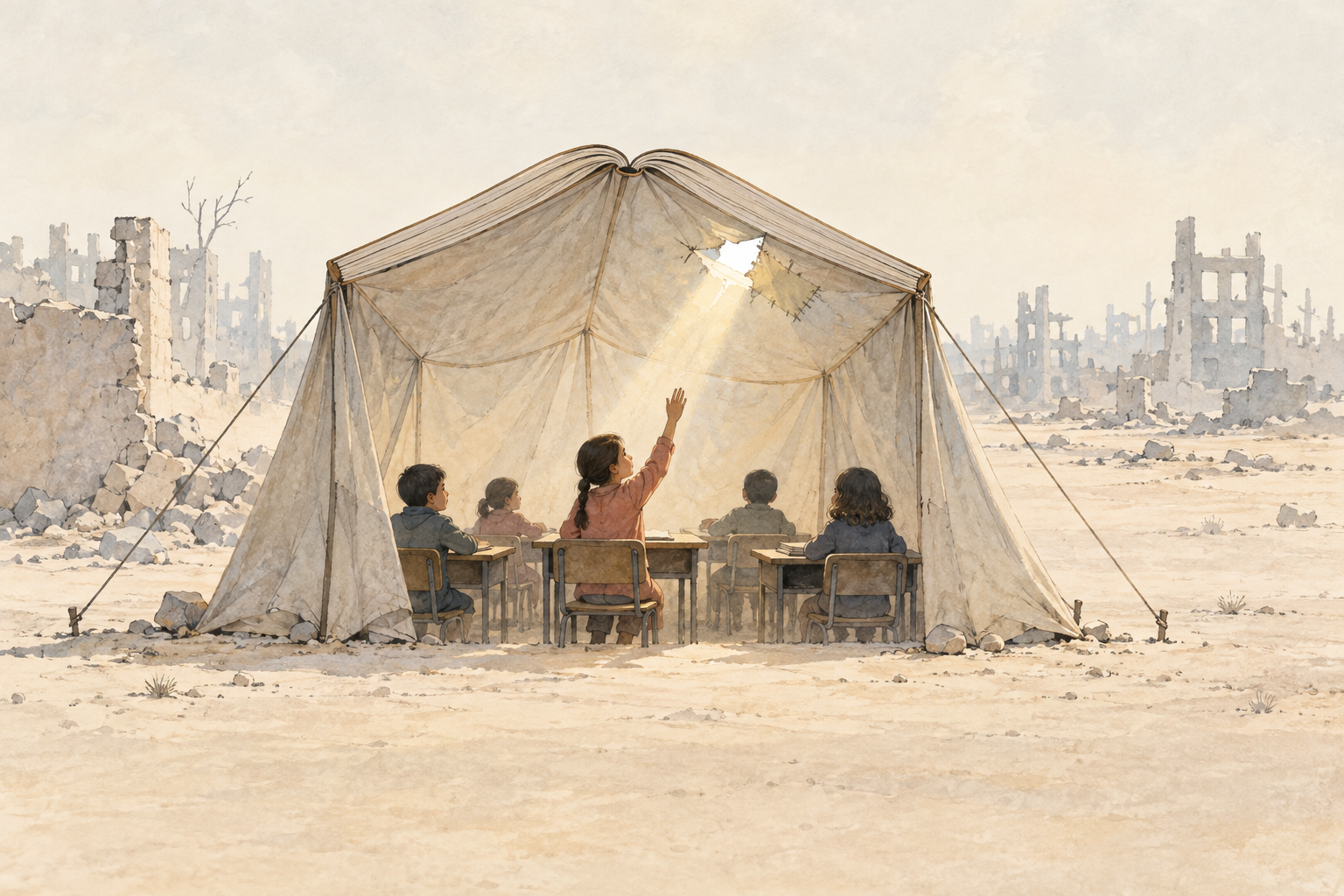
Reports from Gaza describe classes in tents, damaged buildings and overcrowded rooms, with desks, books and stationery in short supply.
$2.45bn plan
A U.S.-backed reconstruction proposal would fund 66 projects over six months, but Gaza’s longer-term rebuilding needs are estimated in the tens of billions.
Hundreds of thousands of children in Gaza have returned to in-person classes for the first time in nearly three years, marking a major humanitarian milestone while underscoring how far civilian recovery remains from the reconstruction promises made since the ceasefire took hold last October.
More than 540,000 students have started the new academic session, according to reports citing local education officials and aid agencies. Many classes are being held in tents, temporary learning centres or damaged buildings after years of war left much of Gaza’s education system unusable.2
The return has restored some routine for children who spent much of the conflict displaced, bereaved or out of school. But for many families, reopening is less a sign of recovery than a test of whether the ceasefire is delivering anything beyond the absence of full-scale fighting.
Reports from Gaza describe classrooms without enough desks, books or stationery; students sitting on the floor; and schools still partly used as shelters for displaced families.1 Some classes have 50 to 60 pupils, and in some locations around 70, according to testimonies collected by the Palestinian Information Center.1 For households already struggling with food, rent and transport, even basic school supplies have become difficult to afford.
The reopening comes as international officials promote a U.S.-backed reconstruction framework. The Board of Peace has proposed a six-month, $2.45 billion plan covering 66 projects, including infrastructure, education, health, housing and governance initiatives.3 But the plan’s backers acknowledge that full reconstruction needs are far larger: about $35.2 billion in the medium term and $71.4 billion over the next decade.5
The new school year began in Gaza on September 19, after an interruption of nearly three years, according to the Palestinian Information Center.1 Education officials and aid groups have turned to temporary spaces made from tents, wood and sheet metal to absorb students while schools are repaired or cleared of non-educational uses.2
For children, the return is both symbolic and practical. One student quoted in a Reuters-based Daily Jagran report said pupils were determined to learn even in tents, while also describing a lack of shoes, notebooks and pens.2 The testimony captures the central tension of the reopening: children are gathering for lessons again, but often without the minimum conditions needed for safe, regular education.
The damage is severe. The Palestinian Information Center cited international reports indicating that about 98% of Gaza’s schools were destroyed or damaged during the war, while about 660,000 students were deprived of regular classroom learning for long periods.1 The Daily Jagran report, citing officials, said about 90% of school buildings had been damaged or destroyed and that more than 22,000 students and hundreds of teachers were killed.2
That means reopening is not simply a matter of unlocking school gates. It requires replacing classrooms, furniture, sanitation, electricity, teaching materials and trained staff in a territory where many public buildings are damaged and many families remain displaced.
The classroom return is unfolding alongside high-level pledges to rebuild Gaza. The Board of Peace proposal, unveiled on the sidelines of the U.N. General Assembly, includes education and health initiatives as part of a wider effort to support President Donald Trump’s 20-point ceasefire plan.3 Axios reported that the blueprint includes temporary housing, rubble and unexploded ordnance clearance, hospital repairs, road work, restoration of water and electricity systems, and roughly $300 million for health, education and welfare programmes.4
The Times of Israel, citing a Board of Peace official, reported that the plan would include repairs to roads, homes, schools, hospitals, ports and crossings, as well as expanded fuel and food deliveries and upgraded communications.6 The National reported that the first phase is intended to address urgent needs while laying the groundwork for longer-term reconstruction and governance.5
But on the ground, the education system remains in emergency mode. The Palestinian Information Center reported that some schools or parts of schools are still being used for shelter and humanitarian services, forcing education authorities to balance classroom needs against the housing needs of displaced families.1 In some temporary schools, children study on the ground or write on improvised materials because desks and stationery are unavailable.1
That gap between blueprint and reality is central to the ceasefire’s humanitarian credibility. The Associated Press report carried by ABC News said the U.S.-backed plan has largely stalled: reconstruction has not begun, the international force and new government have not entered Gaza, and most Palestinians continue to live in tents or the ruins of former homes.3
Nearly a year after the October 10, 2025 ceasefire took effect, Gaza’s classrooms are becoming one of the clearest measures of civilian recovery. Schools are where several parts of reconstruction intersect: housing, because displaced families still shelter in education facilities; infrastructure, because children need water, sanitation and electricity; health, because overcrowding increases risks; and protection, because classrooms can restore supervision and routine.
Humanitarian agencies have long warned that school closures deepen risks for children beyond academic loss. A UNFPA analysis covered by Moneycontrol linked Gaza’s broader deterioration — hunger, displacement, poverty, school closures and weakened protection systems — to increased risks facing women and girls, including a reported rise in forced and child marriage.7 The report underscores that reopening classrooms alone cannot resolve Gaza’s protection crisis, but it can help restore social structures eroded during the war.
The challenge is that temporary schooling can become a prolonged substitute if reconstruction remains delayed. Gaza educators and parents cited by the Palestinian Information Center warned that tents, overcrowded rooms and remote learning cannot replace a functioning school system, especially for children who have already lost years of regular instruction.1
The return to in-person learning is both a humanitarian achievement and a warning. It shows that families, teachers and aid workers are trying to restore daily life despite severe shortages. It also shows that the ceasefire’s benefits remain fragile and uneven.
For reconstruction planners, the immediate test is whether pledges become desks, books, repaired classrooms, safe water, sanitation and salaries for teachers. For Gaza’s children, the test is more direct: whether the first school year after three years of disruption becomes the start of educational recovery, or another emergency arrangement that stretches indefinitely.






Comments