Hormuz talks hinge on sequencing as Iran’s rial hits new low
Strait of Hormuz
A narrow waterway between Iran and Oman that is critical to global oil and gas shipments from the Persian Gulf.
Frozen funds
Iranian assets held abroad that Tehran cannot freely access because of sanctions or banking restrictions.
IAEA inspections
Monitoring by the International Atomic Energy Agency intended to verify whether a country’s nuclear program remains within agreed limits.
Sequencing
The order in which each side takes steps in a deal, often the hardest part of negotiations when trust is low.
Associated Press
news
Mediators are working to broker a US-Iran deal, but major hurdles remain
Associated Press
news
Iran's currency hits a new record low as war erodes the country's economic stability
Axios
news
Trump willing to ease sanctions and unfreeze assets in exchange for Iran nuclear concessions
Untracked bias
100% of tracked sources are High factuality
Investing.com
US, Iran set to hold separate talks with mediators on Monday or Tuesday, official says
The Independent
Trump trolls Iran by renaming the Strait of Hormuz shipping route after himself
Bias and factuality ratings from Media Bias Fact Check. Outlets without a rating are marked “Untracked.”
Hormuz sequence
The proposed order starts with reopening the Strait of Hormuz, then lifting the U.S. blockade, followed by possible economic relief tied to nuclear steps.
Rial record
Iran’s currency fell to a new record low, with reports placing it past 2.5 million rials to the dollar.
Verification fight
Washington wants concrete nuclear concessions and renewed inspections before sanctions relief or frozen funds are released.
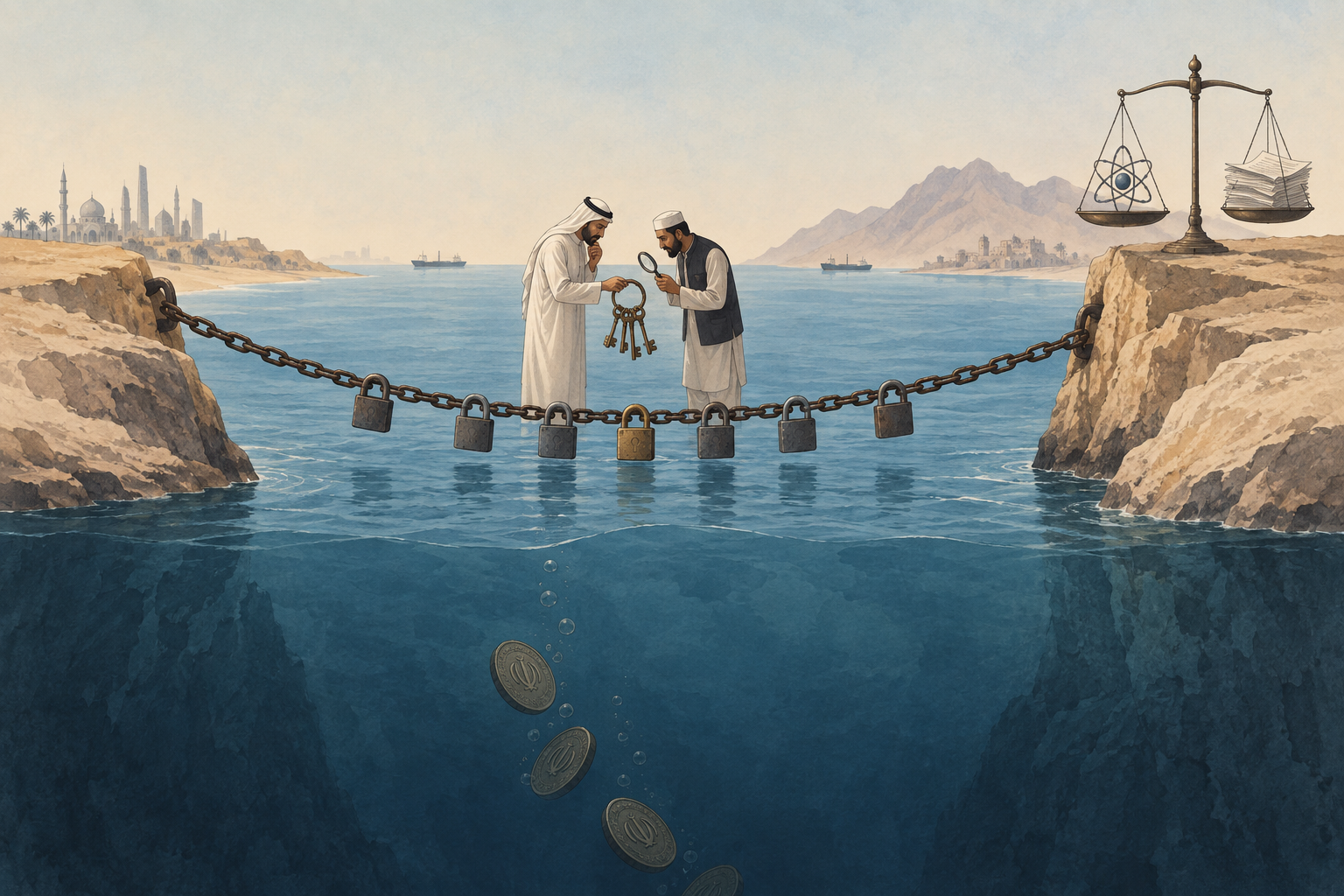
Qatari and Pakistani mediators are still working with Washington and Tehran on a possible deal to reopen the Strait of Hormuz, despite President Donald Trump’s public rejection of an Iranian proposal. The effort continues as Iran’s currency falls to another record low under the combined pressure of war, sanctions and restricted trade.12
The emerging diplomatic package links two urgent fronts that had been treated separately during the conflict: restoring access through one of the world’s most important oil chokepoints and restarting credible oversight of Iran’s nuclear program. According to reporting on the talks, the sequence under discussion would begin with Iran reopening the strait, followed by the United States lifting its blockade. Potential sanctions relief, access to frozen Iranian funds and other economic steps would then be tied to nuclear concessions and inspections.13
That order is now the central dispute. Tehran wants fast, front-loaded economic relief after any move on Hormuz. Washington wants concrete nuclear steps, including renewed verification, before easing sanctions or releasing frozen assets.36 The result is a fragile bargain in which energy security, military de-escalation, sanctions policy and nuclear monitoring are being negotiated as one package.
The first step would be reopening the Strait of Hormuz, the narrow waterway between Iran and Oman through which a major share of seaborne oil and liquefied natural gas moves. Reopening it would be the clearest de-escalatory move and the strongest signal to energy markets that the conflict no longer poses an immediate threat to Gulf exports.1
The second step would be lifting the U.S. blockade, according to the reported framework. That would test whether Washington is willing to reduce military and economic pressure quickly once maritime access is restored.1
The third layer would involve sanctions relief, oil-related waivers and access to frozen Iranian funds. U.S. officials cited in multiple reports have described those measures as possible only after concrete Iranian nuclear steps. Trump, meanwhile, has publicly denied offering financial relief to Tehran, calling the reporting false and saying he offered Iran nothing.357
The final and most politically sensitive piece is nuclear verification. Washington wants International Atomic Energy Agency inspectors back at Iranian facilities, along with evidence that Iran is making measurable concessions before major economic benefits are delivered.6 Iran has framed the talks as a rapid implementation package and has engaged Qatari mediators while resisting a process that would require it to make the most sensitive concessions before receiving sanctions relief.4
The biggest hurdle is trust over timing. If Iran reopens Hormuz first, Tehran risks surrendering its strongest immediate leverage before receiving economic relief. If the United States lifts pressure first, Washington risks giving Iran benefits without verified nuclear limits.13
A second sticking point is the U.S. demand for nuclear verification. The return of inspectors is not just a technical issue. It would determine whether Washington can argue that any sanctions relief is tied to measurable nuclear restraint, rather than a concession extracted by Iranian pressure in Hormuz.6
A third obstacle is Trump’s public messaging. Reports that the White House was willing to consider sanctions relief and unfreezing assets have collided with Trump’s denial that he made such an offer. That has created uncertainty over whether mediators are carrying a firm U.S. proposal or testing ideas that remain politically contested in Washington.37
A fourth challenge is Iran’s deteriorating economy. The rial’s latest record low — reported as falling past 2.5 million rials to the dollar — raises pressure on Tehran to secure relief. It may also harden Iranian demands for rapid access to funds, oil waivers and sanctions easing.28
The currency slide gives the talks added urgency. Iran’s economy was already strained by years of sanctions, and the war has deepened instability by disrupting expectations for trade, investment and access to hard currency.2 A weaker rial increases import costs, fuels inflation and can worsen public anxiety about the government’s ability to manage the crisis.
For Washington, that pressure is leverage. For Tehran, it is also a reason to insist that any deal cannot stop at reopening Hormuz or symbolic de-escalation. Iranian officials are seeking relief that would be felt in access to funds, oil sales and currency stability, not just a reduction in military pressure.24
The talks now appear less like a cease-fire channel and more like a sequencing negotiation: which side moves first, what counts as proof and when economic relief begins. That makes the mediation effort both more ambitious and more vulnerable.
A narrow deal could restore traffic through Hormuz and reduce the immediate risk to Gulf energy flows. A broader deal would require agreement on sanctions relief, frozen funds and nuclear inspections — issues that have repeatedly broken U.S.-Iran diplomacy even in less volatile moments.16
For now, the mediators’ task is to convert battlefield leverage into synchronized steps. The longer that takes, the more Iran’s economic crisis and Washington’s verification demands are likely to pull the package in opposite directions.






Comments