India uses first BIMSTEC home ministers’ meeting to deepen Bay of Bengal security cooperation
BIMSTEC
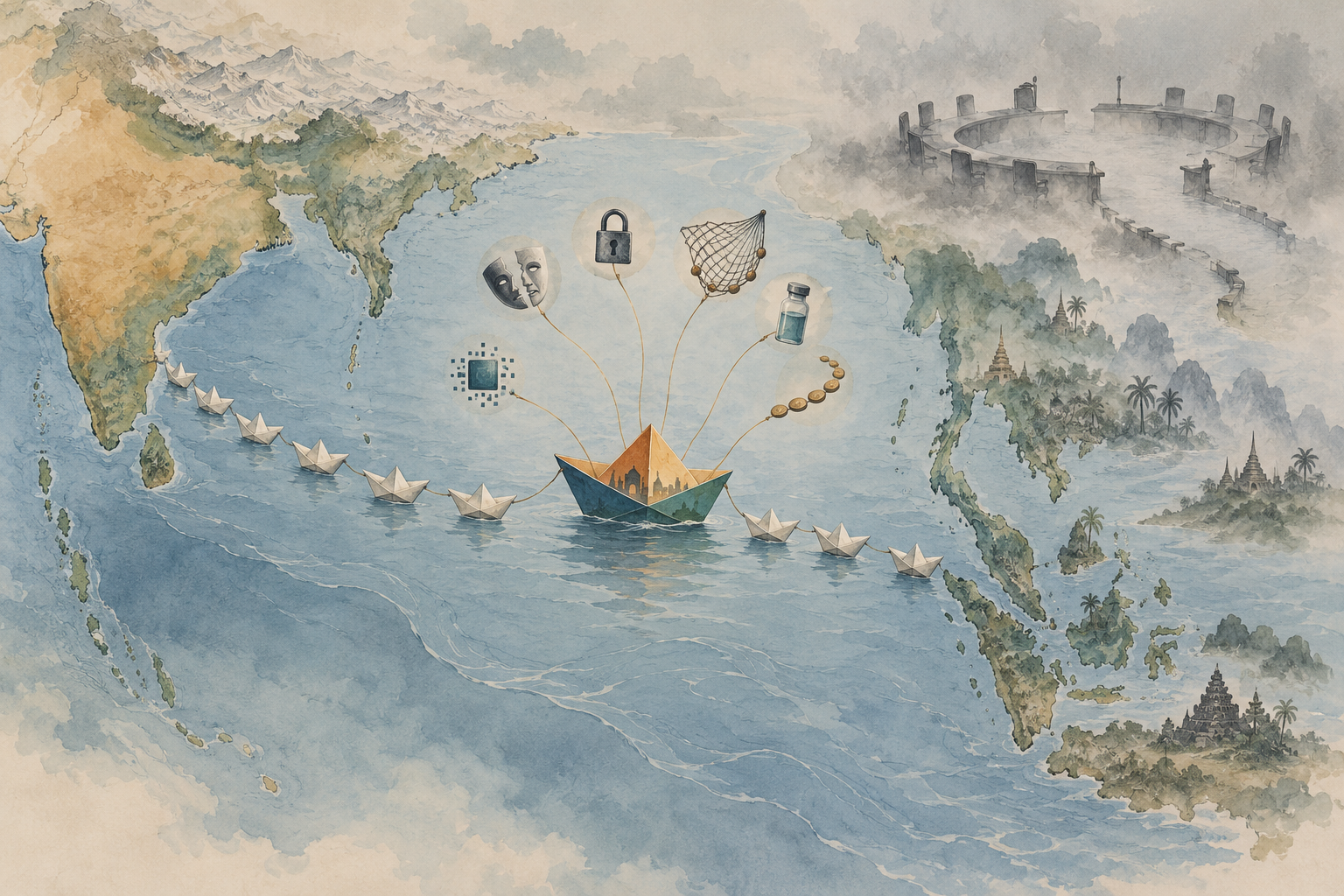
The Bay of Bengal Initiative for Multi-Sectoral Technical and Economic Cooperation links Bangladesh, Bhutan, India, Myanmar, Nepal, Sri Lanka and Thailand.
SAARC
The South Asian Association for Regional Cooperation includes Pakistan and has struggled to function because of India-Pakistan tensions.
Mutual legal assistance
A formal process by which countries help one another gather evidence, share records or support criminal investigations.
Illicit financial flows
Money moved across borders illegally, often connected to corruption, tax evasion, organized crime, terrorism or sanctions evasion.
Press Information Bureau, Government of India
government
First BIMSTEC Home Ministers’ Meeting concludes with adoption of Delhi Declaration
Press Information Bureau, Government of India
government
Union Home Minister and Minister of Cooperation Shri Amit Shah says India is honored to host the First BIMSTEC Home Ministers’ Meeting in New Delhi
ThePrint / PTI
news
BIMSTEC approves Delhi Declaration with focus on combating cross-border terror, other issues
Untracked bias
The New Indian Express
India to host first-ever BIMSTEC home ministers’ meeting in New Delhi
DD India
Ensure terror networks do not find haven in region: Amit Shah to BIMSTEC countries
ThePrint
India will host first BIMSTEC Home Ministers’ Meeting in Delhi on Oct 13: Amit Shah
India Today
BIMSTEC Delhi Declaration targets cross-border terrorism, trafficking and cybercrime
The Economic Times
India to host first BIMSTEC Home Ministers' Meeting on October 13, says Amit Shah
Business Standard
Ensure terror networks do not find haven in region: Shah to Bimstec nations
Hindustan Times
Ensure terror networks do not find haven in region: Shah to BIMSTEC countries
Hindustan Times
Bangladesh home minister Salahuddin Ahmed to skip BIMSTEC meeting in New Delhi
Prothom Alo
Bangladesh Home Minister skipping BIMSTEC's first Home Ministers' meeting in Delhi
Mint
Bangladesh Home Minister skips first BIMSTEC meet in Delhi: What it means for India ties
The Kathmandu Post
Nepal, India discuss border security, transnational crime and disaster response
The Kathmandu Post
Home Minister Sudan Gurung heads to India for first BIMSTEC security talks
Daily Excelsior
Ensure Terror Networks Do Not Find Haven In Region: Shah To BIMSTEC Countries
The News Now
Ensure terror networks do not find haven in region: HM Shah to BIMSTEC countries
Daily Pioneer
India to host first BIMSTEC Home Ministers’ meeting in New Delhi on October 13
Bias and factuality ratings from Media Bias Fact Check. Outlets without a rating are marked “Untracked.”
Delhi Declaration
BIMSTEC home ministers adopted a declaration targeting terrorism, organized crime, narcotics, trafficking, money laundering and cybercrime.
Seven members
The forum links Bangladesh, Bhutan, India, Myanmar, Nepal, Sri Lanka and Thailand across the Bay of Bengal.
Five initiatives
Ministers approved initiatives on trafficking, drug control, money laundering and terror financing, illicit financial flows and disaster preparedness.
India hosted the first BIMSTEC Home Ministers’ Meeting in New Delhi on October 13, with member states adopting a Delhi Declaration that casts the Bay of Bengal as a shared security space and commits governments to closer cooperation against terrorism, transnational organized crime, narcotics, trafficking, money laundering and cybercrime.1
The meeting brought together the seven members of the Bay of Bengal Initiative for Multi-Sectoral Technical and Economic Cooperation: Bangladesh, Bhutan, India, Myanmar, Nepal, Sri Lanka and Thailand.1 For New Delhi, the new home-ministers track gives BIMSTEC a more operational security role, linking India’s eastern neighborhood and Southeast Asian gateway through a forum that excludes Pakistan and bypasses the political deadlock that has limited SAARC’s usefulness for regional security coordination.
The Delhi Declaration says BIMSTEC security cooperation rests on sovereign equality, territorial integrity, non-interference and mutual benefit. It recognizes that terrorism, violent extremism, drug trafficking, cybercrime, money laundering, human trafficking, arms smuggling, piracy, illegal migration and online misuse have regional and transnational dimensions.1 It also says security and development are interlinked, reflecting India’s effort to present crime control and counterterrorism as prerequisites for connectivity, trade and regional resilience.1
The new mechanism builds on earlier BIMSTEC decisions. The 2018 Kathmandu summit called for home-minister-level meetings, alongside meetings of national security advisers and chiefs, to promote cooperation on counterterrorism and transnational crime. The 2025 Bangkok summit welcomed the establishment of the Home Ministers’ Meeting mechanism to provide strategic direction in the security sector.1
India’s home minister, Amit Shah, previewed the meeting as a venue for coordinated action on terrorism, cross-border organized crime, narcotics, radicalization, trafficking, illicit financial flows and cyber threats.2 The Economic Times reported before the meeting that home ministers and delegations from BIMSTEC countries were expected to attend and discuss those shared security challenges.5
The agenda went beyond counterterrorism. ThePrint, citing the post-meeting statement, reported that BIMSTEC approved cooperation on information sharing, mutual legal assistance and extradition. It also backed agreements and action plans covering trafficking, drug control, money laundering, terror financing, illicit financial flows and disaster preparedness.3 The Tribune reported that Shah emphasized timely intelligence sharing, financial investigations, mutual legal assistance and extradition as tools to bring criminals and terrorists to justice.4
Reports on the meeting identified five regional security initiatives approved by the home ministers: a convention against trafficking in persons; an action plan on drug control; a memorandum of understanding on capacity-building to combat money laundering and terror financing; a plan of action on illicit financial flows; and a plan for disaster preparedness and coordination in the Bay of Bengal region.34
The trafficking convention is aimed at prevention, criminalization, victim protection and rehabilitation. The drug plan targets narcotic drugs, psychotropic substances and precursor chemicals.3 The money-laundering and terror-financing framework covers financial intelligence, investigations, asset recovery, anti-money-laundering measures and countering the financing of terrorism.3 The disaster plan includes regional risk planning, joint exercises, early-warning systems, disaster mapping, training centers, information sharing, research, technological innovation and tsunami-risk reduction.3
The Delhi Declaration also calls for full implementation of the BIMSTEC Convention on Combating International Terrorism, Transnational Organized Crime and Illicit Drug Trafficking, which entered into force in March 2021, and the BIMSTEC Convention on Mutual Legal Assistance in Criminal Matters, signed at the 2022 Colombo summit.1 It encourages early finalization of conventions on extradition, transfer of sentenced persons and trafficking in persons, as well as standard operating procedures for rescue, repatriation and reintegration of trafficking victims.1
The strategic significance lies in BIMSTEC’s geography. The grouping links South Asia’s eastern arc with mainland Southeast Asia through the Bay of Bengal, including Myanmar and Thailand, both central to India’s connectivity and security interests to the east. Unlike SAARC, which includes Pakistan and has been immobilized by India-Pakistan tensions, BIMSTEC gives New Delhi a platform for regional security cooperation without requiring consensus from Islamabad.
That does not mean the forum is free of politics. The Business Standard in Bangladesh reported that Bangladesh’s home minister did not attend the inaugural meeting and was represented by a senior home ministry official amid strained Dhaka-Delhi ties over former prime minister Sheikh Hasina.7 The outlet’s post-meeting report said Bangladesh, Bhutan, Nepal, Myanmar, Sri Lanka, Thailand and India were represented by ministers and senior officials, and that the Delhi Declaration committed members to stronger security cooperation.6
Myanmar’s participation also underscores the complexity of using BIMSTEC as a security platform. The country sits between South and Southeast Asia and is central to trafficking, narcotics, border insurgency and cyber-scam networks, but its internal conflict and international isolation complicate regional law-enforcement cooperation. The Delhi Declaration’s language on sovereignty, non-interference and national legal frameworks reflects those sensitivities while still pushing for information sharing and capacity-building.1
The meeting also served as a platform for bilateral security diplomacy. Nepal’s Home Minister Sudan Gurung met Shah on the sidelines, with the two sides discussing border security, transnational crime and disaster response, according to The Kathmandu Post.8 The report noted that Nepal and India are seeking closer coordination along their 1,850-kilometer open border, where longstanding passport-free movement supports social and economic ties but also creates challenges involving smuggling, trafficking and criminal networks.8
That sideline engagement illustrates how New Delhi appears to be using BIMSTEC: not only as a summit-level diplomatic grouping, but also as an institutional frame for practical cooperation on policing, border management, financial crime and disaster response. India reiterated its willingness to share expertise in police training, counterterrorism operations and forensic investigations, while the meeting discussed a proposed BIMSTEC disaster management center in Jamnagar, Gujarat.34
The test will be implementation. BIMSTEC has often been described as promising but slow-moving, and the Delhi Declaration includes several familiar tasks: finalizing conventions, implementing existing plans, publishing drug reports, building monitoring desks and developing information-sharing mechanisms.1 But the creation of a dedicated home-ministers track gives the grouping a clearer security chain of command. If it meets regularly and turns declarations into joint investigations, training, legal cooperation and border-level coordination, BIMSTEC could become the Bay of Bengal security platform India has long sought.





Comments