India threads G20 trade line on supply chains, labor and WTO rules
Most-Favoured-Nation principle
A WTO non-discrimination rule requiring a country to extend the same trade treatment to all WTO members, unless a permitted exception applies.
Structural excess capacity
A situation in which production capacity, often supported by state policy, is viewed as exceeding sustainable demand and distorting global competition.
Special and differential treatment
WTO provisions that give developing countries more flexibility or time to implement commitments.
Countervailing duties
Import duties used to offset subsidies that give foreign producers an unfair trade advantage, usually after an evidence-based investigation.
Press Information Bureau, Government of India / Ministry of Commerce & Industry
government
Commerce and Industry Minister Piyush Goyal Calls for WTO-Compliant Approach to Correcting Global Trade Distortions at the Concluding Day of G20 Trade Ministers’ Meeting in Milwaukee, U.S.
Office of the United States Trade Representative
government
Chair’s Statement of the G20 Trade Ministerial
Office of the United States Trade Representative
government
Ambassador Greer Issues a Statement on G20 Trade Ministers Reaching Consensus on Condemning the Weaponization of Food through Coercive Trade Actions
Untracked bias
100% of tracked sources are High factuality
Business Standard
Action on forced labour should be evidence-based: Piyush Goyal at G20 meet
Press Trust of India
India does not have structural excess manufacturing capacity: Goyal at G20
Bias and factuality ratings from Media Bias Fact Check. Outlets without a rating are marked “Untracked.”
WTO guardrails
India backed action on trade distortions and forced labor only when based on WTO rules, evidence and due process.
Food consensus
G20 trade ministers reached consensus only on condemning the coercive weaponization of food trade.
Labor split
Only the United States, Mexico and Argentina joined the separate forced-labor supply-chain statement.
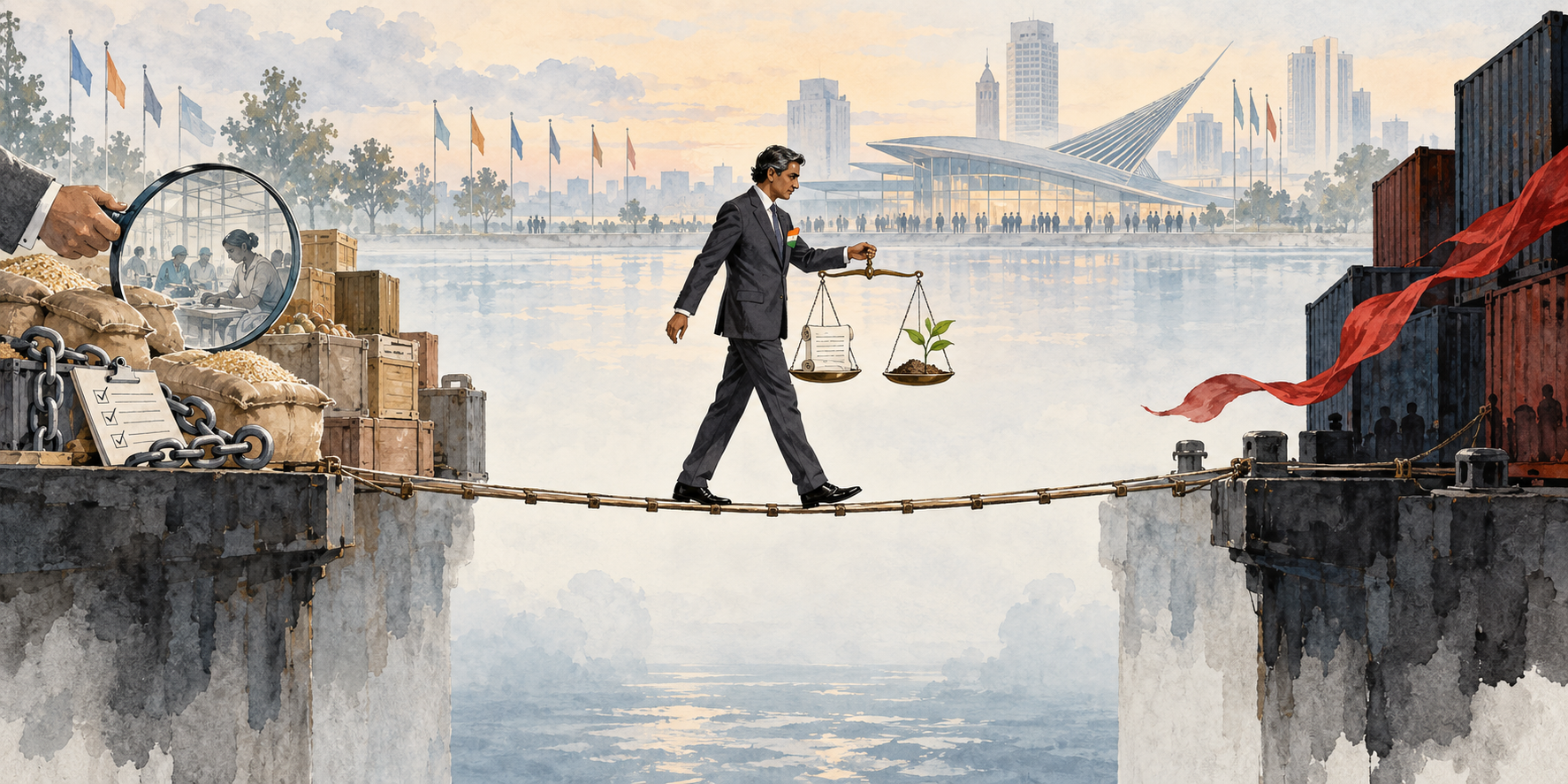
India used the October 1-2 G20 trade ministers’ meeting in Milwaukee to align with major concerns over supply-chain resilience and forced labor, while resisting any move toward unilateral trade remedies or limits on developing-country industrial policy. Commerce and Industry Minister Piyush Goyal backed rules-based responses to excess capacity, forced labor and the coercive use of food trade, but tied those responses to evidence, due process, World Trade Organization disciplines and policy space for developing economies.1
The split was clearest in the gap between the meeting’s single consensus outcome and its unresolved disputes. G20 trade ministers agreed to condemn the weaponization of food through coercive trade actions, a position India backed while stressing that food-security measures, public stockholding and temporary, transparent interventions should not be treated as coercion.5 But ministers did not reach consensus on the U.S. presidency’s other priorities: forced labor in global supply chains, structural excess capacity and production, and reform of the Most-Favoured-Nation principle.2
That divide gave New Delhi room to support the broad goals of supply-chain security without endorsing the full U.S. enforcement agenda. Washington called the Milwaukee meeting a success because all G20 members agreed on the food statement. But U.S. Trade Representative Jamieson Greer also said he was disappointed that the G20 did not reach consensus on forced labor and that “a handful” of members rejected a pathway toward cooperative action on excess capacity.2 A separate U.S.-backed forced-labor statement was joined only by the United States, Mexico and Argentina. India did not sign on to the narrower coalition, even as Goyal said India’s commitment to eliminating forced labor was “absolute and unconditional.”4
Goyal separated India’s support for stated objectives from its acceptance of enforcement methods. On structural excess capacity, he said India shared concerns that trade-distorting support in some economies can lead to dumping and predatory pricing. But he argued that such concerns should be addressed through WTO-consistent anti-dumping and countervailing-duty processes, backed by evidence and subject to judicial review.1
That formulation allowed India to acknowledge a concern often directed at China — production concentrated by subsidies, hidden support and non-market practices — without adopting an open-ended “overcapacity” framework that could later be used against developing-country industrialization. Goyal said industrial capacity itself was not the problem. He said diversification of production and supply chains is legitimate only if it does not become a pretext for measures outside WTO rules or for shifting adjustment costs onto developing countries.1
The same logic shaped India’s stance on forced labor. Goyal cited India’s constitutional prohibition on forced labor, its ratification of International Labour Organization conventions 29 and 105, and a July 2026 amendment to India’s Foreign Trade Policy prohibiting imports of goods made with forced labor.1 But he said border measures must rest on “specific and verifiable evidence,” not presumptions about entire countries, regions or sectors, and must respect due process and WTO rules.10
That position aligns India with forced-labor enforcement as a principle while opposing blanket restrictions, supply-chain monitoring mandates or information-sharing arrangements that could support unilateral trade action. India backed voluntary exchanges of good practices, but Goyal said cooperation should not create new obligations, involve monitoring of members, or feed unilateral measures.1
Diplomatically, India’s approach placed it neither fully inside the U.S. camp nor alongside China’s rejection of the agenda. Washington framed the meeting around four priorities: food coercion, forced labor, excess capacity and MFN reform.2 India accepted the first as a consensus concern, engaged constructively on the others, and used WTO language to limit how far any G20 statement should go.
China’s Commerce Ministry said participants exchanged views on the same U.S.-set issues and noted that the meeting produced a joint statement only on food, not on the other three topics.7 Beijing’s account said Li Chenggang opposed unilateralism and protectionism carried out under the banners of addressing overcapacity and eliminating forced labor. It also said he called for support for the WTO-centered multilateral trading system and the MFN principle.7
India shares some of that procedural vocabulary, especially the defense of WTO rules, MFN and multilateral decision-making. But its substantive emphasis differs. Goyal did not dismiss concerns about hidden subsidies, dumping, predatory pricing or forced labor. Instead, he accepted that these issues can distort trade while insisting that remedies must be multilateral, evidence-based and reviewable.1
That distinction matters for India’s foreign-policy audience because New Delhi is trying to preserve strategic flexibility. It wants the United States, Japan, Europe and other partners to see it as a credible alternative in diversified supply chains. At the same time, it is guarding against precedents that could expose Indian industrial policy, food-security policy or labor-governance systems to externally driven trade restrictions.
The food-trade statement was the clearest area of convergence. The agreed text condemned governments that use targeted action to slow, stop, block or direct trade in food, agricultural products and agricultural inputs to extract unrelated geopolitical concessions.5 It also preserved space for transparent measures that advance legitimate domestic public-policy objectives, including food security.5
That carve-out was important for India. It allowed New Delhi to condemn coercive food trade without conceding that domestic food-security tools — including public stockholding, procurement from small and marginal farmers, or temporary measures during supply shocks — should be treated as trade weaponization. The result fit India’s long-standing position that food security and farmer support require different treatment from coercive trade actions.
The U.S. side highlighted the food statement as the meeting’s main consensus outcome, saying the G20 had agreed that food weaponization is a humanitarian and economic threat.3 For India, backing the statement offered a low-cost way to align with resilience-oriented language while protecting its own policy instruments through the public-policy exception.
The lack of consensus on forced labor, excess capacity and MFN reform shows the limits of India’s balancing act. Japan, another U.S.-aligned G20 member, said the meeting focused on food weaponization, structural excess capacity and production, the MFN principle, and eliminating forced labor in global supply chains.8 Tokyo framed arbitrary food-trade restrictions, overproduction, level-playing-field concerns and human rights in supply chains as linked to the stability of the trade order.8
India did not reject those themes. It narrowed them. On excess capacity, Goyal argued that the issue is not manufacturing scale but distortions caused by hidden subsidies and concentrated production. Indian coverage of the meeting similarly noted that New Delhi pushed for supply-chain diversification while warning that overcapacity claims should not become a broad justification for WTO-inconsistent action.11
On MFN, India took a defensive position. Goyal described non-discrimination as a key guarantee of the trading system and said WTO consensus, special and differential treatment for developing countries, and restoration of a two-tier dispute settlement system should remain central.1 That stance responds to U.S. interest in rethinking MFN for a changed trade environment while signaling to other developing countries that India will not endorse reforms that erode formal equality or development flexibilities.
The Milwaukee interventions show India refining a trade-diplomacy formula likely to recur in other forums: support the policy objective, demand WTO process, preserve domestic policy space, and avoid unilateral coalitions. That approach lets New Delhi work with the United States and other partners on resilient supply chains, forced-labor concerns and food security, while keeping enough distance from U.S.-style trade-remedy politics to avoid constraining its own industrial and development agenda.
It also gives India a distinct position among G20 members. Unlike China, India did not primarily frame the agenda as an attack. Unlike the United States, it did not treat coalition-based enforcement statements as the necessary path forward. Instead, it presented itself as a rules-based developing economy that will support action against coercion and distortion when the evidence is specific, the process is multilateral, and the burden does not fall disproportionately on countries still building industrial capacity.
The practical consequence is diplomatic rather than market-driven. India is trying to occupy the middle ground between supply-chain realignment and multilateral restraint. Milwaukee showed that this middle ground is useful but difficult: it lets New Delhi join emerging trade-security debates without surrendering the WTO-centered safeguards it sees as essential to developing-country policy autonomy.






Comments