Japan, U.S. Extend Science Pact Indefinitely as Tokyo Pushes AI Governance Through Alliance
SI
SI refers to super intelligence, a term used in the Japanese release alongside artificial intelligence to describe advanced future AI capabilities.
Global South
A broad diplomatic term for developing and emerging economies, many of which are being courted by major powers on infrastructure, technology and governance standards.
Free and Open Indo-Pacific
A strategic concept used by Japan, the United States and partners to describe regional cooperation based on openness, rules, connectivity and resistance to coercion.
Intellectual property annex
A section of the agreement dealing with rights over inventions, research outputs and related assets created through cooperation.
Ministry of Foreign Affairs of Japan
government
Signing of the Protocol Extending and Amending the Agreement between Japan and the U.S. on Cooperation in Research and Development in Science and Technology
Ministry of Foreign Affairs of Japan
government
日米科学技術研究開発協力協定の延長及び一部改正議定書の署名
Mirage News / U.S. Department of State
government
U.S. and Japan Extend Science and Technology Pact Indefinitely
Untracked bias
Bias and factuality ratings from Media Bias Fact Check. Outlets without a rating are marked “Untracked.”
Indefinite extension
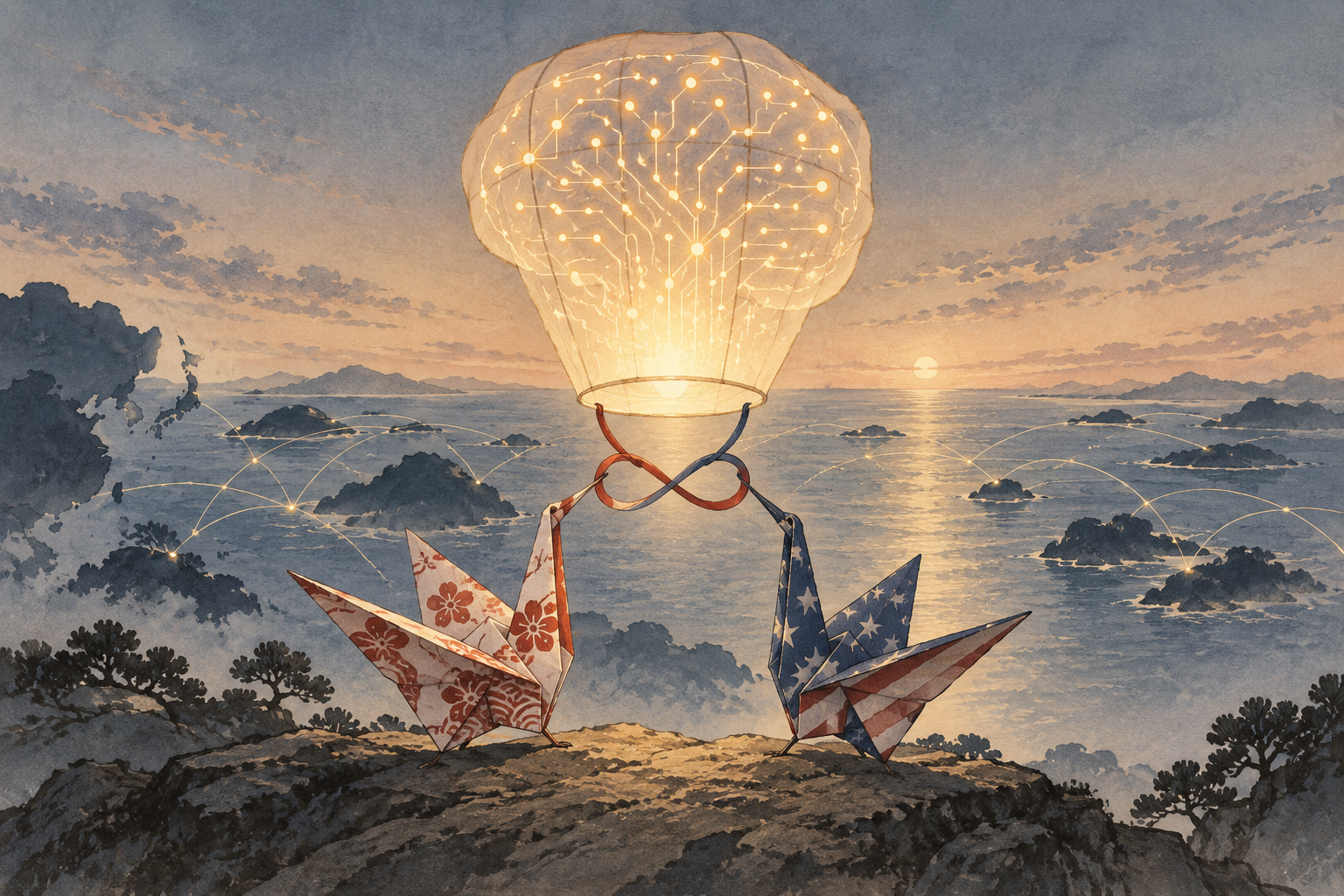
Japan and the United States signed an October 2 protocol making their science and technology cooperation agreement open-ended.
AI ecosystem
Foreign Minister Toshimitsu Motegi called for Japan and the United States to build a safe, secure and trustworthy AI and SI ecosystem in the Global South.
Alliance policy
The pact links research cooperation, intellectual property rules and emerging technology governance to Indo-Pacific alliance diplomacy.
Japan and the United States signed a protocol in Tokyo on October 2 that indefinitely extends and amends their bilateral science and technology research and development agreement. The update adds revised language on intellectual property and sets up further cooperation on artificial intelligence and super intelligence.1
The move gives permanent footing to a science pact first signed in 1988 and places technology governance more clearly within Japan’s alliance policy. Japan’s Foreign Ministry said Foreign Minister Toshimitsu Motegi and Michael Kratsios, director of the White House Office of Science and Technology Policy and the U.S. president’s science and technology adviser, signed the protocol at 5 p.m. in Tokyo before holding talks.1
Tokyo said the amended agreement strengthens the legal foundation for bilateral cooperation and is expected to promote a range of joint projects. The protocol also revises the annex on intellectual property rights, a key issue as allied governments deepen research ties in fields where commercial value, national security and standards-setting overlap.1
Motegi used the post-signing meeting to call for a “golden age” of Japan-U.S. science and technology cooperation under the amended agreement, according to the ministry. He cited advanced technology initiatives, including AI and SI, or super intelligence, and said Japan and the United States should promote cooperation in the Indo-Pacific while working together to build a “safe, secure, and trustworthy” AI and SI ecosystem in Global South countries.1
The Japanese-language release used the phrase “安全、安心、信頼できる” to describe the AI and SI ecosystem Tokyo wants to advance with Washington, underscoring the governance focus of the message.2 For diplomacy watchers, that language points beyond laboratory collaboration. Japan is tying research frameworks to the export of norms, safeguards and trusted technology architectures.
The U.S. framing was similar but narrower. A Department of State release, carried by Mirage News, said the protocol extends and amends the U.S.-Japan Science and Technology Agreement indefinitely and positions the two countries to sustain cooperation in critical and emerging technologies. Washington said the extension advances a secure and trusted innovation ecosystem benefiting both countries.3
The agreement fits a broader pattern in which Tokyo uses alliance channels to shape technology rules across the Indo-Pacific. By linking the science pact to AI, super intelligence and Global South capacity-building, Japan is signaling that standards for trusted digital and emerging technology systems are now part of alliance statecraft, not just domestic regulation or technical cooperation.
That approach is consistent with recent U.S.-Japan diplomatic messaging around the alliance, regional stability and economic security. In a separate October 2 State Department readout reproduced by GlobalSecurity.org, U.S. Deputy Secretary of State Christopher Landau and Japanese State Minister for Foreign Affairs Iwao Horii discussed the U.S.-Japan Alliance, cooperation in the Pacific Islands, development and infrastructure projects supporting a free and open Indo-Pacific, and shared commitments on economic security.8
For Japan, the science protocol provides a legal platform for long-term cooperation with Washington while supporting a wider effort to influence how emerging technologies are adopted in partner countries. That matters as governments across the Indo-Pacific and Global South weigh competing digital infrastructure, AI governance models and data-security expectations.
After the signing, Motegi and Kratsios agreed to advance bilateral science and technology cooperation under the amended pact and begin coordination for the next Japan-U.S. Joint Committee meeting.1 The committee process is likely to be where broad political language on AI, super intelligence, intellectual property and Indo-Pacific cooperation is translated into specific programs.
Kratsios emphasized the importance of further promoting Japan-U.S. cooperation in science and technology and said Washington wanted to move ahead with concrete bilateral cooperation, according to Japan’s Foreign Ministry.1
The indefinite extension reduces uncertainty over the legal basis for future joint work. But its larger diplomatic significance lies in how Tokyo is using that foundation: to align innovation, intellectual property rules and AI trust frameworks with the strategic priorities of the U.S.-Japan alliance.






Comments