Judge blocks Big Bend border-wall work in test of DHS waiver power
Preliminary injunction
A temporary court order that preserves the status quo while a lawsuit continues, usually issued when plaintiffs show likely success and likely irreparable harm.
DHS waiver authority
Federal immigration law allows the homeland security secretary to waive certain legal requirements to speed border-barrier construction, but the scope and use of that power can be challenged in court.
Big Bend Sector
A remote stretch of the Texas-Mexico border that includes Big Bend National Park, Big Bend Ranch State Park and nearby private lands along the Rio Grande.
Operational control
A border-enforcement term the government uses to describe preventing unauthorized crossings, sometimes framed by officials as a goal of zero illegal entries.
U.S. District Court for the Western District of Texas / CourtListener RECAP
government
Order Granting Preliminary Injunction, Friends of the Ruidosa Church et al. v. Mullin et al., No. 3:26-cv-01099-KC
Associated Press
news
Federal court temporarily blocks Trump administration border wall in Texas’ Big Bend region
The Texas Tribune / Big Bend Sentinel
news
Judge halts border barrier construction in Big Bend
Untracked bias
100% of tracked sources are High factuality
Spectrum News
Federal judge temporarily blocks border barrier construction in Big Bend amid lawsuit
KVIA
Federal judge grants injunction to pause Big Bend National Park border barrier construction
Bias and factuality ratings from Media Bias Fact Check. Outlets without a rating are marked “Untracked.”
Work halted
Judge Kathleen Cardone barred border-barrier construction and ground-disturbing activity in the Big Bend Sector unless the government complies with applicable laws.
Waivers stayed
The order temporarily stays DHS waivers that sought to speed construction by bypassing environmental and related legal requirements.
Low crossings
Big Bend covers about a quarter of the U.S.-Mexico border but accounts for only a small share of CBP migrant apprehensions each year.
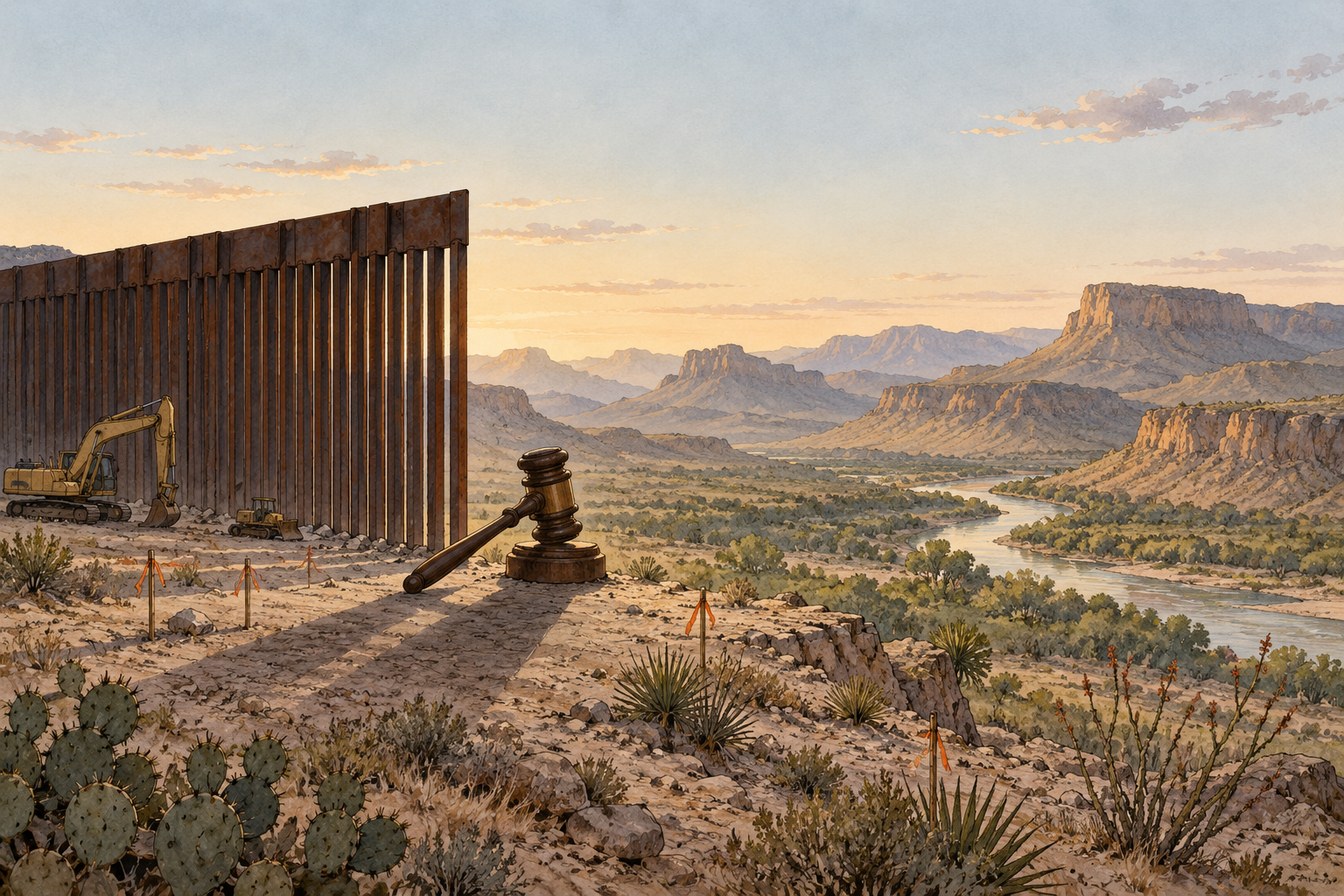
A federal judge in Texas on October 2 temporarily blocked the Trump administration from building border barriers, roads and related infrastructure across the Big Bend region, ordering the government to halt construction and other ground-disturbing work unless it complies with applicable laws.1
U.S. District Judge Kathleen Cardone said the plaintiffs were likely to succeed on at least one claim, faced a likelihood of serious and irreparable harm without an injunction, and had shown that the balance of equities and public interest favored court intervention.1 The order stays the effect of DHS waivers covering the Big Bend projects, including waivers for western Big Bend, national-park areas and the Lower Canyons.1
The ruling pauses a high-profile piece of President Donald Trump’s renewed border-wall drive at a politically sensitive moment, with immigration central to the midterm campaign. It also tests the administration’s claim that the Department of Homeland Security and U.S. Customs and Border Protection can use executive authority and environmental-law waivers to quickly expand border infrastructure, even where Congress, local officials and courts contest the process.
Cardone’s injunction bars federal defendants from building “border barrier or related infrastructure” or engaging in “construction or ground disturbing activities” in the Big Bend Sector while the case proceeds, unless the government complies with all applicable laws.1 The sector includes Big Bend National Park and nearby public and private lands along the Rio Grande.
The ruling applies beyond the national park. AP reported that the projects are part of a broader $46 billion administration effort to line the southern border with a mix of tall steel walls, vehicle barriers, roads and surveillance technology.2 Reuters reported that CBP’s plans in the national park focused on roads, surveillance technology and vehicle barriers rather than the 30-foot walls planned in other areas.8
The order is preliminary, not a final ruling on the merits. Cardone said a fuller memorandum opinion would follow, but the immediate effect is to prevent DHS and CBP from resuming or expanding ground work under the challenged Big Bend waivers.1
The short order rested on the traditional preliminary-injunction test: likelihood of success, likely irreparable harm, balance of equities and public interest.1 In practical terms, the court accepted that the plaintiffs had raised serious legal questions about whether the administration could rely on the waivers to bypass otherwise applicable laws. It also accepted that bulldozing, road building or barrier installation could cause damage that could not be fixed later with money damages.
The plaintiffs argued that the administration exceeded its authority by issuing sweeping waivers to fast-track construction through Big Bend National Park, Big Bend Ranch State Park and other parts of the region.4 Axios reported that challengers warned that once vegetation is cleared, roads are cut and infrastructure installed, the region’s natural and recreational qualities cannot be restored through after-the-fact relief.6
The order specifically stays the “Big Bend Waivers,” including the West Waiver, National Park Waiver and Lower Canyons Waiver, for the duration of the injunction.1 That language is significant because DHS has historically relied on Section 102 of the Illegal Immigration Reform and Immigrant Responsibility Act, as amended, to waive legal requirements it says impede rapid border-barrier construction.
The government has argued that physical infrastructure remains necessary even in remote areas such as Big Bend to achieve “operational control” of the border, which officials have defined as zero unauthorized crossings.3 The Texas Tribune reported that former DHS Secretary Kristi Noem wrote in a series of waivers that DHS had delivered “the most secure border in history” but that more could be done.3
CBP and DHS have also pointed to the risk that migration or cartel activity could shift into Big Bend if infrastructure is built elsewhere along the southern border.3 Reuters reported that CBP Commissioner Rodney Scott had earlier paused construction amid bipartisan criticism and said he wanted to evaluate the area personally and speak with interested parties.8
After the injunction, AP reported that CBP said it stood by its legal assessment and was working with the Justice Department on next steps.2 As of the cited reports, the administration had not announced a specific emergency appeal or request to stay Cardone’s order, though the agency’s statement left open the possibility of further court action.2
The lawsuit was brought by the Center for Biological Diversity, Friends of the Ruidosa Church and Danny William Miller, a Big Bend-area river guide and landowner.3 The Texas Tribune reported that Friends of the Ruidosa Church is dedicated to preserving a historic church in Presidio County, while Miller says he stands to lose property in Redford to the wall.3
The plaintiffs say the projects threaten desert landscapes, river access, cultural sites, wildlife habitat and private property. The Center for Biological Diversity said the challenged waiver set aside laws including the National Park Service Organic Act, Endangered Species Act and National Wild and Scenic Rivers Act inside a national park.4
Conservation groups have also focused on construction already done. The National Parks Conservation Association said federal contractors began bulldozing sensitive habitat in August near popular areas including Santa Elena Canyon, Cottonwood Campground and Mariscal Canyon, and called for remediation of damage already caused.5
Local opposition has cut across partisan lines. The Texas Tribune reported that Big Bend plans sparked a grassroots bipartisan backlash after details emerged in January 2026. Reuters noted opposition from local officials, conservationists and some Texas Republicans, including Sen. John Cornyn, who urged DHS to consult local leaders and reconsider barriers in terrain that already acts as a natural deterrent.38
Big Bend covers a large share of the U.S.-Mexico border but accounts for a small share of migrant apprehensions. The Texas Tribune reported that the sector includes Big Bend National Park and Big Bend Ranch State Park, covers about a quarter of the border and sees between 1% and 3% of CBP migrant apprehensions each year.3
The Center for Biological Diversity put the sector at 517 miles and said it represented more than a quarter of the U.S.-Mexico border, while accounting for 1.3% of total border apprehensions in 2025.4 Opponents argue that Big Bend’s rugged canyons, mountains and remoteness already deter unauthorized crossings, making large-scale barriers unnecessary and environmentally costly.2
The administration’s position is broader: gaps in physical infrastructure can become vulnerabilities if traffic shifts. That dispute — whether Big Bend is a low-risk wilderness region or a future enforcement gap — now sits at the center of a legal fight with national political stakes.
The injunction remains in place while litigation continues, and Cardone’s forthcoming memorandum opinion is expected to explain the court’s reasoning in greater detail.1 The administration could ask the district court, the U.S. Court of Appeals for the 5th Circuit or ultimately the Supreme Court for emergency relief if it wants construction to resume quickly.
For now, the ruling is a setback for one of Trump’s most visible immigration promises. It does not end the Big Bend projects, but it forces DHS and CBP to confront a central question before construction proceeds: whether executive waiver power can override environmental, historic-preservation and property-related objections in one of the most remote and politically contested stretches of the border.






Comments