Latvia votes as pro-Ukraine consensus faces coalition test
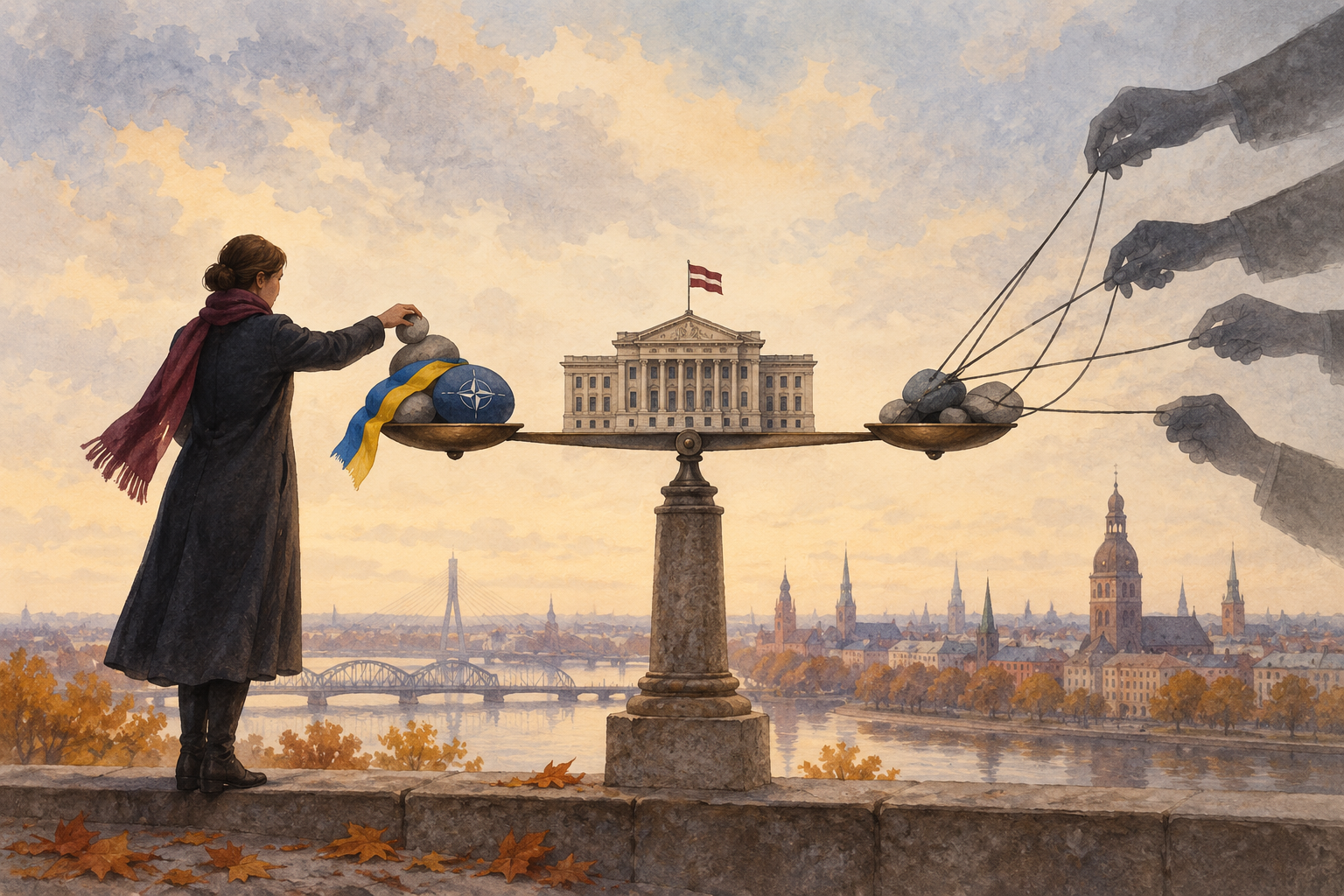
Saeima
Latvia’s unicameral parliament, made up of 100 members elected for four-year terms.
5% threshold
Parties generally need at least 5% of the national vote to win seats, making small shifts decisive for coalition arithmetic.
Hybrid threats
Security threats below the level of open war, such as cyberattacks, disinformation, sabotage, arson or drone provocations.
United List
The centrist alliance led by Prime Minister Andris Kulbergs, polling as the likely largest force but still needing coalition partners.
Central Election Commission of Latvia
government
3. oktobrī Latvijā un ārvalstīs notiks 15. Saeimas vēlēšanas
Associated Press
news
Latvians vote for a new parliament as fears of Russian hybrid attacks loom
Reuters via Internazionale
news
Latvians vote in election in shadow of drone incursions and war in Ukraine
Untracked bias
100% of tracked sources are High factuality
Global Banking & Finance Review
Latvians Vote in Election Amid Ukraine War, Drone Incursions
Modern Diplomacy
Latvia Votes Under Pressure as Drone Incursions and Ukraine War Dominate Election
Bias and factuality ratings from Media Bias Fact Check. Outlets without a rating are marked “Untracked.”
100 seats
Latvians are electing all 100 members of the 15th Saeima for a four-year term.
Russia pressure
The vote is unfolding amid concern over Russian hybrid threats, drone incursions and the war in Ukraine.
Coalition test
Prime Minister Andris Kulbergs is favoured to lead, but will likely need partners in a fragmented parliament.
Latvians voted on Saturday, 3 October, in a parliamentary election that will determine whether Prime Minister Andris Kulbergs can turn a short-lived caretaker government into a stable mandate — and whether the next Saeima preserves Latvia’s firm pro-Ukraine, pro-NATO line amid intensified Russian hybrid pressure on the Baltic region.
Polling stations in Latvia and abroad were open from 08:00 to 20:00 local time, with voters choosing 100 members of the 15th Saeima for a four-year term. The Central Election Commission said votes would be counted manually after polls close, with results published progressively as precinct data arrive.1 Latvian public media reported that 14 candidate lists and 1,428 candidates were competing for seats.7
The election is expected to produce another fragmented parliament, making coalition arithmetic the central issue. Kulbergs, leader of the centrist United List, came to power in May after the previous government collapsed over its handling of stray military drones that entered Latvian airspace. He is seeking a direct mandate from voters, but any government is still likely to require several parties to clear the 5% threshold and cooperate in a multiparty coalition.23
The outcome matters beyond Riga. Latvia has been one of the European Union and NATO’s most consistent supporters of Ukraine since Russia’s full-scale invasion. The vote is being watched for signs that parties viewed as closer to Moscow, or more ambivalent about aid to Kyiv, could gain enough seats to shape coalition talks, dilute sanctions policy or sharpen domestic disputes over defence spending and language policy.56
Pre-election polling cited by international outlets put Kulbergs’ United List ahead, but far short of a standalone majority.34 The central question is therefore not whether United List finishes first, but whether Kulbergs can assemble a majority without relying on parties that would strain Latvia’s foreign-policy consensus.
His current governing bloc includes United List, New Unity, the National Alliance and the Union of Greens and Farmers. Euronews reported that polls suggested this bloc was unlikely to retain power in its existing form, even if United List emerged as the largest party.4 The Kyiv Independent also noted uncertainty over whether some incumbent coalition parties would cross the 5% threshold, while the pro-European Progressives could become a potential, though ideologically complicated, partner.5
That leaves three broad scenarios.
The first is a continuity coalition. United List could perform strongly enough to rebuild a centre-right, pro-European government with some combination of its current partners. This would be the clearest route to preserving Latvia’s stance on Ukraine, sanctions and defence spending, but it depends on enough allied parties surviving the threshold.
The second is a broadened pro-Western coalition including the Progressives. This would likely maintain Latvia’s pro-Ukraine orientation, but could require negotiations across social and economic divides, especially with conservative and nationalist parties.
The third is a more disruptive coalition geometry in which Latvia First, led by businessman Ainars Slesers, becomes difficult to exclude. Reuters reported that Kulbergs might need a deal with Latvia First if the numbers leave him short, while analysts described the party’s Ukraine messaging as formally condemning Russia’s invasion but arguing that support for Ukraine imposes costs on Latvia’s economy.3 Euronews also described Latvia First as a possible indispensable partner if the current coalition weakens.4
The most sensitive question is the role of parties appealing to Russian-speaking voters or taking positions viewed as softer on Moscow. Reuters described Sovereign Power as overtly pro-Russian and placed it close behind United List in some opinion polling.3 The Kyiv Independent identified Sovereign Power/Young Latvians as the only relevant political force opposing aid to Ukraine, while noting that Kulbergs had ruled out governing with it.5
Even if Sovereign Power is excluded from coalition talks, a strong showing could still affect Latvian politics. It could amplify parliamentary opposition to aid for Ukraine, provide a platform for arguments against sanctions and increase pressure on mainstream parties to address grievances among Russian-speaking citizens without weakening national-security policy.
Latvia First is more ambiguous. It is not positioned in the same category as Sovereign Power, and Slesers has condemned Russia’s invasion, according to Reuters and the Kyiv Independent.35 But his party’s emphasis on economic costs, its outreach to Russian-speaking voters and its stated openness to restoring economic ties with Russia after the war make it a potential stress test for Latvia’s policy continuity.5
Le Monde reported that the rise of populist parties courting Russian-speaking voters has generated concern in Latvia, where political disillusionment has created openings for Russian propaganda and memories of Soviet occupation remain politically salient.6 That does not mean a pro-Russian turn is likely. It does mean the next parliament may include a louder bloc pressing against the current consensus, especially if economic grievances dominate post-election bargaining.
Latvia’s election is taking place in a security environment shaped by the war in Ukraine, the country’s borders with Russia and Belarus, and wider concern over drone incursions, sabotage and disinformation in Europe’s east. The Associated Press noted that Latvia, like Lithuania and Estonia, strongly supports Ukraine and sits on NATO’s eastern flank.2
Reuters linked the election directly to drone incursions and the war in Ukraine, noting that the crisis that brought Kulbergs to power followed incidents in which stray military drones flew undetected into Latvia. Officials blamed Russia for causing the drones to divert from their flight paths.3 The Kyiv Independent reported that Western officials have warned of escalating Russian hybrid threats, including cyberattacks, disinformation, arson and sabotage.5
Defence spending is therefore less a marginal policy issue than a governing baseline. Euronews cited analysis that, apart from a few dissenting voices, Latvia has broad consensus on maintaining military spending at nearly 5% of GDP and continuing support for Ukraine.4 A fragmented Saeima could complicate budget politics, but any government that visibly weakens Latvia’s deterrence posture would face strong institutional, public and allied resistance.
The Ukraine dimension is not only geopolitical. Latvian public media reported that the country’s only polling station in Ukraine opened at the Latvian embassy in Kyiv despite air alerts, Russian drone attacks and disruptions to movement in the capital.8 The report underscored the practical symbolism of the vote: Latvian citizens were casting ballots in a country that Riga has backed militarily, diplomatically and politically since Russia’s invasion.
For Kyiv, the Latvian election is a measure of whether a small but vocal EU and NATO ally remains a reliable advocate. The Kyiv Independent reported that Kulbergs has pledged unwavering support for Ukraine if re-elected, while also warning that roughly one-fifth to one-quarter of votes could go to parties seeking support among Russian speakers, including Latvia First and Sovereign Power.5
That makes the final seat distribution more important than the identity of the largest party. A pro-Ukraine prime minister with a narrow or ideologically strained coalition may still keep policy intact, but with less room to manoeuvre on new aid packages, sanctions enforcement or EU debates requiring unanimity.
The first indicator will be which parties cross the 5% threshold. A small shift around that line could change the coalition map, either enabling a broadly pro-Western majority or forcing Kulbergs to negotiate with more difficult partners.23
The second will be the combined strength of Latvia First and Sovereign Power/Young Latvians. Their influence will depend less on whether they can enter government than on whether their seat totals narrow the path to a conventional pro-Ukraine coalition.
The third will be whether United List can claim not just first place, but a governing mandate. Kulbergs’ pitch has linked economic strength with defence readiness, arguing that Latvia needs both to navigate the next four years.2 If his party wins clearly but lacks obvious partners, the election could produce a prime minister strengthened electorally but constrained politically.
The most likely strategic outcome remains continuity. Latvia’s NATO membership, EU alignment and support for Ukraine are deeply embedded across much of the political system. But the election could still complicate how that consensus is managed. A larger parliamentary presence for parties softer on Russia would not necessarily reverse Latvia’s orientation, but it could make every major security, sanctions and Ukraine-related decision more contested.




Comments