Modi-Xi thaw signals managed stability, not a breakthrough
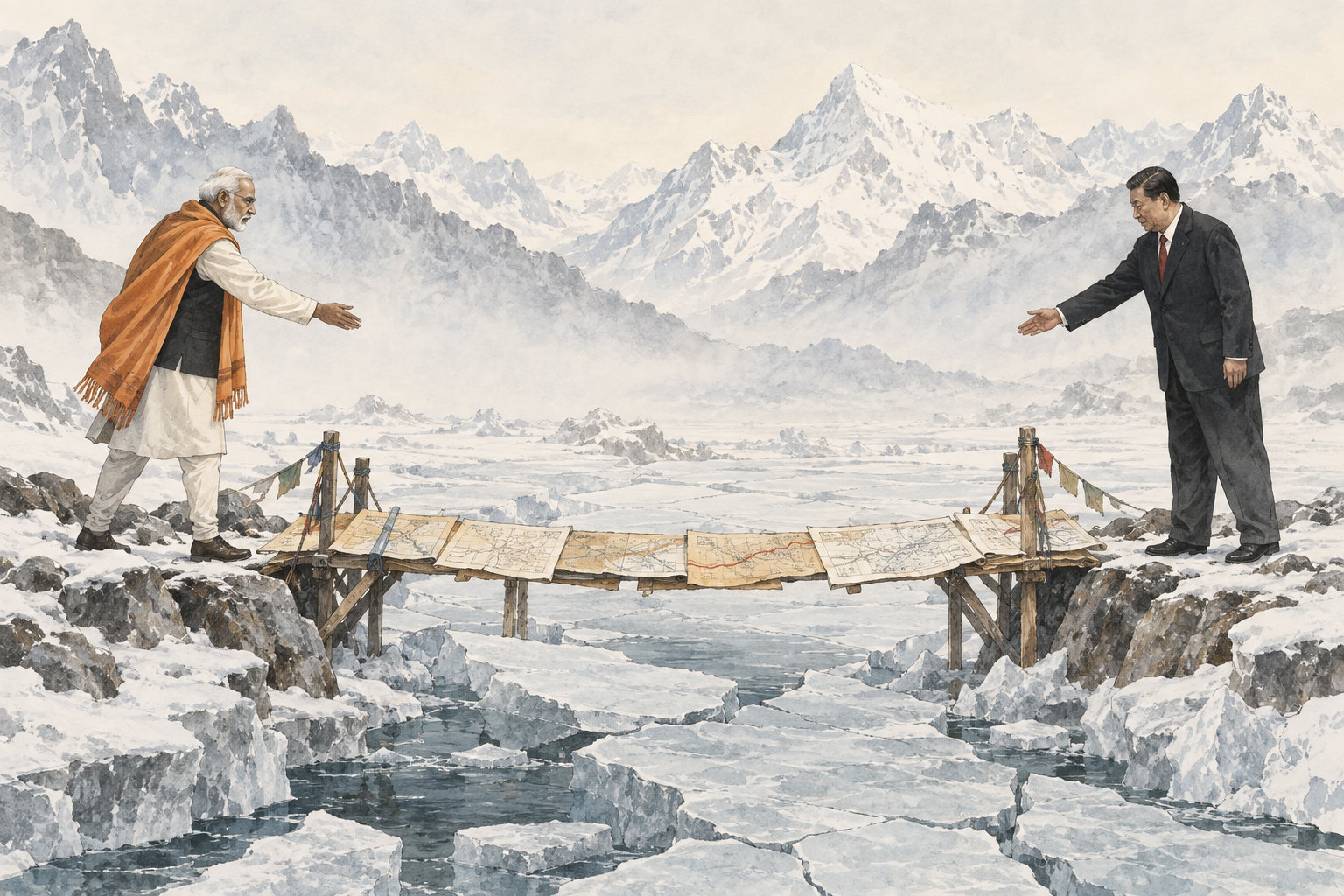
Line of Actual Control
The de facto boundary separating Indian- and Chinese-controlled territory in disputed Himalayan areas; it is not a mutually agreed international border.
2020 Ladakh clash
A deadly confrontation between Indian and Chinese forces in the Galwan Valley area that sharply worsened bilateral ties and led to a prolonged military standoff.
Managed stability
A diplomatic approach that seeks to prevent crises and reopen limited cooperation without resolving the underlying strategic disputes.
BRICS
A grouping originally formed by Brazil, Russia, India, China and South Africa that has expanded and is often used by members to coordinate Global South and multipolarity messaging.
Associated Press
news
India’s Modi and China’s Xi seek to reset ties on BRICS sidelines
Reuters via ThePrint
news
Modi and Xi push India-China business links, mobility at Delhi talks
PTI via ThePrint
news
Border peace essential for India-China ties: PM Modi to President Xi
Untracked bias
100% of tracked sources are High factuality
ThePrint
‘Differences should not become disputes’: Modi, Xi welcome progress in India-China ties
Bias and factuality ratings from Media Bias Fact Check. Outlets without a rating are marked “Untracked.”
Border condition
Modi told Xi that peace along the disputed frontier remains essential for broader India-China ties.
Mobility push
Both sides emphasized greater mobility, people-to-people exchanges and potential direct-flight cooperation.
Trade test
Business links, supply chains, trade imbalance and market access are the practical measures of whether the reset advances.
Indian Prime Minister Narendra Modi and Chinese President Xi Jinping put a public reset on display in New Delhi on September 12, using a BRICS sideline meeting to endorse cooperation, mobility and business ties while keeping the core condition for normalization unchanged: peace along the disputed frontier.1
The meeting, held during the BRICS leaders’ summit, was the latest step in a cautious thaw after the 2020 military clash in Ladakh, which killed at least 20 Indian soldiers and four Chinese service members and triggered a prolonged standoff along the Himalayan border.1 It was also Xi’s first visit to India since 2019, giving the encounter symbolic weight beyond the formal agenda.1
But the language from both governments pointed less to a diplomatic breakthrough than to a managed-stability exercise. Modi told Xi that peace along the border was essential for broader ties and urged both sides to respect existing agreements, according to India’s foreign ministry account cited by AP and PTI.13 Xi’s official readout emphasized partnership, cooperation, direct flights, people-to-people exchanges and the need to maintain peace in border areas. It also framed China and India as opportunities for each other rather than threats.4
That convergence matters. It shows both capitals want room to reopen parts of the relationship restricted after 2020. Yet it also underlines the limits of the reset: business links, mobility and public warmth can advance only so far if the Line of Actual Control remains militarized, mistrustful and vulnerable to another confrontation.
The most important message from New Delhi was conditional. India placed border peace at the center of the discussion, saying broader relations depend on tranquility along the frontier and respect for existing arrangements.13 Modi also used the familiar formulation that differences should not become disputes and linked future engagement to “mutual respect, mutual sensitivity and mutual interest,” according to AP.1
That phrasing keeps dialogue open without pretending the boundary question is resolved. The two leaders reaffirmed support for a fair and mutually acceptable settlement of the boundary dispute. But the available readouts did not announce a new border agreement, a verified pullback schedule or a demilitarization step along the Line of Actual Control.13
This distinction is central. A summit can stabilize political signaling, but the relationship since 2020 has been shaped by facts on the ground: forward deployments, infrastructure buildup and operational mistrust. AP noted that both sides have stationed tens of thousands of troops in the Ladakh region, backed by heavy equipment, and that India and China continue to dispute parts of their border.1
For India, the test is not whether Beijing accepts the language of partnership. It is whether border management mechanisms prevent friction, existing agreements are observed and military calm becomes durable enough to justify broader normalization.
For China, the aim appears to be a parallel-track approach: keep the boundary issue contained while expanding cooperation elsewhere. Xinhua’s readout described a need to advance bilateral relations and the boundary question on parallel tracks while maintaining peace in border areas.4
The practical agenda was clearest on people-to-people links. Reuters reported that Modi and Xi stressed the need to promote business linkages and greater mobility as the two countries rebuild ties damaged by the 2020 clash.2 Xinhua’s readout also referred to expanding people-to-people exchanges and direct-flight cooperation as part of improving the public foundation for the relationship.4
These are politically useful areas because they can produce visible progress without requiring either side to concede on the boundary dispute. Restoring or expanding direct air connectivity, easing visas for students, business travelers and professionals, and reopening cultural exchanges can all be framed as practical steps that benefit ordinary people while remaining reversible if tensions return.
PTI’s account of the Indian readout also highlighted cultural exchanges and mobility, placing them alongside trade imbalance, supply chains and market access concerns.3 That grouping is important: New Delhi is not treating mobility as a stand-alone confidence-building measure. It is part of a broader transactional agenda in which India wants smoother travel and commercial access, but not at the price of relaxing its security concerns.
Economic engagement is both the incentive for stabilization and one of its most difficult tests. The two countries have deep trade ties, but India’s large trade deficit with China, restrictions on Chinese investment and technology, and strategic competition in Asia continue to weigh on relations.1
The September 12 meeting acknowledged those pressures. The leaders discussed expanding business ties while addressing trade imbalances, supply-chain issues and market-access concerns, according to AP’s account of the Indian statement.1 Reuters similarly framed the meeting around business linkages and mobility, underscoring the practical agenda behind the diplomatic reset.2
For India, market access is likely to be judged by whether China opens more space for Indian goods, services and companies, and whether supply-chain bottlenecks ease in sectors where Indian manufacturers remain exposed to Chinese inputs. For China, improved access to India’s market and a less restrictive climate for Chinese firms would be a major sign that relations are moving beyond crisis management.
Neither side, however, appears ready to separate economics fully from security. India has sought to position itself as an alternative manufacturing base as China’s costs rise and its relations with the United States and Europe remain strained. Beijing, meanwhile, views India’s deepening strategic relationship with Washington with suspicion.1 That larger geopolitical setting limits how far a bilateral reset can go, even when both sides see value in stabilizing trade.
The BRICS setting made the meeting easier to choreograph. Modi thanked Xi for China’s cooperation during India’s BRICS chairship, while China is due to host the summit next year.1 Other accounts of the opening moments recorded Modi’s thanks for Chinese support and the presence of senior Indian officials, including External Affairs Minister S. Jaishankar and National Security Adviser Ajit Doval.6
For Modi, the meeting showed India engaging China from a position of diplomatic confidence while hosting a major Global South forum. For Xi, it supported Beijing’s message that China and India should not allow differences to define the relationship and should cooperate in multilateral settings. Xinhua cast the two countries as major Global South actors with responsibilities for global stability and development.4
That multilateral framing is useful but limited. BRICS can provide a platform for polite messaging and shared criticism of global instability, but it cannot resolve the bilateral security dilemma on the border. The result is a familiar two-level dynamic: leaders speak the language of partnership internationally while their militaries and bureaucracies manage distrust locally.
The New Delhi meeting should be read as a signal that both governments want to prevent competition from becoming uncontrolled confrontation. The emphasis on mobility, business ties and people-to-people links suggests a willingness to reopen channels narrowed after 2020.234
Still, the absence of a reported new border mechanism or concrete disengagement announcement means the reset remains provisional. It is not a return to pre-2020 assumptions, and it is not a settlement of the boundary dispute. It is a bid to stabilize a difficult relationship while testing whether limited cooperation can resume without weakening either side’s security posture.
For Asia diplomacy watchers, the key indicator will not be the warmth of the next photo opportunity. It will be whether the Line of Actual Control stays quiet, whether direct connectivity and visas expand, and whether market-access complaints produce measurable changes. Until then, the Modi-Xi meeting is best understood as managed stability: necessary, useful and deliberately cautious.




Comments