Montana Supreme Court race tests future of nonpartisan judicial elections
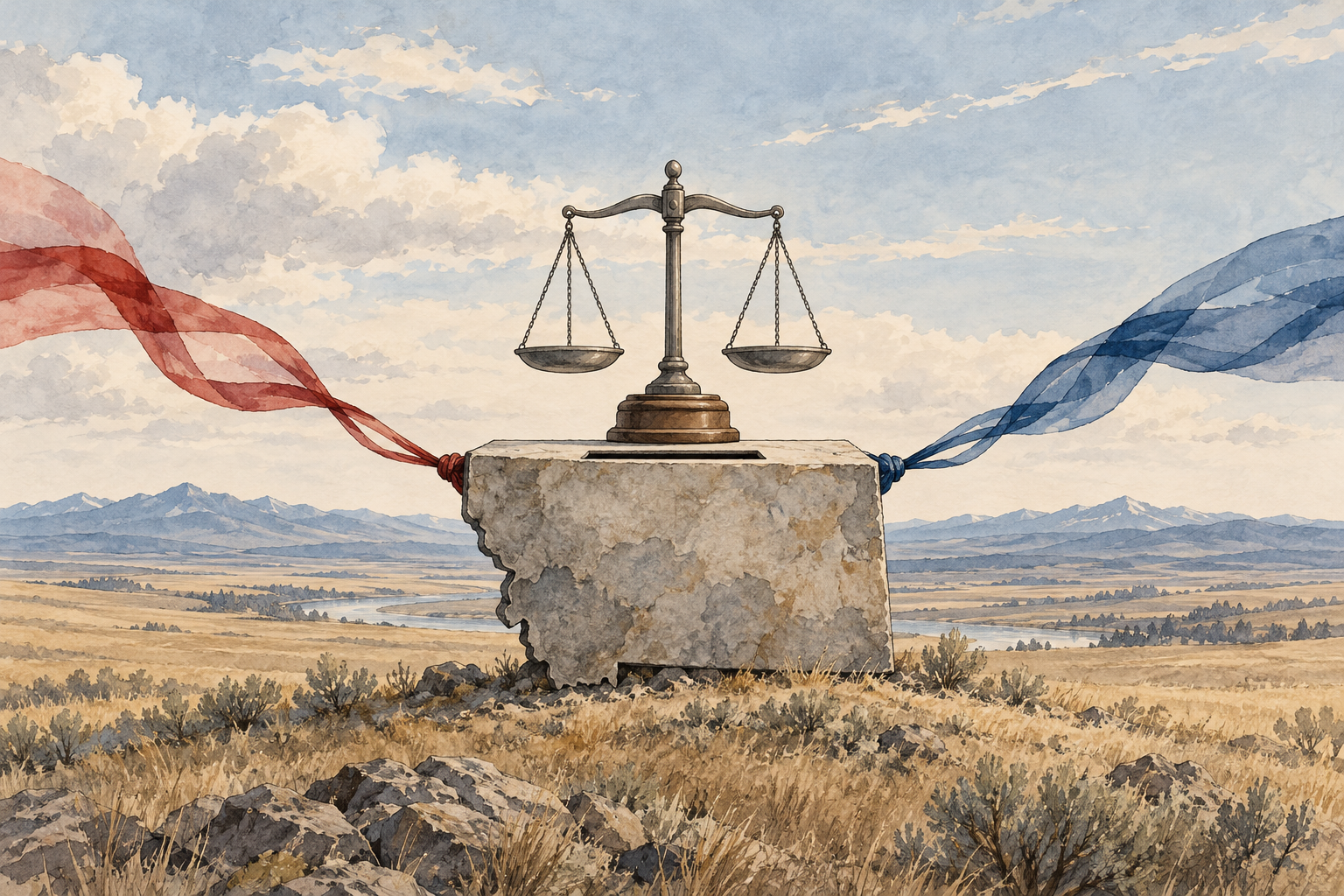
Nonpartisan judicial election
A court election in which candidates appear on the ballot without party labels, even if parties or aligned groups support them.
CI-132
A proposed Montana constitutional amendment that would require the state’s judicial elections to remain nonpartisan.
State Supreme Court
A state’s highest court, often the final authority on the meaning of the state constitution and state laws.
Interest-group spending
Money spent by advocacy organizations, political committees or outside groups to support or oppose candidates or ballot measures.
Untracked bias
100% of tracked sources are High factuality
WBAL Baltimore News
Nonpartisan state Supreme Court elections are being put to the test in Montana
Winnipeg Free Press
Nonpartisan state Supreme Court elections are being put to the test in Montana
Greenwich Time
Nonpartisan state Supreme Court elections are being put to the test in Montana
Houston Chronicle
Nonpartisan state Supreme Court elections are being put to the test in Montana
The Walton Tribune
Nonpartisan state Supreme Court elections are being put to the test in Montana
The Oconee Enterprise
Nonpartisan state Supreme Court elections are being put to the test in Montana
Bias and factuality ratings from Media Bias Fact Check. Outlets without a rating are marked “Untracked.”
Dual vote
Montana voters will decide both a Supreme Court race and CI-132, a constitutional amendment on nonpartisan judicial elections.
Money fight
The ACLU has contributed $2.1 million to the CI-132 campaign and is spending $5.5 million on Supreme Court races in three states.
Rights stakes
Recent Montana Supreme Court rulings have addressed abortion restrictions, Election Day voter registration and the state’s climate obligations.
Montana voters will decide Nov. 3 whether to preserve nonpartisan judicial elections in the state constitution while choosing between two candidates for a state Supreme Court seat. The vote has made Montana a closely watched test of how court races are becoming political battlegrounds over abortion, voting rules, climate policy and legislative power.1
The Supreme Court race features Amy Eddy and Dan Wilson, both Flathead County district court judges, in an officially nonpartisan contest that has drawn overt partisan and interest-group involvement. Eddy narrowly led Wilson in the June primary by fewer than 8,000 votes out of about 270,000 cast, but both advanced because they were the only candidates.1
Voters will also consider Constitutional Initiative 132, or CI-132, which would require Montana judicial elections to remain nonpartisan. The measure reached the ballot after Republican lawmakers tried in 2025 to move judicial elections toward a partisan model, including a proposal that passed the state Senate but failed in the House.12
The fight follows a series of Montana Supreme Court decisions that frustrated Republican officials, who control the Legislature. In recent years, the court has struck down abortion restrictions, rejected limits on Election Day voter registration and upheld a landmark climate ruling that found the state violated residents’ constitutional right to a clean environment by allowing fossil fuel development without considering climate impacts.1
Eddy, serving as a substitute Supreme Court justice, joined the majority in a ruling that found Montana abortion laws violated the state constitution’s privacy protections.1 Wilson has framed the race around judicial objectivity. Eddy has criticized party money in judicial campaigns as a threat to public confidence in impartial courts.1
The election will replace a retiring justice who has sometimes been a swing vote, raising the stakes for future disputes over laws passed by the Republican-led Legislature.1
Montana Supreme Court candidates appear on the ballot without party labels, but the campaign has not been free of partisan signals. A new state law in effect for this year’s election allows political parties to contribute directly to judicial candidates.12
Wilson has received money from Republican Party committees and spoke earlier this year at a GOP event, according to the Associated Press. Eddy has been supported by the Democratic-aligned group Defend Our Courts. The American Civil Liberties Union has sent mailers highlighting her support for abortion rights and her refusal to take political party contributions.1
The ACLU has also contributed $2.1 million to the campaign supporting CI-132, according to campaign finance reports filed at the end of September. Nationally, the organization is spending $5.5 million on Supreme Court races in Michigan, Montana and North Carolina, after spending more than $1 million earlier this year on races in Georgia and Wisconsin.1
The spending reflects a broader national shift: State supreme courts increasingly decide disputes over voting access, redistricting, abortion rights, environmental protections and the balance of power between legislatures and courts.1
CI-132 would amend the Montana Constitution to require judicial elections to remain nonpartisan. Supporters say it would preserve a system that has existed in Montana for more than 90 years and keep judges from being formally tied to party labels on the ballot.2
The measure would apply broadly to judicial offices, including the state Supreme Court, district courts, water courts and municipal courts. It would not bar judicial candidates from associating with political parties or accepting party contributions, according to reporting by the Flathead Beacon.2
A “yes” vote would enshrine nonpartisan judicial elections in the state constitution. A “no” vote would leave open the possibility that lawmakers could change the current system in future sessions.2
Supporters argue that party labels would undermine the expectation that judges decide cases based on facts and law rather than political allegiance. Opponents say voters deserve clearer information about judicial candidates’ political leanings, especially when courts are deciding disputes over laws passed by elected officials.2
Montana is not alone. State supreme court elections have become more expensive and more openly ideological across the country. In Wisconsin last year, more than $100 million was spent on a pivotal Supreme Court race that preserved a liberal majority. Since then, that court has struck down an abortion ban and overturned Republican-favored legislative maps.1
Other states have moved in different directions. Kansas voters in August rejected a Republican-backed proposal to elect Supreme Court justices instead of appointing them. North Carolina restored partisan Supreme Court elections in 2018, and Republicans later won control of the court. The court then upheld a voter photo identification law and reversed a ruling against a Republican-drawn congressional map. Ohio added partisan labels for Supreme Court general election candidates in 2021, after which Republicans expanded their majority.1
For Montana voters, the decision is both structural and practical: whether to keep judicial elections officially nonpartisan and which candidate should join a court that may continue to decide the fate of laws on abortion, elections, climate and legislative power.






Comments