Port Shuaiba strike tests U.S. counter-drone readiness in Gulf
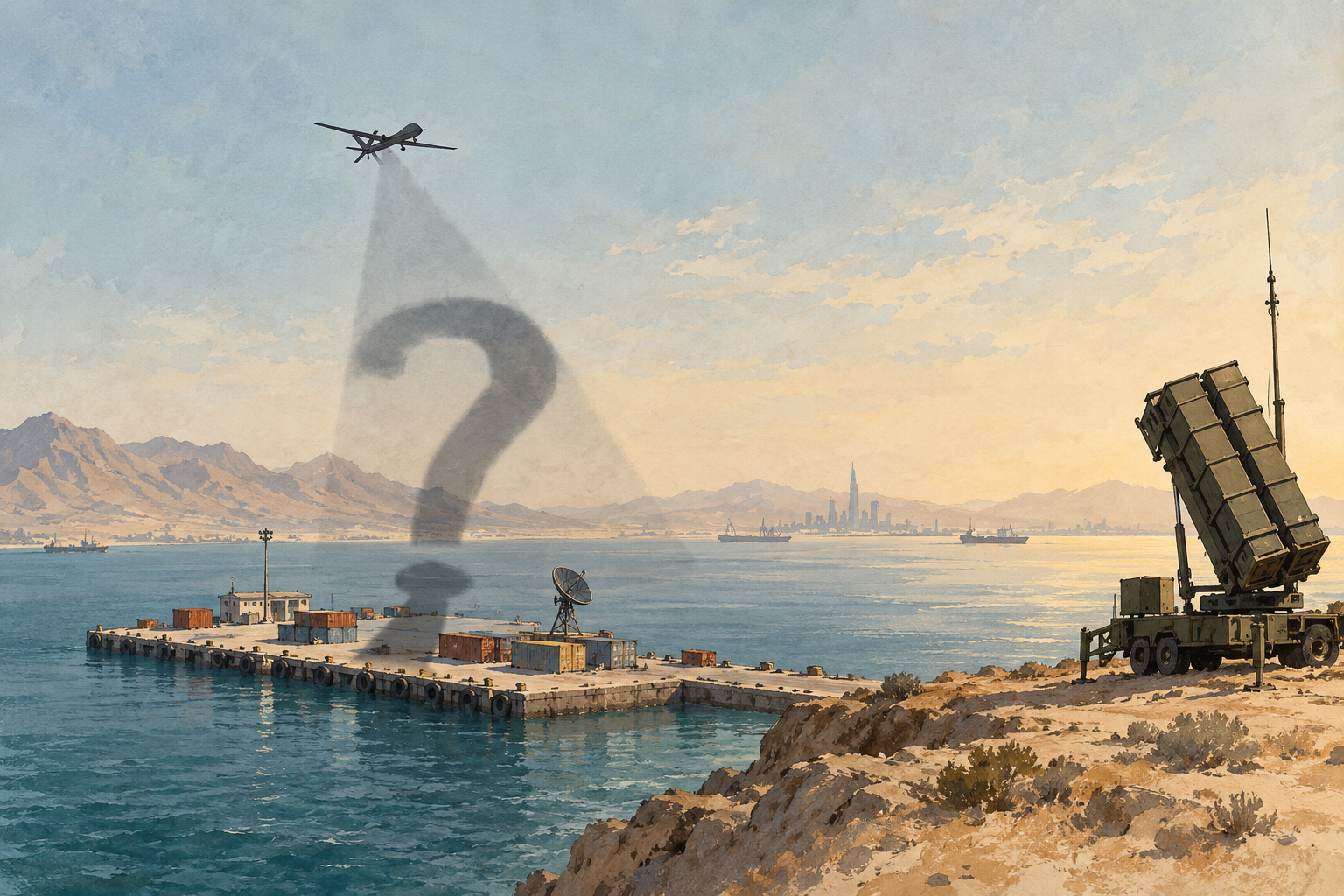
Patriot system
A U.S. air- and missile-defense system designed primarily for threats such as aircraft and ballistic missiles, not as the sole answer to mass drone attacks.
Counter-drone defense
The mix of sensors, interceptors, electronic warfare, guns, passive protection and procedures used to detect and defeat hostile drones.
Mass-casualty plan
A rehearsed medical response plan for treating and evacuating many wounded people at once after an attack or disaster.
Logistics hub
A site used to move, coordinate or store supplies, equipment and personnel; in modern conflicts, these hubs can be direct targets.
Associated Press
news
Exclusive: Soldiers and Gold Star families press Army leadership after deadly Iranian drone strike
Associated Press
news
Takeaways from AP report on Iranian attack in Kuwait that killed 6 US soldiers and wounded dozens
Associated Press
news
Soldiers seriously wounded in Iranian drone strike tell AP the military’s medical system failed them
Untracked bias
Bias and factuality ratings from Media Bias Fact Check. Outlets without a rating are marked “Untracked.”
Six killed
The March 1 Iranian drone strike at Kuwait’s Port Shuaiba killed six U.S. soldiers and wounded dozens.
Drone gap
AP reported that Port Shuaiba relied on nearby Patriot coverage even though the system was poorly matched to large numbers of low-cost drones.
Care gaps
Wounded soldiers said the site lacked a broad mass-casualty plan and that some troops searched online for the nearest hospital after the attack.
The Iranian drone strike that killed six U.S. soldiers and wounded dozens at Kuwait’s Port Shuaiba on March 1 has become a test case for a central question facing U.S. commanders in the Gulf: whether bases, ports and logistics nodes have absorbed the lessons of modern drone warfare quickly enough.1
The Associated Press reported that soldiers and Gold Star families are pressing Army leaders for answers after officers warned before the attack that the civilian port and oil refinery lacked adequate drone defenses. The site’s main U.S. air-defense coverage came from a nearby Patriot system, a high-end missile-defense asset that soldiers and officers described as poorly suited to stopping large numbers of low-cost Iranian drones.12
The strike, the deadliest known attack on U.S. troops since Operation Epic Fury began on Feb. 28, also exposed a second vulnerability: resilience after impact. AP reported that soldiers said Port Shuaiba lacked a broad mass-casualty plan, and that some wounded troops used phones to search for the nearest hospital after the blast.235
For U.S. defense planners and Iran watchers, the issue reaches beyond one port. Iran’s missile and drone attacks have damaged U.S.-manned bases and energy infrastructure across the Gulf, according to The Soufan Center, while Gulf states are reassessing their missile and drone defenses.6 Port Shuaiba raises a wider readiness question: in any renewed or expanded confrontation with Iran, are U.S. logistics hubs protected against the cheap, numerous and hard-to-prioritize drones now shaping battlefields from Ukraine to the Middle East?
Port Shuaiba had long been used by the Army as a logistics site. Planners treated it as a place that could be safer than more obvious U.S. military bases during Iranian retaliation. In February, as Operation Epic Fury approached, U.S. personnel were moved there from Camp Arifjan, a major Army logistics hub in Kuwait.1
AP reported that Maj. Gen. John Hinson, who oversaw logistics for U.S. Central Command in the region, and Brig. Gen. Clint Barnes, who led the Iowa-based 103rd Expeditionary Sustainment Command, chose to move an operations center to the port even though soldiers said threat assessments showed it was not sufficiently defensible against drone strikes.12
The attack killed Maj. Cody Khork, Master Sgt. Noah L. Tietjens, Maj. Jeffrey R. O’Brien, Master Sgt. Nicole M. Amor, Sgt. Declan J. Coady and Chief Warrant Officer 3 Robert Marzan.14 Many of the soldiers killed or wounded were from the 103rd Expeditionary Sustainment Command, which had deployed to Kuwait in 2025.14
The Army declined to comment on AP’s specific reporting, saying families had not yet been briefed on the official findings of its completed investigation. The Pentagon also declined to comment on the Port Shuaiba reporting.12
The Port Shuaiba attack challenges an older assumption about rear-area logistics. In past wars, ports, depots and sustainment nodes often sat behind the front line. In the Gulf, Iran can threaten those sites directly with drones and missiles, including low-flying systems that may approach below the threat profile emphasized in missile-defense planning.
AP reported that officers warned Port Shuaiba would not be safe for troops because it lacked air protection against drones. Soldiers familiar with threat briefings said the port was not on a list of planned Iranian targets obtained by U.S. intelligence, but was considered a likely secondary target.1
That distinction matters operationally. A site does not need to be identified as a primary target to require protection if it hosts communications, logistics command functions, fuel, port access or troop concentrations. In a conflict with Iran, secondary and opportunity targets can still produce strategic effects if they disrupt sustainment or cause U.S. casualties.
The Port Shuaiba case also shows how logistics efficiency can compete with force protection. AP reported that senior officers saw communications and infrastructure advantages in remaining in Kuwait, and that some soldiers believed the port had the facilities needed for their logistics mission.12 But those advantages became liabilities once the port’s fixed location, limited defenses and concentration of personnel were exposed to Iranian drones.
The clearest operational warning from Port Shuaiba concerns an air-defense mismatch. The three major U.S. bases in Kuwait had bolstered air protection before the war, AP reported. Port Shuaiba’s only U.S. air support came from a Patriot anti-missile system near Camp Arifjan.12
Patriot is critical for defending against ballistic missiles and some aircraft. But the problem at Port Shuaiba was not whether Patriot could detect small drones. AP reported that the system can detect such aircraft, but that large numbers of drones can quickly drain a battery, Patriot interceptors cost far more than the drones they would destroy, and using them against drones can leave an area more vulnerable to missile attack.12
That is the central dilemma of modern air defense: the defender’s expensive interceptor may be technically capable but economically and operationally inefficient. Iran, like Russia in Ukraine and other actors across the Middle East, can use drones to saturate defenses, force commanders to spend high-value interceptors, or expose gaps between missile-defense coverage and close-in base defense.
For U.S. forces, the Port Shuaiba lesson is not that Patriot is obsolete. It is that Patriot must be part of a layered defense that includes sensors, electronic warfare, short-range interceptors, guns, directed-energy systems where available, passive protection, deception and hardened shelters. A Gulf port that depends mainly on a distant missile-defense battery remains exposed to the drone threat most likely to arrive in numbers.
Counter-drone readiness does not end with interception. It also includes what happens when interception fails.
AP reported that soldiers at Port Shuaiba entered the war without a broad mass-casualty plan, according to seven soldiers, including senior officers. After the strike, troops tended to one another, used tourniquets and searched online for hospitals in Kuwait City.235
Several wounded soldiers told AP that they later faced delayed or inadequate care, including problems with evacuation, documentation and traumatic brain injury diagnosis. The Pentagon said wounded troops arriving at its facilities are evaluated and may be admitted based on injury severity and physician judgment.3
Operationally, drone defense and medical readiness are linked. A logistics hub that may be hit by drones needs rehearsed casualty routes, hospital coordination, evacuation plans, communications backups, protected triage areas and documentation procedures that work under missile and drone attack. Otherwise, the attack continues to impose costs long after the blast.
Iran’s advantage is not simply that it has drones. It is that drones fit its preferred way of pressuring U.S. forces: striking across distance, forcing defensive expenditure, threatening Gulf infrastructure and complicating U.S. decisions about escalation.
The Soufan Center assessed that Iranian missiles and drones inflicted significant damage on U.S.-manned bases and energy infrastructure in Gulf states during the current crisis, and that Gulf governments are likely to focus on hardening infrastructure and expanding missile and drone defenses.6
That environment creates a difficult target set for U.S. planners. The United States must protect large bases, small detachments, ports, fuel sites, airfields, headquarters, housing, communications nodes and medical evacuation routes. Iran does not need to defeat every defensive layer everywhere. It needs to find the places where command assumptions, geography and limited counter-drone assets overlap.
Port Shuaiba appears to have been one of those places.
The Port Shuaiba strike points to several questions U.S. commanders are likely to examine before any renewed confrontation with Iran:
Those questions are not abstract. Soldiers told AP that warnings about Port Shuaiba’s drone vulnerability were raised before the attack. Families of those killed say they are still waiting for answers.14
The March 1 strike does not show that U.S. forces are defenseless against Iran. It shows that a high-end regional posture can still have low-end vulnerabilities. A force built around advanced aircraft, missile defenses and large bases can suffer severe losses if a lightly defended logistics node is hit by a comparatively cheap drone.
That is why Port Shuaiba matters beyond Kuwait. It is a warning about the gap between knowing the lessons of Ukraine and the Middle East and applying them to every U.S. site within range of Iranian drones. The lesson is not only to buy more counter-drone systems. It is to treat every logistics hub, port and temporary command post as part of the front line.






Comments