Russian strikes near Poland sharpen NATO air-defense dilemma
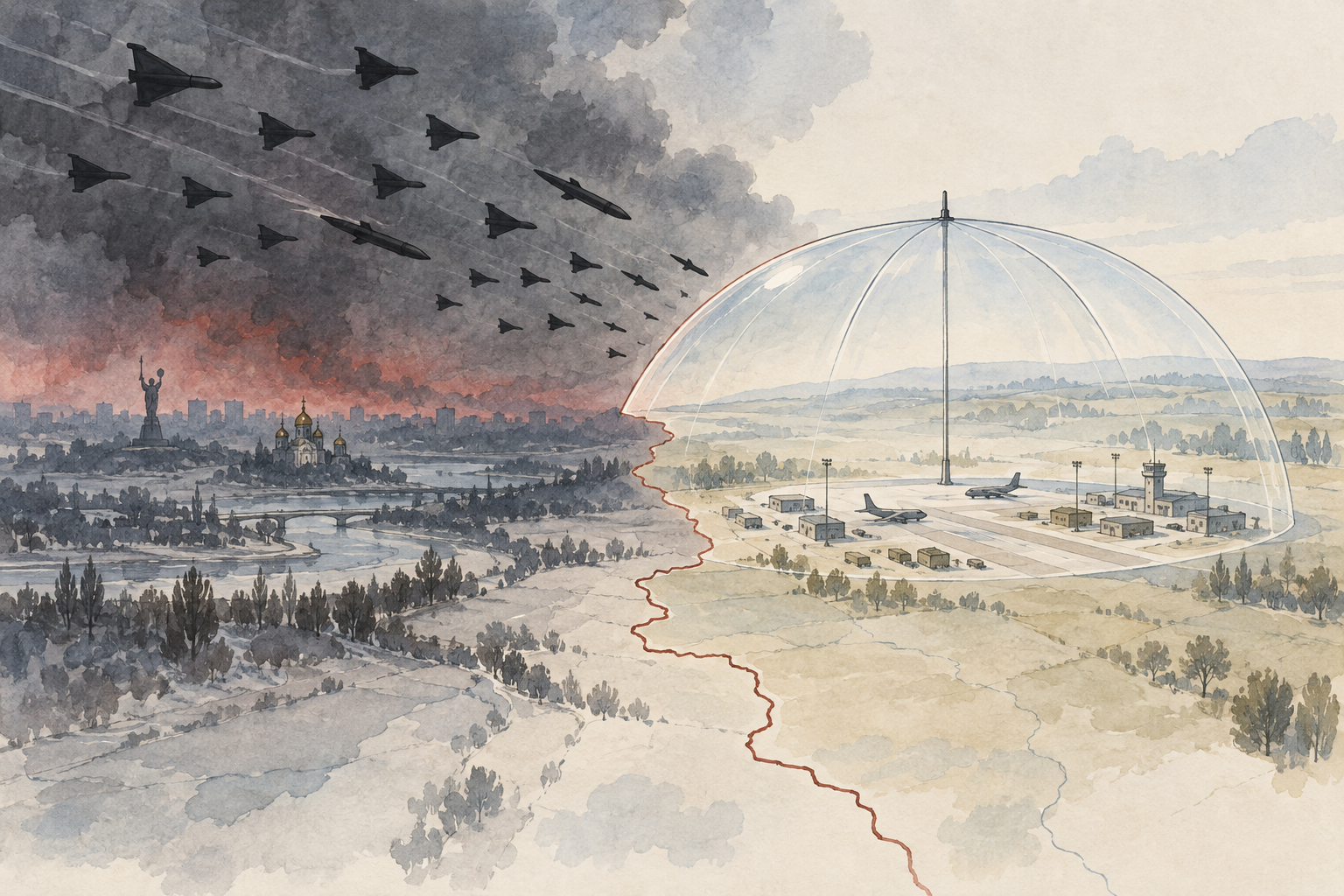
Rzeszow hub
Rzeszow in southeastern Poland has been a major transit point for Western military and humanitarian support moving into Ukraine.
Airspace violation
An airspace violation occurs when an aircraft, missile or drone enters a state’s sovereign airspace without authorization; Poland said none was registered in this alert.
Mixed salvo
A strike package combining drones, ballistic missiles, cruise missiles or decoys to overload or confuse air-defense systems.
Escalation management
The process by which states signal readiness and defend themselves while trying to avoid unintended widening of a conflict.
Reuters via AOL
news
Russia strikes Kyiv and other Ukrainian cities, Poland scrambles jets
Reuters via MarketScreener
news
Poland ends alert after jets scrambled, sirens sound as Russia strikes western Ukraine
Polskie Radio
news
Poland scrambles fighter jets as Russia launches drone attack on western Ukraine
Untracked bias
100% of tracked sources are High factuality
Bias and factuality ratings from Media Bias Fact Check. Outlets without a rating are marked “Untracked.”
Border alert
Poland scrambled aircraft and temporarily suspended flights at Rzeszow and Lublin after Russian strikes near its border with Ukraine.
No breach
Polish authorities said no violation of Polish airspace was registered during the Sept. 17 alert.
NATO risk
Near-border Russian attacks can pressure NATO air defenses and logistics hubs even without a confirmed incursion.
Russia’s large Sept. 17 missile-and-drone barrage against Kyiv and other Ukrainian regions underscored a growing risk for NATO: Moscow can increase pressure on allied air forces without crossing the alliance’s borders.
Poland scrambled aircraft, sounded air-raid sirens in eastern areas and temporarily suspended flights at Rzeszow and Lublin after Russian strikes in western Ukraine near the Polish border, according to Reuters and Polish authorities. The Polish military later said no violation of Polish airspace had been registered, and the two airports reopened after the alert ended.123
That distinction matters. The crisis did not become a confirmed NATO airspace incident. But the response showed how Russia’s expanding strike geography — especially attacks on western Ukraine and daylight strikes — can force Warsaw and allied air-defense networks into fast, politically sensitive decisions even when incoming weapons remain on the Ukrainian side of the border.
The Sept. 17 wave was not limited to the border region. Ukrainian officials reported damage and casualties in Kyiv. The Kyiv City State Administration recorded repeated air alerts, drone and missile damage across several districts, water-pressure disruptions and emergency response operations during the day.5 The Kyiv Independent, citing Ukrainian authorities, reported at least 10 people killed and 75 injured across Ukraine over the past day, with Kyiv, Zaporizhzhia and Odesa oblasts among the hardest-hit areas.6
For NATO, the main danger is often framed as a Russian missile or drone entering Polish territory. That remains the clearest trigger for allied crisis management. But the Sept. 17 alert showed a broader problem: Russia can create air-defense risk for NATO by striking Ukrainian targets close enough to Poland that allied commanders must assume, at least temporarily, that flight paths, debris, malfunctions or guidance errors could threaten allied territory.
Reuters reported that sirens sounded in eastern Poland as Russia struck western Ukraine near the border. Poland’s military launched preventive air operations and later ended the alert after no breach was recorded.2 Polskie Radio, citing Poland’s Operational Command, the Government Security Centre and the Polish Air Navigation Services Agency, reported alerts in Lubelskie and Podkarpackie, temporary airport suspensions and later reopening, again with no Polish airspace breach reported.3 Euronews reported Poland’s preventive deployment of air power and restrictions at Rzeszow and Lublin, while Prime Minister Donald Tusk described a massive strike near the Yahodyn-Dorohusk area, a key border zone for Ukraine-Poland movement.4
That combination — near-border strikes, civilian flight restrictions, military aircraft in the air and public warnings — compresses the timeline for judgment. Polish and allied forces must decide whether to track, intercept, warn civilians or close airspace before they know whether a Russian weapon will remain inside Ukraine. The absence of a confirmed airspace violation lowers the legal and alliance threshold, but it does not remove the operational risk.
Russia’s focus on western Ukraine has strategic significance beyond the immediate damage. Western regions are vital to Ukraine’s military and economic endurance. They host repair, storage, training, energy and transport nodes and connect Ukraine to Poland, Slovakia, Romania and other European support routes. Attacks there also signal to NATO countries that support for Kyiv carries proximity risk.
The Sept. 17 barrage included ballistic missiles, cruise missiles, Oniks anti-ship missiles and nearly 160 drones, according to Ukrainian air-force figures cited by Reuters and Ukrainian reporting.16 The scale matters because larger mixed salvos complicate air-defense sorting. Ukraine must distinguish missiles, slower Shahed-type drones, decoys and loitering munitions, while Poland must watch for spillover along a heavily monitored border.
A follow-on overnight attack beginning Sept. 17 suggested the pressure did not end with one wave. UNN, citing Ukraine’s Air Force, reported that Russia launched 93 drones and loitering munitions, including 46 jet-powered Shaheds. Ukraine said 72 targets were neutralized and 13 impacts were recorded.7 Jet-powered drones, if used in larger numbers, could further narrow decision windows for Ukrainian and neighboring air-defense operators.
Temporary restrictions at Rzeszow and Lublin were significant because both sit inside the logistics geography of NATO support to Ukraine. Rzeszow, in particular, has been a major hub for Western military and humanitarian aid moving toward Ukraine. Even a short suspension of flights can be read by Moscow, Kyiv and allied capitals as evidence that strikes just across the border can disrupt, or at least complicate, allied routines without directly attacking NATO territory.
That makes the border area an escalation-management zone rather than a simple rear area. For Warsaw, the priority is to protect Polish airspace and reassure civilians without appearing to escalate unnecessarily. For Kyiv, the challenge is to defend western infrastructure while keeping cross-border support flowing. For NATO air forces, the task is to preserve deterrence and readiness while avoiding an accidental clash triggered by ambiguous tracks or debris.
Poland’s public messaging reflected that balance. Authorities activated aircraft and issued warnings, but also emphasized that no violation had been registered once the alert ended.13 That approach aims to show readiness without overstating the event. It also leaves open a harder question: how often NATO can repeat these alerts before the risk of miscalculation rises.
Russia does not need to announce an intent to test NATO for near-border strikes to have that effect. Ambiguity itself can be useful. Al Jazeera reported that Tusk warned intelligence suggested possible Russian hybrid drone and missile attacks against states supporting Ukraine, a warning that came alongside the aircraft scramble and temporary Rzeszow and Lublin closures.8 The Institute for the Study of War assessed that Russian drone incursions and ambiguity around NATO-adjacent airspace are part of a broader Russian pressure campaign against NATO, including efforts to create psychological and informational conditions for future provocations.9
That assessment does not prove every near-border strike is designed to provoke NATO. Some may be aimed principally at Ukrainian logistics, energy or military targets. But the effect is similar: allied air-defense systems are pushed into higher readiness, civilian authorities must manage alarms and Moscow can observe NATO procedures, response times and political messaging.
The Sept. 17 episode therefore sits in a gray zone below direct attack but above routine battlefield activity. It is a test of thresholds, not only radar coverage. If Russia can normalize heavy strikes near NATO borders, it may increase the frequency with which allied commanders face ambiguous aerial threats.
The immediate NATO response is likely to remain defensive: more combat air patrols, tighter radar integration, temporary airspace restrictions and closer coordination with Ukrainian air-defense data. But the political problem is harder. If NATO reacts too little, Russia may perceive freedom to intensify near-border attacks. If it reacts too aggressively, Moscow may portray defensive measures as escalation.
The Sept. 17 barrage shows why the alliance’s eastern flank is increasingly defined by risk management, not formal red lines alone. Poland did not report a confirmed airspace violation. Yet Polish aircraft still launched, sirens still sounded and airports still suspended flights.24 That is the practical effect of Russia’s evolving strike pattern: western Ukraine’s rear areas and NATO-adjacent logistics hubs are becoming a more dangerous interface between the war and the alliance.
For Kyiv, Warsaw and NATO, the key question is no longer only whether a Russian drone crosses the border. It is how to manage repeated near-border attacks that force allied defenses to act as if one might.








Comments