Static front pushes Ukraine war deeper into infrastructure strikes
Refining capacity
The maximum amount of crude oil a refinery system can process into usable fuels such as diesel, gasoline and jet fuel.
Jet-powered Shahed
A faster variant of Russia’s Shahed-type attack drones that can be harder for slower interceptor drones and mobile fire teams to stop.
Electronic warfare
The use of jamming, spoofing or other electromagnetic tools to disrupt drones, missiles, communications or targeting systems.
Inverted pyramid
A news structure that places the most important facts first, followed by supporting detail, context and analysis.
Associated Press
news
Ukraine claims its attacks have taken out more than half of Russia's oil refining capacity
Ukrainska Pravda
news
Ukraine puts more than 51% of Russia's oil refining capacity out of action
RBC-Ukraine
news
Russia launches 205 drones at Ukraine, including 49 jet-powered Shaheds
Untracked bias
100% of tracked sources are High factuality
Ukrainska Pravda
Ukraine puts more than 51% of Russia's oil refining capacity out of action
TVP World
‘Knocked out’: Ukraine says more than half of Russia’s oil refining capacity now destroyed
RBC-Ukraine
Russian forces unleash 205 drones on Ukraine overnight as air defenses fight back
KSAT
Ukraine claims its attacks have taken out more than half of Russia's oil refining capacity
Local 10
Ukraine claims its attacks have taken out more than half of Russia's oil refining capacity
News4JAX
Ukraine claims its attacks have taken out more than half of Russia's oil refining capacity
WESH
Ukraine claims its attacks have taken out more than half of Russia's oil refining capacity
WMTW
Ukraine claims its attacks have taken out more than half of Russia's oil refining capacity
SeattlePI
Ukraine claims its attacks have taken out more than half of Russia's oil refining capacity
The Hour
Ukraine claims its attacks have taken out more than half of Russia's oil refining capacity
2 News
Ukraine claims its attacks have taken out more than half of Russia's oil refining capacity
Bias and factuality ratings from Media Bias Fact Check. Outlets without a rating are marked “Untracked.”
Refinery claim
Ukraine says its long-range strikes have disabled 51% of Russia’s oil refining capacity, a claim not independently verified.
Drone barrage
Ukraine’s Air Force said Russia launched 205 drones overnight, with 172 shot down or suppressed and impacts recorded at 13 locations.
AI defenses
Ukraine says AI-assisted automatic gun turrets have begun downing Russian jet-powered drones as Kyiv adapts to faster attack systems.
Ukraine’s claim that its long-range attacks have put 51% of Russia’s oil refining capacity out of action, if even partly borne out, would mark a significant shift in the war’s logistics contest. With the front line largely static, Kyiv is trying to turn fuel production and distribution into battlefield vulnerabilities. The Associated Press reported that the claim could not be independently verified, but that Kyiv tied the figure to recent strikes on refineries in Moscow, Yaroslavl, Ust-Luga, Perm, Saratov and Syzran.1
The same reporting cycle showed the other side of the pattern. Russia launched 205 drones at Ukraine overnight into Monday, while Moscow said it struck energy, port and military-linked infrastructure, including an electrical substation in Kharkiv region and maritime targets it alleged were used by Ukraine’s military.16 Ukrainian officials said air defenses shot down or electronically suppressed 172 drones, but hits were recorded at 13 locations. The figures show how even high interception rates can leave critical infrastructure exposed.34
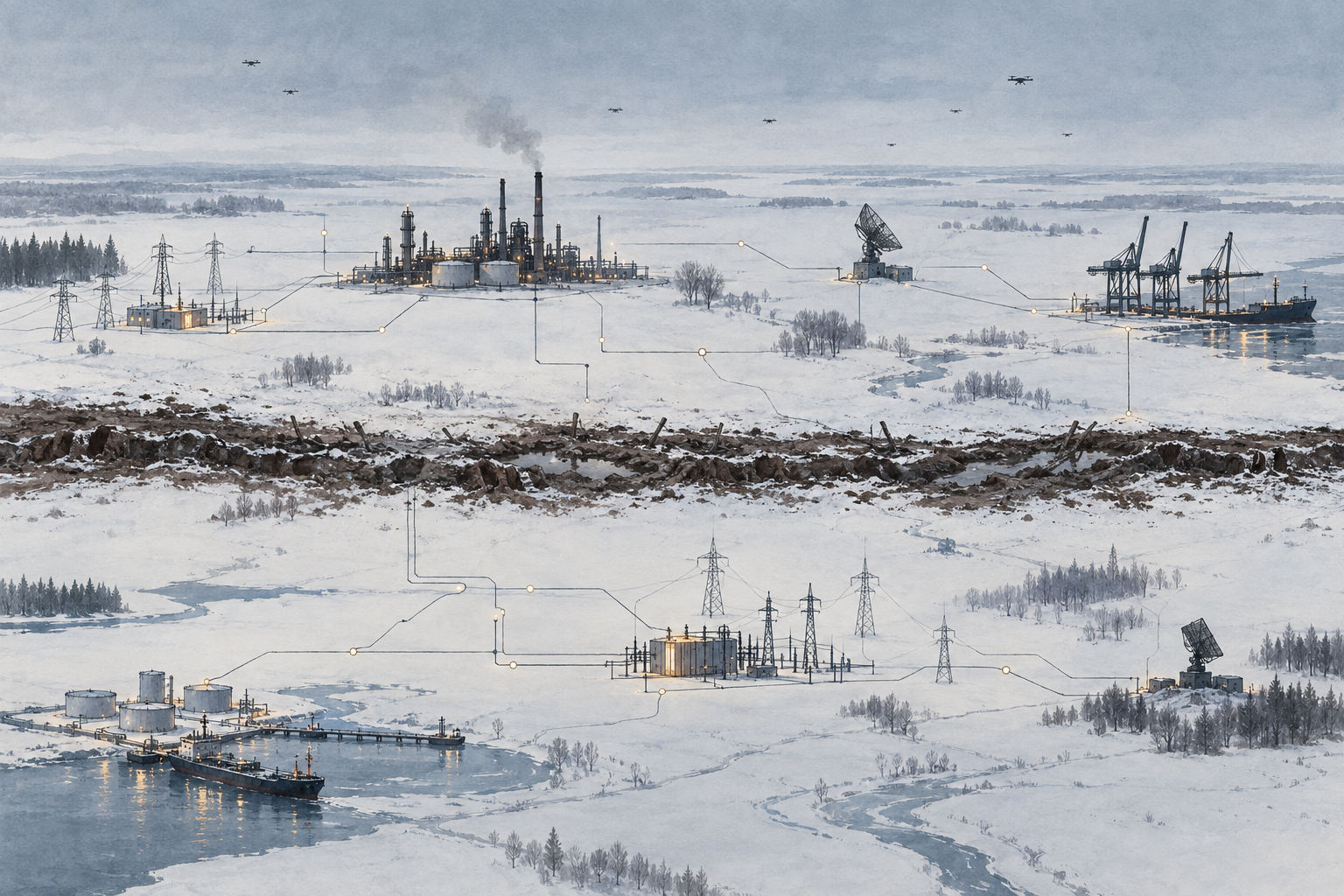
The war is increasingly being fought through the systems that sustain the battlefield, not only through maneuver on it: oil refineries, fuel depots, substations, port nodes, cargo vessels, drone factories and short-range air-defense networks. With neither side achieving rapid territorial breakthroughs, both are expanding the definition of a military target to include infrastructure that keeps armies supplied and populations under pressure.
Ukraine’s stated aim is to degrade Russia’s ability to supply its forces and finance the war. Ukrainska Pravda, citing Ukraine’s Defence Ministry and Defence Minister Yevhenii Khmara, reported that the 51% figure came from assessments by military intelligence, the General Staff and the ministry, and named recently hit refineries as part of the campaign.2 AP likewise reported Khmara’s argument that the strikes affect Russia’s economy, its ability to conduct aggression and its capacity to supply troop groupings.1
The military logic is direct. Russia’s army needs large volumes of diesel, gasoline, lubricants and aviation fuel to move armor, trucks, generators, engineering equipment and aircraft support systems. A refinery is not a frontline ammunition dump, but repeated damage to refining units can force longer transport routes, emergency repairs, rationing, lower-quality fuel blends or the diversion of air defenses to industrial sites far from the front.
The campaign also creates uncertainty. If Russia must assume that refineries hundreds, or even more than a thousand, kilometers from Ukraine are vulnerable, Moscow faces a choice: disperse air defenses across a wider rear area or accept repeated disruption to fuel production. That is the logistics calculus Kyiv appears to be trying to change, forcing Russia to spend scarce defensive capacity on its war economy instead of concentrating those systems near occupied Ukraine or around major cities.
Still, the 51% claim should be treated cautiously. It has not been independently verified, and “capacity out of action” can mean different things depending on whether a facility is fully offline, operating at reduced output or temporarily halted for repairs. Russia has not published comprehensive damage data on its oil infrastructure.1 The operational impact also depends on how quickly plants can restore output, whether Russia can reroute refined products and whether stockpiles can cushion frontline units.
The refinery campaign is unfolding against a battlefield defined by intense but grinding combat. Ukraine’s General Staff reported 177 combat engagements over the previous day, with Russian forces most active in the Pokrovsk and Kostiantynivka directions.7 The front is far from quiet, but the pattern remains attritional: heavy daily pressure, limited movement and no clear path to a decisive breakthrough.
In that environment, strategic infrastructure attacks offer both sides another way to impose costs. Ukraine can use long-range drones and missiles to reach deep into Russian industry, seeking cumulative disruption that may not immediately appear on a map. Russia can use drone-and-missile salvos to stretch Ukraine’s air defenses, damage power and port systems, and force Kyiv to spend interceptors, ammunition and manpower protecting cities.
The operational question is whether infrastructure pressure can produce battlefield effects. For Ukraine, refinery strikes matter most if they reduce the reliability, cost or speed of Russian fuel supplies to combat formations. For Russia, attacks on substations, ports and logistics-linked nodes matter if they slow Ukrainian military transport, weaken export revenue, disrupt repair cycles or exhaust air-defense stocks.
Russia’s overnight package of 205 drones included 49 jet-powered Shahed-type drones, according to RBC-Ukraine’s account of the Ukrainian Air Force statement.3 Ukrainska Pravda reported that the attack involved multiple launch directions, several drone types, electronic warfare and mobile fire groups, with 172 drones neutralized and 13 impact locations recorded.4
Those figures point to a central problem for Ukraine: the defense can perform well statistically and still fail locally. A large drone wave forces defenders to detect, track, classify and engage many targets at once. Some drones may be decoys, some may be slower propeller-driven systems and others may be faster jet-powered models designed to outrun cheaper interceptors or compress reaction time.
The pressure is not only military. BTA reported that Odesa regional authorities said Russia hit industrial and port infrastructure in the region during the overnight attack.5 Russia’s Defense Ministry, according to Anadolu’s summary, claimed strikes on Ukrainian energy and port infrastructure, the Kochetok substation, a port point at Vilkovo, fuel depots at Chornomorsk and cargo ships it alleged were linked to Ukraine’s military.6 Such targets sit at the intersection of civilian economic life and military logistics, making them especially consequential in a long war.
Ukraine’s answer is increasingly layered and improvised. The Kyiv Independent reported that Air Force spokesperson Yurii Ihnat said AI-assisted automatic gun turrets had begun downing Russian jet-powered drones after 12 such systems were installed in areas where the threat has been especially active, including around Kyiv.8 The same report noted that many existing interceptor drones struggle with the speed of jet-powered Russian drones, while jet-powered interceptors face production and supply-chain constraints.8
That makes air defense a production race as much as a technology race. Ukraine needs expensive systems for missiles and ballistic threats, but it also needs cheaper, scalable defenses against mass drone attacks: electronic warfare, mobile gun teams, interceptor drones, automated turrets, sensors and command software. Russia’s apparent strategy is to keep increasing the volume, variety and speed of attack drones until gaps appear.
The refinery campaign and the drone-defense campaign are linked. Each side is trying to force the other into unfavorable resource allocation. Ukraine wants Russia to defend sprawling oil infrastructure and absorb fuel disruptions. Russia wants Ukraine to defend every city, substation, port and logistics node against repeated mass attacks. The side that can impose more cost with cheaper systems will gain an advantage even without dramatic territorial movement.
The immediate facts remain contested. Ukraine’s 51% refinery-capacity claim is unverified, and Russia’s claims about military-linked Ukrainian port and maritime targets should also be read as battlefield assertions rather than independently established fact.16 But the trend is clear: the war’s center of gravity is widening from trenches and assault corridors to the industrial networks that sustain both armies.
For Kyiv, the key test is whether refinery strikes can create durable logistical strain rather than temporary fires and repair cycles. For Moscow, the test is whether drone-and-missile pressure can overwhelm Ukraine’s air defenses faster than Kyiv and its partners can field cheaper counter-drone systems. As the ground war stalls, the decisive targets may increasingly be behind the front: fuel-processing units, power substations, port infrastructure and the defensive machines built to keep them alive.






Comments