Supreme Court keeps Missouri’s 2022 House map in place for November election
Purcell principle
A Supreme Court election-law doctrine cautioning federal courts against changing election rules close to an election because of the risk of voter confusion and administrative disruption.
Referendum petition
A process that allows voters to place a law passed by the legislature on the ballot, potentially delaying or blocking the law until voters approve it.
UOCAVA voters
Military and overseas voters covered by federal law who receive special protections to ensure they can vote from outside their home jurisdiction.
Stay
A court order that temporarily blocks the effect of another court’s ruling while further proceedings or appeals continue.
Mingooland
news
For the third time, Supreme Court declines to allow Missouri to use congressional map expected to aid Republicans
News Portal News Agency / TodayNews
news
Supreme Court rejects GOP’s third effort to capture Democratic House seat in Missouri
The Dispute Index
other
Should Missouri be allowed to use its 2025 congressional map in the 2026 general election?
Untracked bias
67% of tracked sources are High factuality
Missouri Independent
US Supreme Court again blocks Missouri’s gerrymandered congressional map
CBS News
Supreme Court again blocks Missouri's new map drawn to give Republicans an edge
Bias and factuality ratings from Media Bias Fact Check. Outlets without a rating are marked “Untracked.”
2022 map stays
The Supreme Court’s September 25 order keeps Missouri’s 2022 congressional map in place for the 2026 general election.
Voting underway
The justices emphasized that absentee, military and overseas voting had already begun under ballots printed with the 2022 map.
Referendum pending
Missouri voters still will decide Proposition A, the referendum on whether to approve the 2025 congressional map.
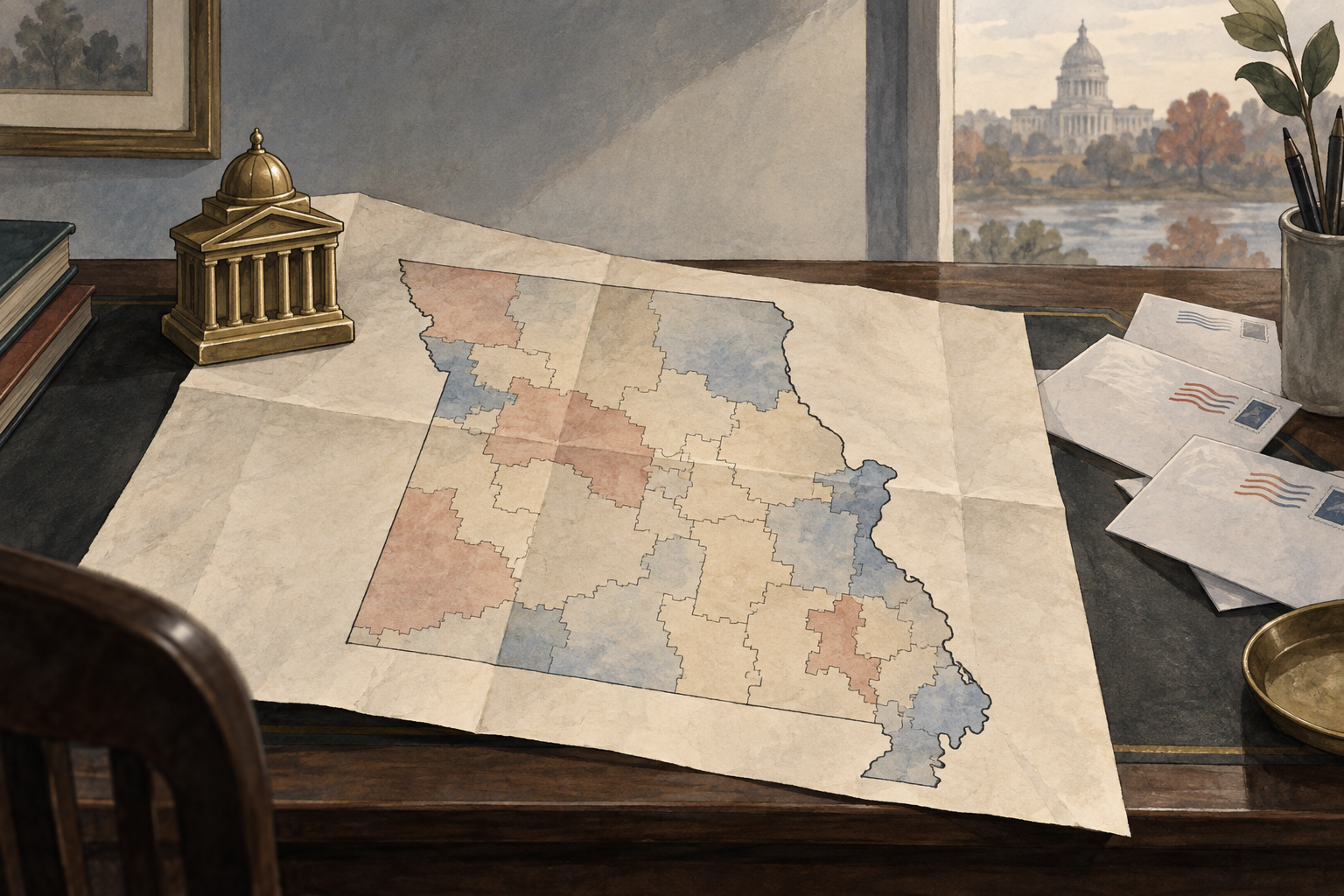
The U.S. Supreme Court on Friday kept Missouri’s 2022 congressional map in place for the November 2026 election, staying lower-court orders that would have required the state to switch to a 2025 map after absentee, military and overseas voting had begun.1
The unsigned September 25 order in People Not Politicians v. Onder was the court’s third intervention in Missouri’s map fight this month. It preserved the practical effect of an earlier Supreme Court stay: Missouri election officials should not be required to use the 2025 congressional map in the 2026 general election and should continue administering the election under the 2022 map.13
The ruling focused less on the politics of redistricting than on election administration. The justices treated the Missouri Supreme Court’s reading of state law as controlling for now and emphasized the risk of changing rules after ballots had been printed and mailed. The 2025 map was backed by Republicans and reported as part of a national effort supported by President Donald Trump to improve the party’s position in the midterm fight for the U.S. House.24
The Supreme Court granted a stay sought by People Not Politicians and other challengers, blocking September 21 and September 22 actions by the U.S. Court of Appeals for the Eighth Circuit and the federal district court that would have required use of the 2025 map.3
That means the 2022 map remains the operative map for Missouri’s November 3 congressional election unless the Supreme Court later changes course. The order also left in place the court’s September 10 stay of an earlier federal district court order that had similarly pushed the state toward the 2025 boundaries.13
For election officials, the immediate instruction is clear: continue using the 2022 map, maintain ballots already issued under that map and avoid a midstream switch to the 2025 plan now that voting is underway.9
Missouri enacted a congressional map in 2022. In 2025, the Republican-led state government enacted a new congressional plan expected to improve GOP prospects, including by targeting Democratic Rep. Emanuel Cleaver’s Kansas City-based district.17
Opponents pursued a referendum petition to put the 2025 map before voters. The referendum effort is now tied to Proposition A, which asks Missouri voters whether to approve the 2025 congressional map.58
On September 3, the Missouri Supreme Court ruled that, under the state constitution, the 2025 map had not taken effect because the referendum petition was legally sufficient. The state court concluded that the 2025 plan could not be used unless and until voters approved it.13
Missouri Secretary of State officials and supporters of the 2025 map then sought emergency relief. On September 8, Justice Brett Kavanaugh, acting for the Eighth Circuit, declined to stay the Missouri Supreme Court’s decision, leaving the 2022 map in effect at that point.1
But the dispute quickly shifted to federal court. Later on September 8, a federal district court in Missouri ordered the state to use the 2025 map. On September 10, the full Supreme Court stayed that order without noted dissent, again preserving the 2022 map for the general election.13
The fight returned after the Eighth Circuit on September 21 ordered the district court to enter a permanent injunction requiring the 2025 map. The district court followed with injunctions on September 21 and September 22. People Not Politicians then returned to the Supreme Court, which issued Friday’s stay.3
The justices’ September 25 order leaned heavily on timing. By the time the Eighth Circuit acted, ballots using the 2022 map had been printed and mailed, absentee voting had begun, and military and overseas voters had started receiving ballots.14
That placed the case in the territory of election-administration doctrine: federal courts are generally cautioned against changing election rules close to an election. Here, the Supreme Court treated the risk as even sharper because the election was no longer merely approaching; voting was already underway.14
The decision also signaled deference to the Missouri Supreme Court’s interpretation of Missouri law. The state court had ruled that the referendum petition prevented the 2025 map from taking effect before voter approval. The federal plaintiffs argued that the U.S. Constitution required Missouri to use in the general election the same map it used in the primary, but the Supreme Court did not accept that argument as clear enough to justify a late change.13
County clerks and election authorities must proceed with the 2022 congressional map for the 2026 general election. That affects ballot styles, voter assignments, absentee processing, and military and overseas ballots already issued.9
The practical consequence is that some candidates who ran in the August primary under the 2025 map will not be running in those same district configurations in November. Supporters of the 2025 map argued that this harms voters and candidates who participated under one set of district lines only to see another used in the general election.6
Rep. Bob Onder, a plaintiff in the federal case, called the Supreme Court’s decision disappointing and argued that the state court process had disenfranchised 1.2 million Missourians.6
Map opponents countered that the disruption would be greater if officials were forced to reconfigure an election already in progress. Richard von Glahn of People Not Politicians said after the order that the group was done with politicians trying to force the 2025 map into effect and would continue the referendum fight.5
Cleaver, whose district was a central target of the 2025 plan, said the Supreme Court had put the effort to rest and pointed to the more than 305,000 referendum signatures submitted by opponents of the new map.7
National Democratic redistricting groups also framed the decision as a rejection of another attempt by Missouri Republicans to push through the 2025 map before voters could decide Proposition A.8
The Supreme Court’s order does not remove the 2025 map from Missouri politics. Instead, it separates the November election-administration question from the referendum question.
Voters will still decide Proposition A, the referendum on the 2025 congressional map. If voters approve it, the 2025 map could take effect later under Missouri law. If they reject it, the 2025 plan would fail at the ballot box.58
For the 2026 general election, however, the immediate rule is settled unless the Supreme Court issues another order: Missouri votes under the 2022 congressional map.




Comments