Trump’s tariffs test executive trade power ahead of midterms
Section 301
A provision of the Trade Act of 1974 that lets the U.S. respond to unfair foreign trade practices, including through tariffs.
Import duty
A tax charged on goods brought into the country. Importers pay it at the border and may absorb the cost or pass it to consumers.
Congressional acquiescence
A situation in which Congress does not formally approve a policy but allows the executive branch to keep using power in practice.
Inverted pyramid
A news structure that puts the most important facts first, followed by context and supporting detail.
Associated Press
news
Trump sticks with tariffs even as US voters turn against them before the midterms
Associated Press
news
Republicans face midterm backlash from factory workers squeezed out of jobs by Trump's tariffs
ABC News / Associated Press
news
Republicans face midterm backlash from factory workers squeezed out of jobs by Trump's tariffs
Untracked bias
100% of tracked sources are High factuality
SeattlePI
Trump sticks with tariffs even as US voters turn against them before the midterms
The Economic Times
Trump sticks with tariffs even as US voters turn against them before the midterms
Dunya News
Trump sticks with tariffs even as US voters turn against them before the midterms
NBC Chicago
Trump sticks with tariffs even as U.S. voters turn against them before the midterms
RiverBender.com
Trump sticks with tariffs even as US voters turn against them before the midterms
Internewscast
Trump Stands by Tariffs Despite Growing US Voter Opposition Ahead of Midterms
Bias and factuality ratings from Media Bias Fact Check. Outlets without a rating are marked “Untracked.”
Legal pivot
After a February Supreme Court setback, the White House shifted chiefly to Section 301 of the Trade Act of 1974 to keep tariffs in place.
Broad duties
The current duties range from 10% to 12.5% on imports from 60 economies, including major U.S. trading partners.
Factory backlash
AP reporting links tariff-driven cost pressures to layoffs or closures in manufacturing states including Michigan, Iowa, Kansas and Pennsylvania.
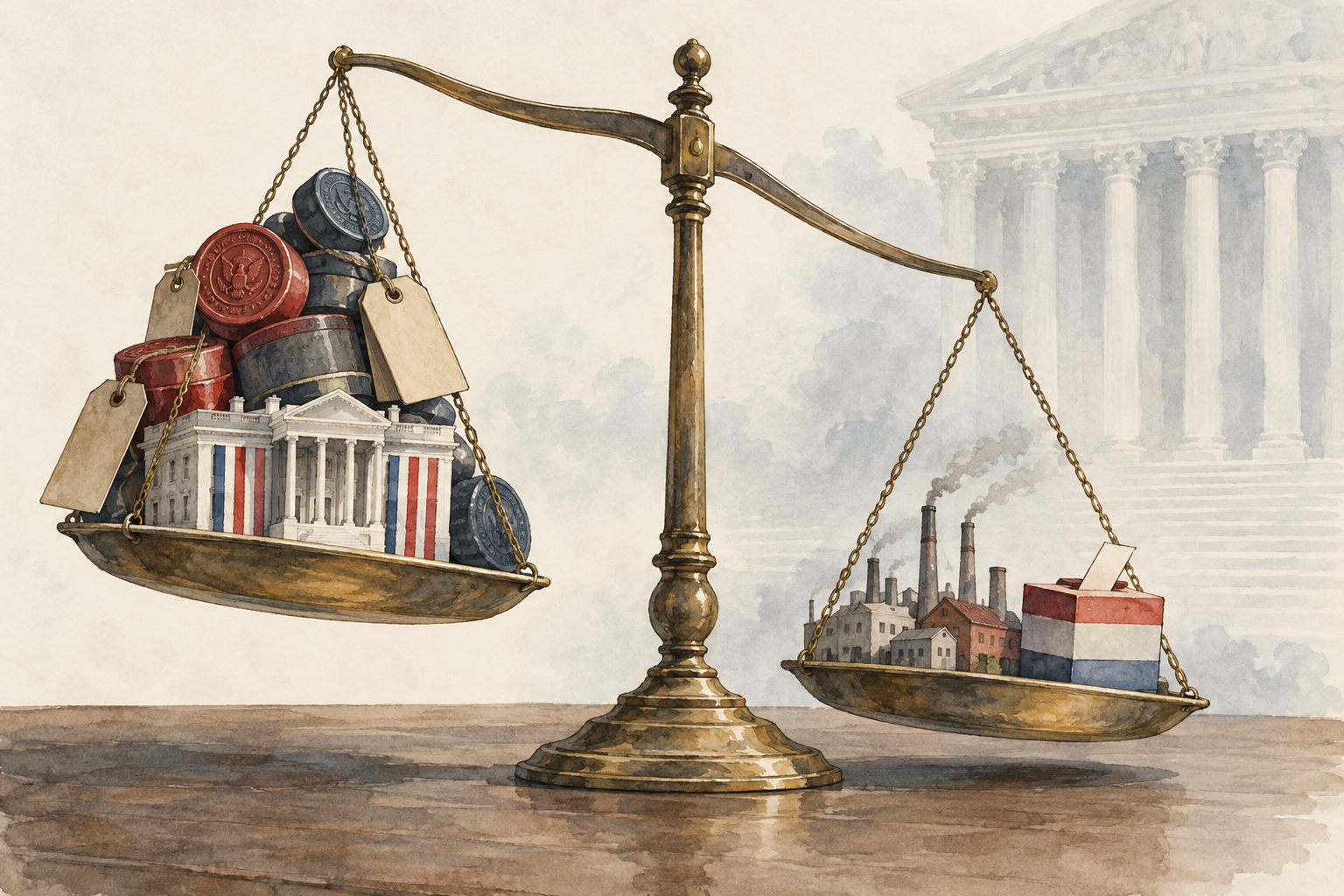
President Donald Trump is keeping broad import duties at the center of his economic agenda, even after a February Supreme Court setback and amid signs voters are turning against his trade policy. The result is a midterm test of executive power, congressional restraint and Republican risk in manufacturing states.1
The governing path has changed. Trump’s largest tariff round relied on a 1977 emergency law that he said allowed him to act without congressional approval. After the Supreme Court struck down that approach in February, the administration turned to other trade authorities, chiefly Section 301 of the Trade Act of 1974.1 Under that authority, the White House is using duties of 10% to 12.5% on imports from 60 economies, including major U.S. trading partners such as the European Union, India, Japan, Canada and Mexico.156
That shift has moved the tariff fight beyond economics. It now tests whether Congress will accept an expansive use of trade statutes after the courts curtailed one emergency-law rationale. It also tests whether Republicans can defend Trump’s approach in districts where factory closures, layoffs and higher input costs have made tariffs a local political issue.2
Polling reported by AP underscores the risk. Most U.S. adults disapprove of Trump’s trade policies, and more than 64% say his latest tariffs go too far, up from 58% in January.1 A separate AP-NORC poll cited in AP’s manufacturing-district report found that only about three in 10 U.S. adults approve of Trump’s handling of trade negotiations, down from about four in 10 in March.2
The administration’s post-February strategy rests on a narrower but still potent legal claim: that the president can impose tariffs in response to unfair trade practices under Section 301.1 AP reported that the law allows tariffs on countries the president believes are engaging in unfair trade practices, including failures tied to enforcement of forced-labor bans.1
That matters because Trump’s earlier approach treated trade deficits and import flows as an emergency that justified broad, unilateral tariffs. The Supreme Court’s February ruling did not end the tariff program, but it forced the White House to route the policy through other statutes rather than the emergency-law basis used for the broadest “Liberation Day” duties.12
The result is a more complex tariff regime. The rates remain broad enough to affect imports from dozens of economies, but the governing argument has shifted from emergency discretion to trade-law enforcement. For Congress, the question is whether lawmakers will reclaim authority over tariffs or continue allowing the executive branch to use existing statutes to set sweeping import taxes.1
Republicans are not responding uniformly. Some continue to defend tariffs as a tool for rebuilding domestic manufacturing. Others are trying to acknowledge the costs without openly breaking with Trump.
In Michigan’s 4th Congressional District, Republican Rep. Bill Huizenga supported Trump’s broad tariff push before implementation. AP reported that a Huizenga spokesperson later said the congressman “sees a potential role for tariffs” in boosting domestic manufacturing while recognizing the need to address wider economic effects.2 That phrasing captures a broader Republican posture: tariffs are defended as leverage, but their costs are increasingly difficult to dismiss.
The political exposure is concentrated in places where import-dependent manufacturers have cut jobs. AP reported that Howard Miller, a Michigan clockmaker that relied on overseas parts, closed its factory and laid off nearly 200 workers after a century in business.2 In Iowa, Winnebago Industries cut 200 jobs after the cost of importing aluminum, steel and electronics rose by tens of millions of dollars.23 In Kansas, appliance maker Vornado Air laid off more than 70 factory workers and blamed higher prices for imported parts.24
Those examples are now part of competitive races. AP identified tariff backlash as an issue in Michigan, Iowa, Kansas, Ohio and Pennsylvania, including contests involving Huizenga in Michigan, Republican Rep. Ashley Hinson in Iowa’s open U.S. Senate race and Republican Sen. Roger Marshall in Kansas.23
The problem for Republicans is not only that tariffs are unpopular in national polling. It is that the policy can be tied to specific business decisions in districts and states where manufacturing identity is politically important. Even where tariffs are not the sole cause of layoffs, they have become part of the cost structure companies cite when cutting jobs or delaying plans.24
Democrats’ clearest strategy is to frame Republican candidates as complicit in Trump’s unilateral tariff policy. In Michigan, Democrat Sean McCann has criticized Huizenga for opposing legislation that would rein in tariffs imposed by Trump without Congress.2 That line of attack shifts the debate from whether tariffs can ever be useful to whether Republican lawmakers have surrendered Congress’ trade role to the White House.
The available AP reporting points more to a campaign and legislative-restraint strategy than to a fully developed oversight push. Democrats are highlighting factory closures, higher prices and congressional acquiescence, especially in districts where Republicans must defend both Trump’s policy and their own votes or positions on limiting it.23
That approach gives Democrats a way to reach voters who may not oppose tariffs in principle but object to instability, rising costs or unilateral decision-making. AP quoted workers and business leaders describing planning difficulties when tariff rates rose, fell or were threatened abruptly.2 For Democrats, the argument is that Congress should impose guardrails before trade policy becomes a recurring presidential lever with limited legislative accountability.
The Nov. 3 midterms will not be a single-issue referendum on trade. AP’s reporting notes that some voters affected by tariffs may still support Republicans because of other issues, and some economists say manufacturing discontent may not translate neatly into Democratic wins.2 Tariffs are also not the only factor behind factory job losses; manufacturing has faced automation, demand shifts and global competition for decades.2
Still, the tariff fight now carries institutional stakes. Trump’s response to the Supreme Court ruling shows how a president can adapt after losing one legal theory by relying on other trade statutes. Republican responses show how congressional majorities can defend that flexibility, tolerate it or try to distance themselves from its consequences. Democratic responses show whether the opposition can turn unease over prices and layoffs into a concrete argument for limiting executive trade power.
That is why tariffs have become more than a White House economic tool. They are now a governing test: whether courts, Congress and voters will accept a presidency that continues to set broad import duties after one legal path has been rejected, and whether Republicans in manufacturing districts can survive the political costs of that choice.12







Comments