U.S. posture signals pressure-and-deterrence phase in Iran conflict
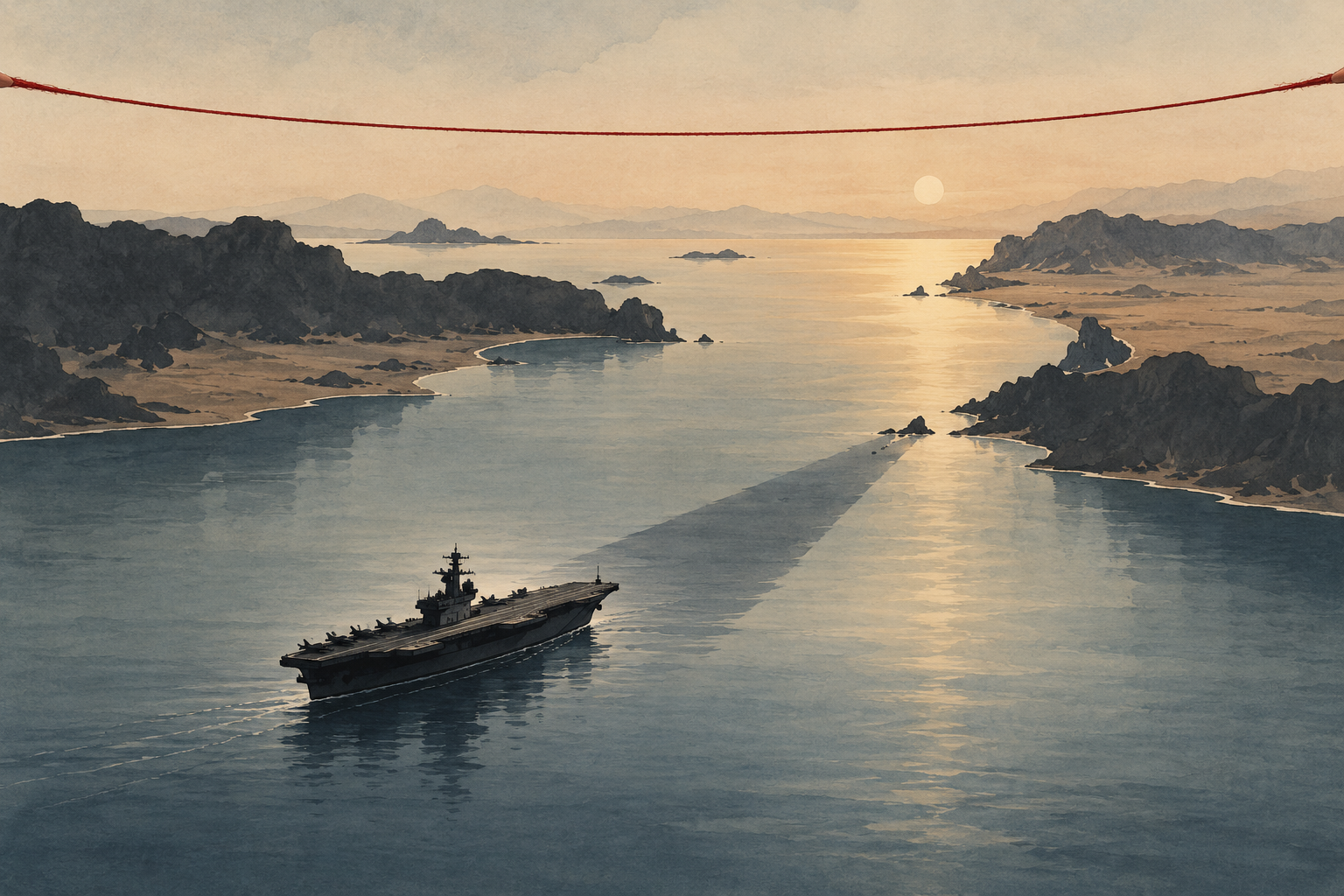
Carrier strike group
A naval formation centered on an aircraft carrier, usually accompanied by destroyers, cruisers, submarines and support ships for air, strike and defensive operations.
Amphibious Ready Group
A group of Navy amphibious ships carrying Marines, aircraft and landing craft that can support evacuations, raids, crisis response or limited combat operations.
Strait of Hormuz
A narrow waterway between Iran and Oman that connects the Persian Gulf to the Gulf of Oman and is a key route for global oil and gas shipments.
Deterrence
A strategy that uses credible military capability and signaling to discourage an adversary from taking certain actions.
Untracked bias
Bias and factuality ratings from Media Bias Fact Check. Outlets without a rating are marked “Untracked.”
Options retained
Hegseth said Trump would keep military options available if Iran refused to abandon nuclear ambitions.
Carrier rotation
The USS George H.W. Bush has left the Middle East, while the USS Theodore Roosevelt and Makin Island Amphibious Ready Group are en route.
Hormuz risk
Traffic through Hormuz shows signs of recovery, but recent tanker strikes continue to threaten commercial shipping.
Defense Secretary Pete Hegseth’s Oct. 3 warning that President Donald Trump will keep “all the options he needs on the table” if Iran does not abandon its nuclear ambitions points to a new phase in the conflict: pressure and deterrence, where force positioning may matter as much as formal diplomacy.1
The signal is not only rhetorical. U.S. naval movements could soon put additional carrier and amphibious forces within reach of the Middle East, though the exact posture is more fluid than some early accounts suggested. Task & Purpose reported Oct. 4 that the USS George H.W. Bush had left the Middle East and arrived in Thailand, leaving the USS George Washington as the only U.S. aircraft carrier currently in theater, while the USS Theodore Roosevelt and the Makin Island Amphibious Ready Group are en route.3 A possible surge remains real, but the timing and overlap of forces are uncertain.
For Washington, the military posture appears designed to preserve escalation options while reinforcing deterrence around the Strait of Hormuz, Gulf energy infrastructure and U.S. forces in the region. For Tehran, it narrows room for maneuver as Iran tries to restore missile capacity, keep Hormuz leverage alive and secure terms for reopening the waterway.
Hegseth declined to say whether the Theodore Roosevelt strike group, dispatched from San Diego last week, would be sent to the Middle East. Instead, he said his role was to maximize Trump’s “decision space.”1
That phrasing matters. It suggests the Pentagon is not preparing only for a specific operation, but trying to create a range of credible options — from convoy protection and air defense to renewed strikes on missile, drone or nuclear-related targets.
Open-source reporting points to a posture in transition rather than a static armada. Iran International reported that the Theodore Roosevelt carrier strike group and the Makin Island Amphibious Ready Group were moving toward the Middle East, and that, if deployments overlapped, the United States could have had three carrier strike groups and two amphibious groups in the region by late October.1
But the later Task & Purpose report on the George H.W. Bush’s departure changes that count. At least for now, the Middle East carrier presence appears to be one carrier, the George Washington, with another on the way.3
That distinction is important for regional readers. A carrier’s arrival can increase strike capacity, air cover, surveillance, command-and-control options and visible political pressure. But another carrier’s departure suggests the U.S. posture may also involve rotations and endurance management, not only preparation for an offensive.
Even so, Washington’s direction is clear: keep enough force nearby to make threats credible, reassure Gulf partners and reduce the perception that Iran can dictate traffic through Hormuz.
Hegseth claimed Washington, not Tehran, now controlled the Strait of Hormuz, saying a U.S. blockade was “ironclad” and that traffic was approaching pre-war levels.1 The claim is contested, but it captures the central strategic competition. Iran wants the waterway to remain a source of leverage; the United States wants shipping flows to recover enough to blunt that leverage.
Recent traffic indicators point both ways. Iran International reported that Iraq’s state tanker company moved 2 million barrels of crude through Hormuz aboard a very large crude carrier, describing it as the company’s first such operation in decades despite disrupted traffic.6 Bloomberg, cited by Moneycontrol, reported that Middle East crude shipments had recovered to 17.5 million barrels per day, or 98% of prewar levels, while Saudi crude exports rose sharply in September.4
But the route remains dangerous. Moneycontrol reported that five Indian nationals were rescued after the Kuwaiti-flagged MT Kazimah III was struck by a projectile in the Strait of Hormuz and caught fire. The incident followed other reported tanker strikes and prompted warnings for vessels to transit cautiously.5 Those attacks show that even if flows are recovering, maritime risk has not normalized.
The result is a partial U.S. success rather than full control. Washington may be reducing Iran’s ability to halt Gulf exports at scale, but Tehran and aligned actors may still be able to impose intermittent costs through projectiles, drones, mines, harassment or selective attacks on commercial shipping.
Hegseth said Iran was trying to rebuild missile and military capabilities damaged by U.S. strikes, but argued that damage to the defense industrial base had slowed that effort.1 The claim fits a broader U.S. pressure strategy: degrade the systems Iran would need for retaliation while tightening economic and maritime constraints.
Iran still has missiles and drones, and its ability to threaten shipping and regional infrastructure remains central to deterrence. But rebuilding under blockade, sanctions and continued surveillance is harder than replenishing in peacetime. If U.S. and Israeli strikes have damaged production sites, storage networks or precision-guidance supply chains, Tehran may face a sequencing problem: it must deter a new campaign before it has fully restored the arsenal needed to respond.
That creates incentives for both caution and risk-taking. A weaker missile inventory could make Iran more careful about using scarce assets. It could also encourage earlier use if Tehran concludes its remaining capabilities may degrade further or be struck preemptively.
The off-ramp is increasingly tied to Hormuz. Al Jazeera reported that Iranian parliament speaker Mohammad Bagher Ghalibaf said the strait would not reopen until Tehran’s seven conditions under the Islamabad memorandum were met, while Iranian officials said they were prepared both to fight and negotiate.2 Foreign Minister Abbas Araghchi also said Tehran was serious about diplomacy but ready to defend itself if the United States again used force.2
That formulation leaves room for a deal, but not an easy one. Iran appears to be trying to convert maritime disruption into bargaining power. Washington, by contrast, appears to be trying to reopen flows first, then negotiate from a position of military and economic advantage.
Economic pressure may intensify the choice. Bloomberg, cited by Moneycontrol, reported that Iranian inflation is nearing 90%, the rial has weakened sharply and U.S. pressure is choking off crude exports.4 The same report framed the pressure as a two-sided risk: it could push Iran toward concessions, or it could provoke escalation.4
That is the core danger of the current phase. Deterrence depends on each side believing the other is willing to escalate, but not so willing that war becomes unavoidable. The more naval assets, air defenses and strike platforms move into the region, the more credible Washington’s threats become. But a denser military environment also raises the cost of miscalculation.
Three indicators will show whether the conflict is moving toward coercive diplomacy or renewed combat.
First, the actual location and duration of the Theodore Roosevelt and Makin Island deployments will matter more than announcements. If they overlap with the George Washington for an extended period, Washington will have greater capacity for strikes, air defense and maritime security. If they rotate in as other forces rotate out, the posture will still be strong but less suggestive of imminent escalation.3
Second, tanker traffic through Hormuz will test Iran’s remaining leverage. Continued large crude movements, such as Iraq’s 2 million-barrel shipment, would support U.S. claims that traffic is recovering.6 More attacks like the MT Kazimah III incident would show that recovery remains fragile.5
Third, diplomacy will hinge on whether either side can sequence concessions. Tehran wants conditions met before reopening Hormuz; Washington wants pressure to force movement on nuclear and security issues.2 Without an agreed order of steps, the military posture may become the diplomacy — a contest of ships, missiles and economic endurance in which signaling replaces negotiation.
For now, the expanding U.S. posture is best read not as proof of an imminent strike, but as a deliberate effort to make a strike plausible. That is the essence of the pressure-and-deterrence phase now emerging around Iran: the ships may matter as much as the talks.






Comments