U.S. tanker strikes escalate six-month Iran conflict after alleged missile attack on warships
Kharg Island
An Iranian island and oil terminal in the Persian Gulf that has long been central to the country’s crude exports.
Strait of Hormuz
A narrow maritime chokepoint between Iran and Oman that is critical to global oil and gas shipments.
Shadow fleet
A network of vessels and ownership structures used to move sanctioned oil while obscuring cargo origin, ownership or destination.
IRGC
Iran’s Islamic Revolutionary Guard Corps, a powerful military force with its own naval, missile and regional proxy networks.
U.S. Central Command
government
U.S. Central Command statement on strikes against three Iranian crude oil carriers
Associated Press
news
US strikes 3 Iranian oil tankers after saying warships were targeted with ballistic missiles
Axios
news
U.S. attacks 3 Iranian tankers in tit-for-tat response
Three tankers
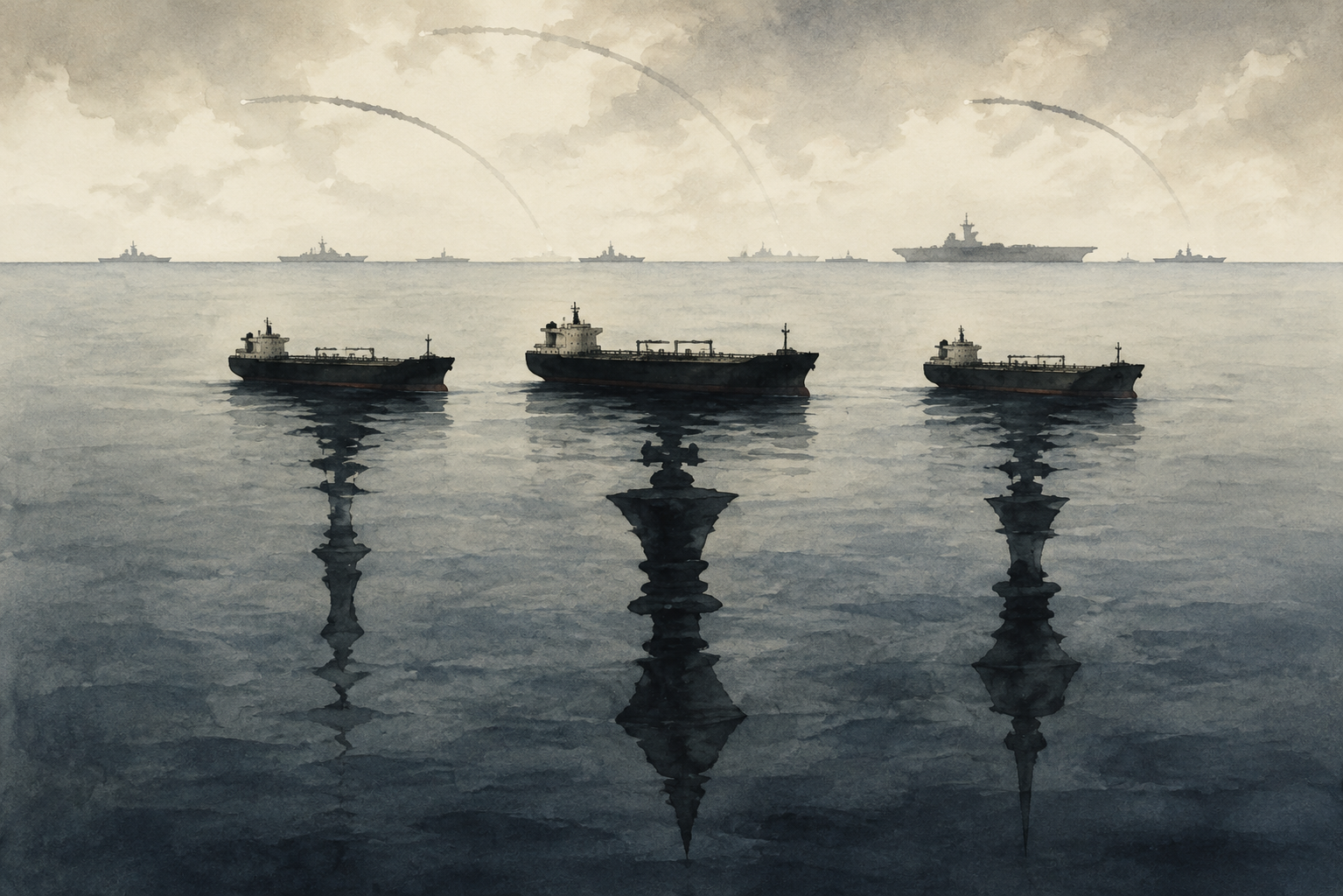
CENTCOM said U.S. forces disabled two Iranian crude carriers and destroyed a third after alleged Iranian missile attacks on U.S. warships.
Kharg risk
Iranian media reported strikes near Kharg Island, a key oil export hub that handled about 90 percent of Iran’s crude exports before the war.
Naval escalation
The reported targeting of a U.S. aircraft carrier marks a shift from pressure on commercial shipping toward direct threats against U.S. naval assets.
U.S. forces struck three Iranian crude oil carriers on Saturday, September 5, after the U.S. military said Iran’s Islamic Revolutionary Guard Corps fired ballistic missiles at an American aircraft carrier and guided-missile destroyer in the region. The confrontation deepens the six-month U.S.-Iran conflict and raises the risk of a broader maritime war.12
U.S. Central Command said no American personnel were harmed and that U.S. ships evaded the Iranian attacks. In response, CENTCOM said U.S. forces permanently disabled two Iranian crude carriers and destroyed a third unladen tanker in the Gulf of Oman.13 The command described the vessels as part of a shadow network that helps finance the IRGC and Iran-backed armed groups.2
Iranian state media and semi-official outlets reported U.S. strikes near Kharg Island, Iran’s key oil export terminal in the Persian Gulf. Tasnim reported that four U.S. missiles hit a tanker near Kharg’s anchorage and said there were no casualties. Iranian state media later said other tanker crews had evacuated.27 Iran’s Foreign Ministry condemned the U.S. strikes as illegal and aggressive. Iran’s military command warned that attacks on U.S. military vessels could become more severe if Washington continues interfering with Iranian shipping.47
Neither side’s full account could be independently verified immediately. The U.S. released footage it said showed the strikes, while Iranian outlets reported the Kharg-area attack and described Tehran’s actions as retaliation. The Associated Press reported that Iran also claimed Saturday to have targeted three oil tankers and three American vessels in response, but said that claim could not be immediately confirmed.2
The reported ballistic missile targeting of a U.S. aircraft carrier is the central escalation. Earlier maritime attacks in the conflict had focused largely on commercial shipping and control of the Strait of Hormuz. Security analysts cited by the AP said an attempt to target a carrier suggests Tehran may now be more willing to threaten high-value U.S. military assets directly, accepting risks it previously sought to avoid.2
That change matters because U.S. carriers and guided-missile destroyers are both combat platforms and symbols of American regional power. Direct attacks on them narrow the space for calibrated retaliation and increase the chance that commanders on either side respond quickly to perceived threats at sea.
The U.S. response also signals a broader pressure campaign against Iran’s oil-linked maritime network. Axios reported that a U.S. official described a new “tanker-for-tanker” policy approved by President Donald Trump earlier in the week. CENTCOM identified the damaged vessels as the M/T Downy and M/T Stark 1 and the destroyed tanker as the M/T Kylo.3
Kharg Island is central to the escalation because of its role in Iran’s oil economy. AP described it as home to a terminal through which Iran exports most of its oil. Reuters, carried by CNA, reported that Iran exported about 90 percent of its crude through Kharg before the war disrupted flows.27 CNN reported that shipping and satellite data indicated nearly 20 Iranian tankers were anchored near Kharg and more than 50 Iranian tankers were in the Gulf and nearby Gulf of Oman.4
The location of the strikes suggests Washington is increasingly willing to impose direct economic costs by targeting Iran’s ability to move crude, not only military launch sites or command nodes. That carries operational risks: disabled or burning tankers can obstruct navigation, endanger crews, cause spills and create salvage problems in waters already crowded by commercial traffic and naval patrols.
The Maritime Executive reported that the Kylo, also associated with the name Noxen and IMO number 9189146, was in ballast when destroyed, reducing spill risk compared with a laden tanker. It reported that the other two tankers appeared to have been hit in ways intended to disable rather than sink them.5 CNN reported that audio it confirmed showed a U.S. military aircraft warning the Stark 1 before a strike and directing the crew to abandon ship.4
The confrontation follows renewed U.S.-Iran fighting after a period of relative calm. AP reported that the war began with U.S. and Israeli attacks on Iran on February 28 and has since mixed military strikes, economic pressure and failed negotiations.2 CNN said the latest exchange risks another retaliatory cycle in and beyond the Persian Gulf, where Iran has sought to control shipping through the Strait of Hormuz while the U.S. has stepped up attacks on Iranian shipping.4
The Strait of Hormuz remains the strategic chokepoint. Reuters reported via CNA that the waterway carried about one-fifth of the world’s oil supply before the war and that Brent crude futures closed Friday at $96.28 a barrel, their highest level since July 24, as Middle East tensions fueled supply concerns.7
For now, the available evidence supports several conclusions: U.S. forces struck three Iranian oil-linked tankers; Iranian and U.S. officials both acknowledge an escalating maritime confrontation; and the most serious disputed claims concern the scope and timing of Iranian missile attacks and any subsequent Iranian retaliation. What is clearer is the direction of travel: the conflict is moving closer to a direct naval contest, with U.S. warships and Iran’s oil fleet increasingly treated as legitimate targets by the opposing side.127





Comments