U.S. Visa Ban Pulls UNGA Into Gaza’s Post-Ceasefire Politics
Palestinian Authority
The PA is the governing body established under the Oslo process to administer parts of the West Bank; it seeks a role in postwar Gaza governance but does not currently control Gaza.
PLO Observer Mission
The Palestine Liberation Organization maintains an observer mission at the United Nations, allowing Palestinian diplomats accredited to the U.N. to continue operating even when other officials face visa restrictions.
ICC and ICJ
The International Criminal Court prosecutes individuals for alleged international crimes, while the International Court of Justice handles disputes between states and advisory opinions under international law.
U.N. host-country access
Because U.N. headquarters is in New York, the United States generally facilitates access for delegations, though Washington says it can restrict visas on legal, security or foreign-policy grounds.
U.S. Department of State via PublicNow
government
Sanctioning Officials of the Palestinian Authority and Members of the Palestine Liberation Organization
Associated Press
news
Trump administration again denies visas for Palestinian delegation to attend the UN General Assembly
WAFA
news
State of Palestine rejects extension of US sanctions against its officials and PLO members
Untracked bias
100% of tracked sources are High factuality
Bias and factuality ratings from Media Bias Fact Check. Outlets without a rating are marked “Untracked.”
Visa denial
The U.S. again denied visas to Mahmoud Abbas and senior PA and PLO officials for the U.N. General Assembly.
Gaza stalled
Reconstruction in Gaza remains stalled under the ceasefire, with Israel tying rebuilding to Hamas disarmament.
Statehood test
The dispute amplifies the clash between Washington’s opposition to unilateral Palestinian statehood moves and growing international recognition efforts.
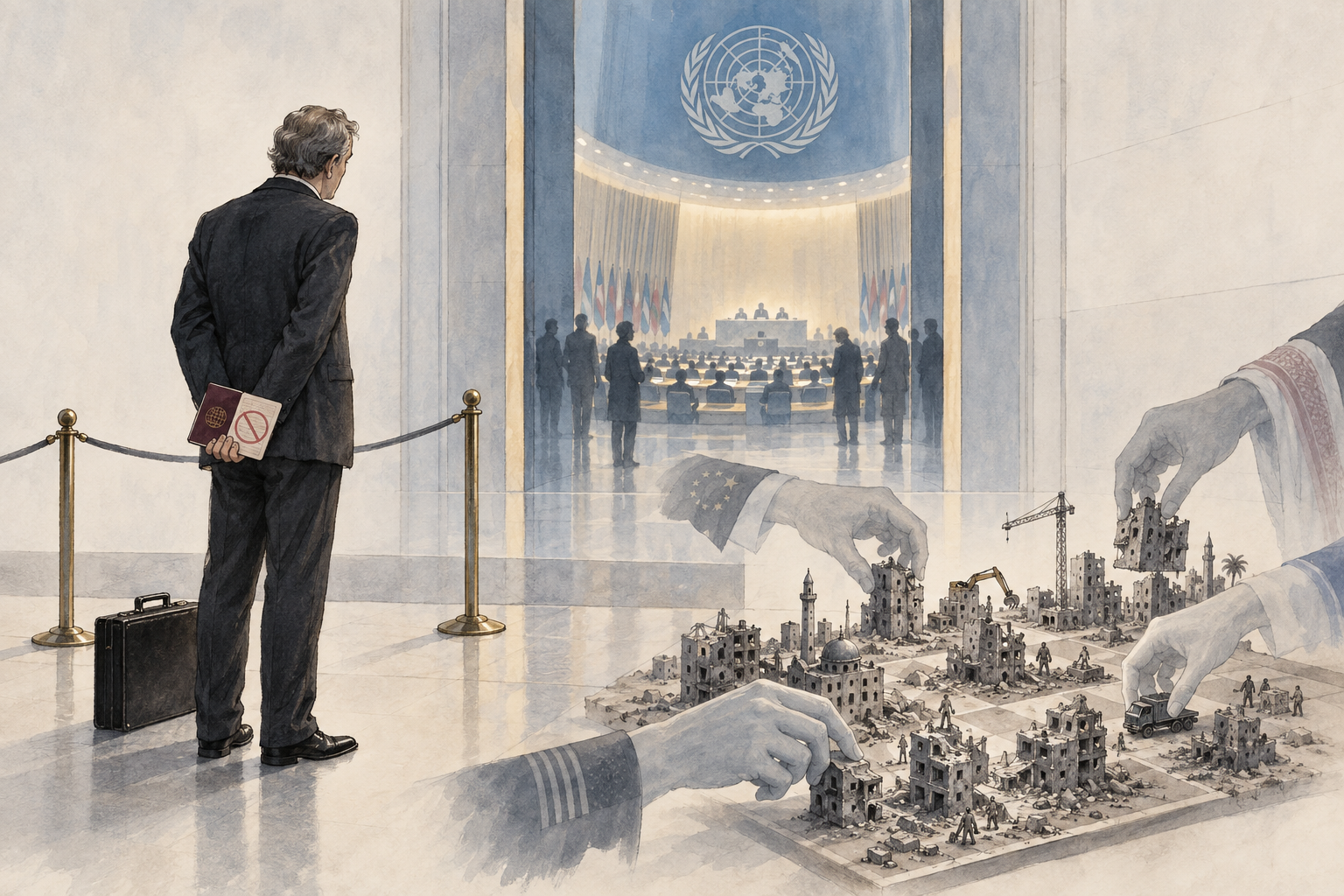
The Trump administration’s decision to again deny visas to Palestinian Authority President Mahmoud Abbas and other senior PA and Palestine Liberation Organization officials is more than a dispute over access to New York for the U.N. General Assembly. It limits the Palestinian leadership’s physical access to the year’s most concentrated diplomatic forum as Gaza’s ceasefire, reconstruction and future governance are under negotiation.2
The State Department said the visa restrictions were extended because the PA and PLO had pursued actions against Israel at the International Criminal Court and International Court of Justice, pressed for unilateral recognition of Palestinian statehood and continued payments to prisoners’ families.1 Palestinian officials rejected the move, arguing that recourse to international law is legitimate and that weakening the PA undermines the partner Washington says is needed for peace and a two-state outcome.3
The practical effect is immediate. Abbas and senior officials will be absent from the high-level U.N. week for a second consecutive year, though accredited Palestinian diplomats already assigned to the U.N. mission may continue to represent the Palestinians in New York.2 The General Assembly is expected to consider whether Abbas can address the gathering by video, as he did after last year’s denial.7
The timing gives the visa decision outsized weight. A U.S.-brokered ceasefire in Gaza remains fragile, reconstruction has barely begun, and the question of who represents Palestinians in a postwar Gaza remains unresolved.2 Excluding Abbas and senior PA figures from in-person diplomacy reduces their ability to hold leader-level meetings, shape donor discussions and counter Israeli and U.S. narratives in real time.
That does not remove the Palestinians from the U.N. system. The State Department has maintained a waiver for personnel attached to the PLO Observer Mission, preserving the basic operation of Palestinian diplomacy at U.N. headquarters.7 But the distinction matters. Mission diplomats can keep a seat at the table; Abbas and top aides would normally use the General Assembly to seek head-of-state meetings, appeal directly to donors and Arab governments, and present the PA as the institutional alternative to Hamas in Gaza.
For Washington, the decision signals that access to the diplomatic track will depend on PA behavior: abandoning or limiting international legal campaigns, changing payments Washington and Israel describe as support for terrorism, and resisting statehood moves not agreed with Israel.1 For the PA, the decision reinforces its argument that the U.S. is using host-country leverage to constrain Palestinian diplomacy while Israel continues military and settlement policies Palestinians say make a negotiated state impossible.3
The most important consequence may be on Gaza’s political track. Any workable post-ceasefire arrangement will have to answer three linked questions: who administers Gaza, who coordinates security, and who speaks to donors about reconstruction. The PA wants to be treated as the Palestinian institutional address for those decisions, but the U.S. visa move makes that harder at the forum where governments are likely to discuss the next phase.
Egypt has been running a parallel track. Abbas met President Abdel Fattah el-Sisi in Cairo for talks on Gaza, the ceasefire and Palestinian reconciliation, with Egypt emphasizing support for the PA and for efforts to reach consensus among Palestinian factions.8 That regional channel becomes more important if Abbas cannot conduct equivalent diplomacy in New York.
But Cairo and New York serve different purposes. Egypt can mediate among Palestinian factions and between the parties closest to Gaza. UNGA offers a broader coalition-building arena, where Gulf donors, European governments and states considering recognition of Palestine can be engaged in one place. The U.S. move shifts more of the Palestinian diplomatic burden onto Egypt, Arab partners and lower-level Palestinian representatives at the U.N.
The visa dispute lands as conditions in Gaza show the cost of delayed reconstruction. AP reported that a strike-damaged building collapsed in Gaza City on Sept. 16, killing at least 21 people, including 11 children, and that no reconstruction work had taken place since the ceasefire was agreed nearly a year ago.9 Israel has said it will not permit rebuilding until Hamas disarms, while only limited heavy machinery has entered Gaza.9
That stalemate makes diplomacy over reconstruction inseparable from diplomacy over governance. Donors will want guarantees that funds and materials do not strengthen Hamas. Israel will press disarmament and security conditions. Palestinians will argue that delaying reconstruction leaves civilians in dangerous ruins and undermines any political alternative to Hamas.
In that context, excluding Abbas is not just symbolic. It weakens the PA’s opportunity to argue in person that it can help administer or coordinate Gaza reconstruction, even as Washington and Israel have long resisted any postwar formula that leaves Hamas in control. If the PA is absent from the highest-profile diplomatic setting, other actors — the U.S., Israel, Egypt, Gulf states, European donors and Palestinian rivals — gain more space to define the reconstruction architecture.
The visa denial also feeds the wider diplomatic contest over Palestinian statehood. Reuters reported that last year’s UNGA visa denial intersected with moves by U.S. allies to recognize Palestinian statehood, and this year’s decision again comes as recognition remains a point of tension between Washington and several partners.4 The National reported that Washington cited efforts to “internationalise” the conflict through international courts and unilateral recognition efforts as part of its rationale.7
For the PA, the General Assembly is the main stage for turning international sympathy over Gaza into support for statehood, U.N. resolutions and recognition campaigns. For the Trump administration, denying visas is a way to push back against a strategy it sees as bypassing direct negotiations with Israel.
The result is a procedural fight with strategic stakes. If Abbas appears only by video, Palestinian diplomacy can still make its argument, but with less access to hallway negotiations and leader-level side meetings. If U.S.-aligned governments treat the visa ban as a warning, statehood momentum could slow. If they view it as overreach by the U.N. host country, it could have the opposite effect and harden support for Palestinian recognition.
The first test is whether the General Assembly permits Abbas to address the session virtually. A video speech would preserve the formal Palestinian message, but not the diplomatic access that comes with being physically present.7
The second is whether Arab and European governments compensate for Abbas’s absence by elevating meetings with the Palestinian U.N. mission or convening separate talks with PA officials outside the United States. Abbas’s Cairo diplomacy suggests the PA will try to keep regional channels active even if the New York track is restricted.8
The third is whether the visa restrictions become part of the bargaining over Gaza’s post-ceasefire order. Washington’s message is that the PA must change course to regain access. The PA’s counterargument is that excluding it weakens the only internationally recognized Palestinian institution that could plausibly participate in reconstruction and governance.
That is why the visa decision matters beyond UNGA protocol. It tests whether the post-ceasefire Gaza track will be shaped through inclusive diplomacy that keeps the PA central, or through a narrower U.S.-Israeli framework that conditions Palestinian participation on political concessions before reconstruction and governance talks fully advance.







Comments