UK pushes EU procurement access to forefront of reset talks
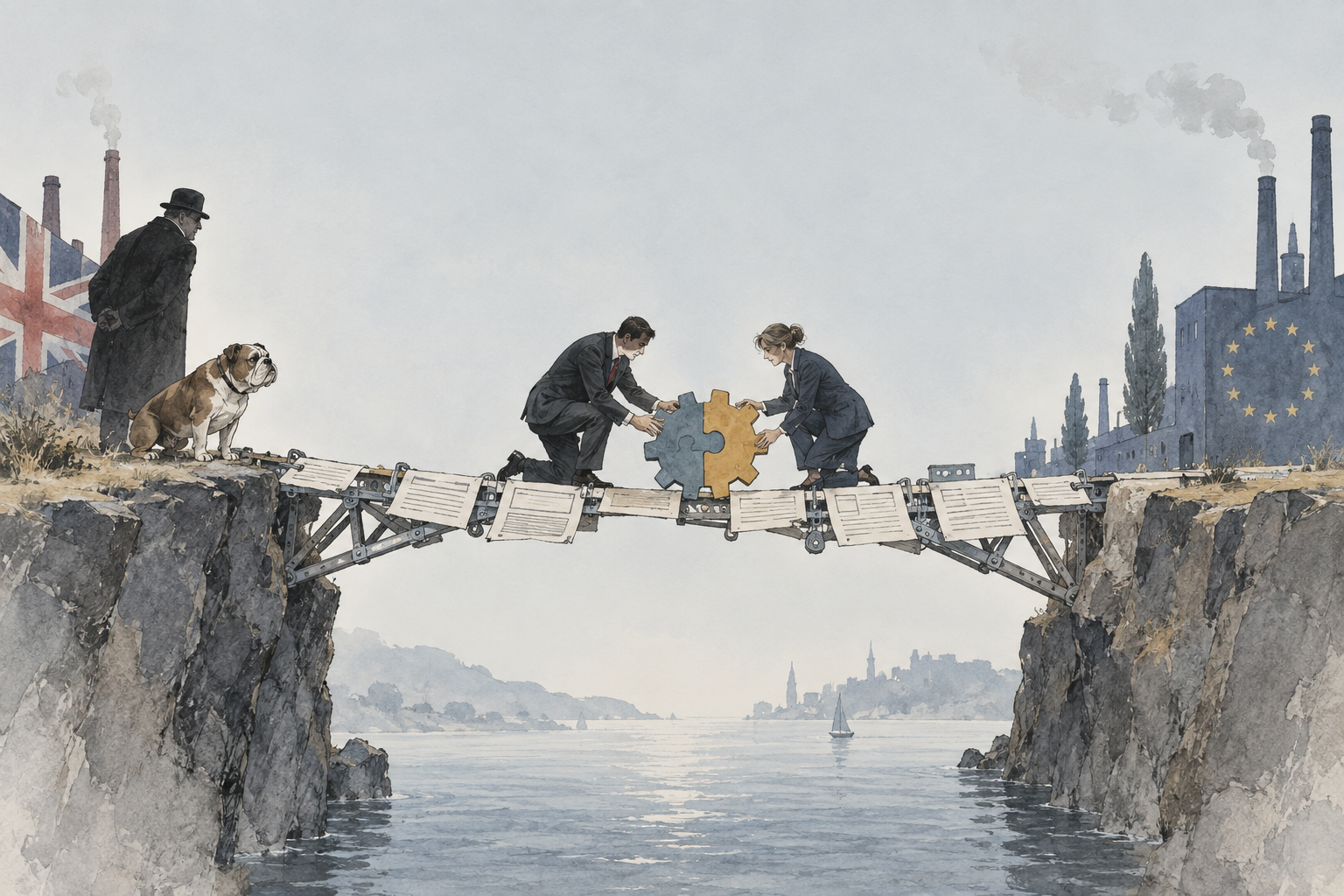
Made in Europe
A proposed EU procurement and industrial-policy agenda intended to favour European suppliers in strategic sectors and reduce dependence on China.
Industrial Accelerator Act
The formal EU legislative proposal associated with the Made in Europe agenda, focused on speeding and protecting strategic industrial capacity.
UK-EU reset
The Labour government’s effort to improve post-Brexit cooperation with the EU without rejoining the bloc or reversing core manifesto red lines.
Youth mobility scheme
A proposed arrangement that would make it easier for young people from the UK and EU to live, work or study across borders for a limited period.
The Guardian
news
‘Made in Europe’ law threatens UK plans for reset with EU
New Dispatch
news
Andy Burnham's 'EU reset' torn apart by Alex Burghart: 'Completely against the referendum!'
EuropeSays / POLITICO Europe mirror
news
Brussels won’t offer ‘associate EU membership’ to Brexit Britain
Untracked bias
100% of tracked sources are High factuality
EUobserver
Burnham’s UK‑first politics meet a more protectionist EU and its ‘Made in Europe’ plan
CRBC News
Burnham Warns EU 'Made In Europe' Procurement Could Threaten UK Steel and Auto Industries
Bias and factuality ratings from Media Bias Fact Check. Outlets without a rating are marked “Untracked.”
Agenda shift
UK ministers want the EU’s Industrial Accelerator Act and Made in Europe procurement agenda added to reset negotiations.
Supply chains
The Cabinet Office has warned that UK-EU strategic supply chains are highly integrated and should not face new trade barriers.
Summit delay
A possible UK-EU summit discussed for 6 November may slip unless the procurement issue is included in talks.
The UK government is trying to make access to EU strategic procurement a central test of its reset with Brussels, warning that proposed “Made in Europe” rules could create new barriers for British companies embedded in continental supply chains.
Government sources told The Guardian that ministers want the EU’s proposed Industrial Accelerator Act, the formal vehicle for the Made in Europe agenda, added to reset negotiations before another UK-EU summit is fixed.1 The push marks a shift in the political handling of the reset under Prime Minister Andy Burnham. Rather than treating the process mainly as a package of inherited agreements on food trade, youth mobility and emissions trading, ministers are seeking to reopen the agenda around industrial access and procurement leverage.
The issue has already moved through the Cabinet Office. In a written answer published on 8 September, Cabinet Office minister Hamish Falconer said the government was working with industry on the potential impact of EU proposals. He said London had told Brussels the two sides should not create trade barriers, citing the “highly integrated” nature of UK-EU supply chains.8 Falconer is also understood to have raised the issue with EU trade commissioner Maroš Šefčovič last week, while trade minister Anas Sarwar has urged UK business leaders to brief European partners on the risks of the policy.1
The immediate result is uncertainty over the next summit. A follow-up meeting, once discussed for 6 November, could slip to late November or beyond if the procurement question is not formally placed on the agenda, according to reporting on the negotiations.1 Separate reporting says the summit is still not scheduled, with talks complicated by EU protectionism in steel and procurement, as well as disputes over tuition fees for EU students under a possible youth mobility scheme.3
The UK’s concern is that EU legislation designed to reduce dependence on Chinese inputs could also disadvantage British firms if UK-made goods are treated as third-country products for public procurement or strategic industry purposes. The agenda is expected to prioritise EU suppliers in sectors including carmaking and defence, raising particular concerns for manufacturers whose supply chains cross the Channel multiple times.1
For Burnham’s team, the argument is political as well as technical. The government wants to show that a warmer EU relationship can secure practical concessions, not simply require the UK to accept Brussels’ rules from the outside. That makes procurement access a test of whether pro-European language can be converted into negotiating leverage.
The parliamentary record shows ministers are framing the issue around mutual interest rather than retaliation. Falconer’s answer did not promise reciprocal UK restrictions on EU exports. Instead, it said maintaining trade in strategic sectors would help both sides meet economic objectives.8 That position gives the government room to argue that it is defending UK industry while avoiding a trade-war posture.
The reset package began under former prime minister Keir Starmer and European Commission President Ursula von der Leyen in May 2025, but the next summit was cancelled after Starmer’s resignation.1 Burnham’s government is now trying to complete that programme while changing the hierarchy of issues.
The existing package remains comparatively modest. Smoother agri-food trade, a youth mobility scheme and coordination on emissions trading are still described as the core deliverables.3 But the procurement dispute has become a potential gatekeeper. If the EU wants progress on areas favoured by member states, including youth mobility, London wants strategic procurement and industrial rules treated as equally legitimate reset business.
Internal EU politics are mixed. The Guardian reported that Germany, the Netherlands, Poland and Italy are favourable toward UK inclusion in Made in Europe arrangements, while France, which has driven the proposal, remains more cautious and wants the legislation passed quickly before third-country carve-outs are settled.1 That sequencing matters for London. If the EU legislates first and negotiates exceptions later, British access could become a prolonged downstream negotiation rather than part of the reset settlement.
The Conservative response is to cast the reset as a route back to EU rule-taking. Alex Burghart, the Conservative deputy leader, has argued that Labour’s approach would bind Britain closer to EU rules and undermine the post-Brexit case for an independent regulatory system.2
Burghart and shadow environment secretary Victoria Atkins also criticised the reset at Policy Exchange, warning that a future Conservative government would not be bound by Labour’s arrangements and would begin work on a more independent regulatory model.1 That line puts pressure on ministers from the opposite direction: any UK request for inclusion in EU industrial schemes can be presented by Conservatives as evidence that closer economic access comes at the price of regulatory autonomy.
Falconer has responded by saying the government’s manifesto red lines remain in place and that Labour is not seeking to rerun the 2016 referendum arguments.2 The government’s immediate task is to distinguish sectoral cooperation from membership-style dependence — a distinction likely to become harder if procurement access requires alignment with EU standards, state-aid conditions or enforcement mechanisms.
The UK push comes as Brussels is widening its industrial and security agenda beyond the traditional single-market frame. In her 2026 State of the Union address, von der Leyen said the EU faced a daily €1 billion trade deficit with China and heavy dependence on Chinese critical materials, including more than 80% reliance for many critical raw materials and 90% for some rare earths.4
She also proposed deepening ties with Canada, moving from CETA toward an “Alliance for the Future” covering economic security, critical minerals, technology and defence industrial bases, and said she wanted Canada to become the EU’s first associate member.4 That offer has sharpened the contrast for London. If Brussels can design new categories of strategic partnership for other non-EU allies, UK ministers are likely to argue that Britain should not be excluded from European industrial procurement where supply chains and security interests are already intertwined.
Security cooperation is also expanding. The Associated Press reported that von der Leyen called for a NATO-like EU mechanism to respond to drone incidents, sabotage and cyberattacks, and said the Commission would develop ideas for a European Security Council involving partners including Britain, Canada, Norway and Ukraine.7 That reinforces the UK government’s argument that procurement, defence supply chains and strategic resilience cannot be separated from the broader reset.
The next stage will turn on whether Brussels accepts procurement access as part of the reset mandate before a summit date is locked in. If it does, Burnham can argue that the UK has extracted a practical negotiating agenda from a friendlier EU stance. If it does not, the reset risks being defined less by its promised thaw than by a familiar post-Brexit dispute: how far Britain can be inside European economic systems while remaining outside the EU legal order.








Comments