UN-Backed Findings Put Civilian Harm at Center of U.S.-Iran Diplomacy
UN-backed fact-finding mission
An independent expert body commissioned by the U.N. Human Rights Council to investigate alleged abuses; its findings are not legally binding but can inform accountability efforts.
Indiscriminate attack
Under international humanitarian law, an attack that does not distinguish adequately between military targets and civilians or civilian objects.
War powers resolution
A congressional measure intended to limit or end a president’s ability to continue military action without authorization from lawmakers.
Strait of Hormuz
A critical waterway for global oil and gas shipments that has become a central point of leverage in the U.S.-Iran war.
Associated Press
news
UN-backed experts find US may have committed war crimes in Iran, and other Mideast developments
Associated Press
news
UN-backed experts cite possible US war crimes in Iran strikes
Reuters via Investing.com
news
UN mission finds grounds to believe US committed war crimes in Iran, and Tehran crimes against humanity
Untracked bias
100% of tracked sources are High factuality
CBS News
U.N.-backed experts allege U.S. war crimes in Iran
Bias and factuality ratings from Media Bias Fact Check. Outlets without a rating are marked “Untracked.”
178 Civilians
UN-backed experts said two February 28 strikes in Iran killed at least 178 civilians, including women and children.
Probe Unreleased
The Trump administration has not released the Pentagon investigation into the Minab school strike or directly accepted responsibility.
Diplomacy Strained
The findings complicate U.S. ceasefire messaging as Trump says Iran wants a deal while negotiations remain stalled.
UN-backed human rights experts said Thursday there are reasonable grounds to believe U.S. strikes in Iran on February 28 may have constituted war crimes, putting civilian-casualty accountability at the center of the U.S.-Iran war as Washington and Tehran trade public signals over a possible settlement.1
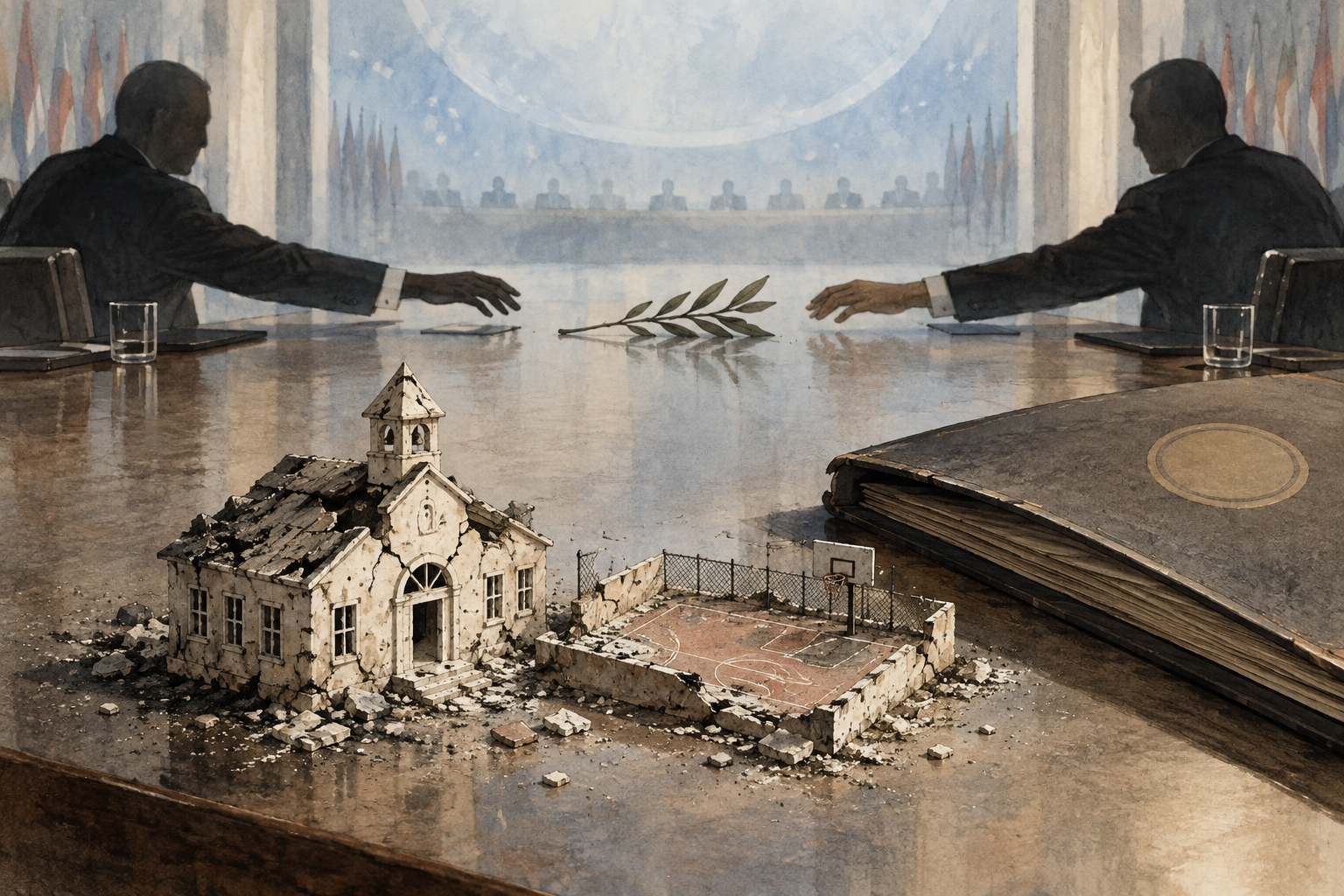
The international fact-finding mission focused on two strikes that killed at least 178 civilians, including women and children, on the war’s first day: one on the Shajareh Tayyebeh school in Minab and another in Lamerd that hit a sports complex and residential area, according to the Associated Press.2 The report is not legally binding, but AP said it could contribute to evidence used in future accountability efforts.2
The allegations come at a sensitive moment for U.S. diplomacy. President Donald Trump again said this week that Iran wants a deal and that the war may be nearing its end, even as negotiations have stalled and regional mediators lack a clear path to de-escalation.78 For conflict watchers, the findings shift part of the diplomatic battlefield from ceasefire sequencing and nuclear demands to whether Washington will acknowledge civilian harm and release the results of its own investigation.
The mission, commissioned by the U.N. Human Rights Council, said the Minab school was “clearly identifiable” as a civilian object. It found reasonable grounds to believe the United States launched an indiscriminate attack that caused civilian deaths, injuries or damage to civilian objects.2 Iranian state media have said 168 people were killed at the school, most of them children; Reuters reported that Iranian officials put the toll at more than 150, including around 120 schoolchildren.23
The mission also cited a strike in Lamerd, where it said Precision Strike Missiles dispersed tungsten pellets over a clearly identifiable sports complex and residential area.2 The UN-backed experts said 22 civilian men and women were killed. U.S. Central Command has denied responsibility for a strike on Lamerd that day.23
Reuters reported that the mission found the U.S. failure to update targeting information related to the Minab school, which was adjacent to an Islamic Revolutionary Guard Corps naval complex, went beyond negligence. The experts said they found no evidence the school was being used for military purposes.3
The Trump administration has not directly accepted responsibility for the Minab school strike or released the findings of a Pentagon investigation, AP and CBS reported.24 Reuters said an initial internal U.S. military investigation indicated U.S. forces were likely responsible for the fatal Minab strike, and that the Pentagon later elevated the probe without publishing preliminary findings.3
CBS reported that a preliminary U.S. assessment suggested the United States was likely responsible for the February school attack but may have hit it in error, possibly because dated intelligence wrongly identified the area as still part of an Iranian military installation.4 That account differs sharply from the UN-backed mission’s conclusion that the school building was the intended point of impact, and that the damage was not caused by an errant strike or collateral damage from an attack on a nearby IRGC site.2
The gap between those accounts is now a central accountability question. If the Pentagon releases findings that confirm U.S. responsibility but frame the strike as an intelligence failure, Washington would still face pressure to explain target validation, precautions to protect civilians and whether commanders acted on outdated information. If the findings remain unreleased, the UN-backed report is likely to become the most visible international account of the strike.
The findings complicate the Trump administration’s public message that a deal may be close. CBS reported that Trump told supporters in North Carolina on Wednesday that Iran wants to make a deal and that he hoped the war was nearing its end, while noting negotiations have stalled in recent months.7
The Soufan Center assessed Thursday that both sides have expressed willingness to de-escalate but have not softened core demands. It said Iran’s conditions include lifting the U.S. naval blockade, unfreezing Iranian assets, moving U.S. military assets away from Iran and forcing Israel to stop attacks on Hezbollah and Hamas.8 The center also said the postponement of a planned Iran-Gulf meeting in Oman left mediators without an obvious roadmap for defusing the conflict.8
That creates a diplomatic contradiction: Washington is trying to project momentum toward a settlement while UN-backed experts press questions about possible U.S. war crimes. Tehran, meanwhile, can use the findings to argue that civilian harm must be part of any ceasefire or postwar process, even as the same UN-backed mission accused Iranian authorities of crimes against humanity against their own population.23
The allegations also arrive as congressional concern over the war grows. The House voted 220-204 this week for a third time to approve a war powers resolution that would halt Trump’s ability to continue military action in Iran without congressional approval. AP reported that the measure has not reached the president’s desk and would almost certainly face a veto.5
The vote reflected mounting political strain after nearly seven months of war. AP reported that the conflict, launched February 28, has involved intermittent missile exchanges and regional disruption, and is becoming a substantial issue ahead of the midterm elections.5
Republican defections underscored that pressure. Two Iowa Republicans in competitive House districts, Zach Nunn and Mariannette Miller-Meeks, changed their positions and backed the war powers measure, joining Democrats and other Republican dissenters.6 AP reported that the war remains unpopular and has contributed to soaring fuel prices, while both lawmakers called for limits on open-ended military action.6
The civilian-harm findings are not emerging in isolation. The war has disrupted Gulf security, energy markets and diplomacy around Lebanon, Yemen and the Strait of Hormuz. CBS reported that Brent crude fell Thursday after earlier increases linked to regional infrastructure attacks, while Vice President JD Vance warned that a U.S. withdrawal from the region could trigger an energy crisis.7
The Soufan Center said Houthi advances in Yemen and attacks on Saudi energy infrastructure have weakened U.S. leverage and raised the risk that U.S.-Iran exchanges could escalate into broader combat.8 It also said regional diplomacy was set back when a planned meeting involving Iran and Gulf states in Oman was postponed amid Gulf distrust and Saudi concerns over Houthi attacks.8
Against that backdrop, the UN-backed report gives ceasefire diplomacy a new accountability dimension. Any prospective deal will have to address not only nuclear, maritime and regional-security disputes, but also demands for transparency over civilian deaths in Minab and Lamerd — and whether the United States will publicly reconcile its military review with the findings of international investigators.






Comments