UNRWA dispute tests Gaza ceasefire and postwar aid plans
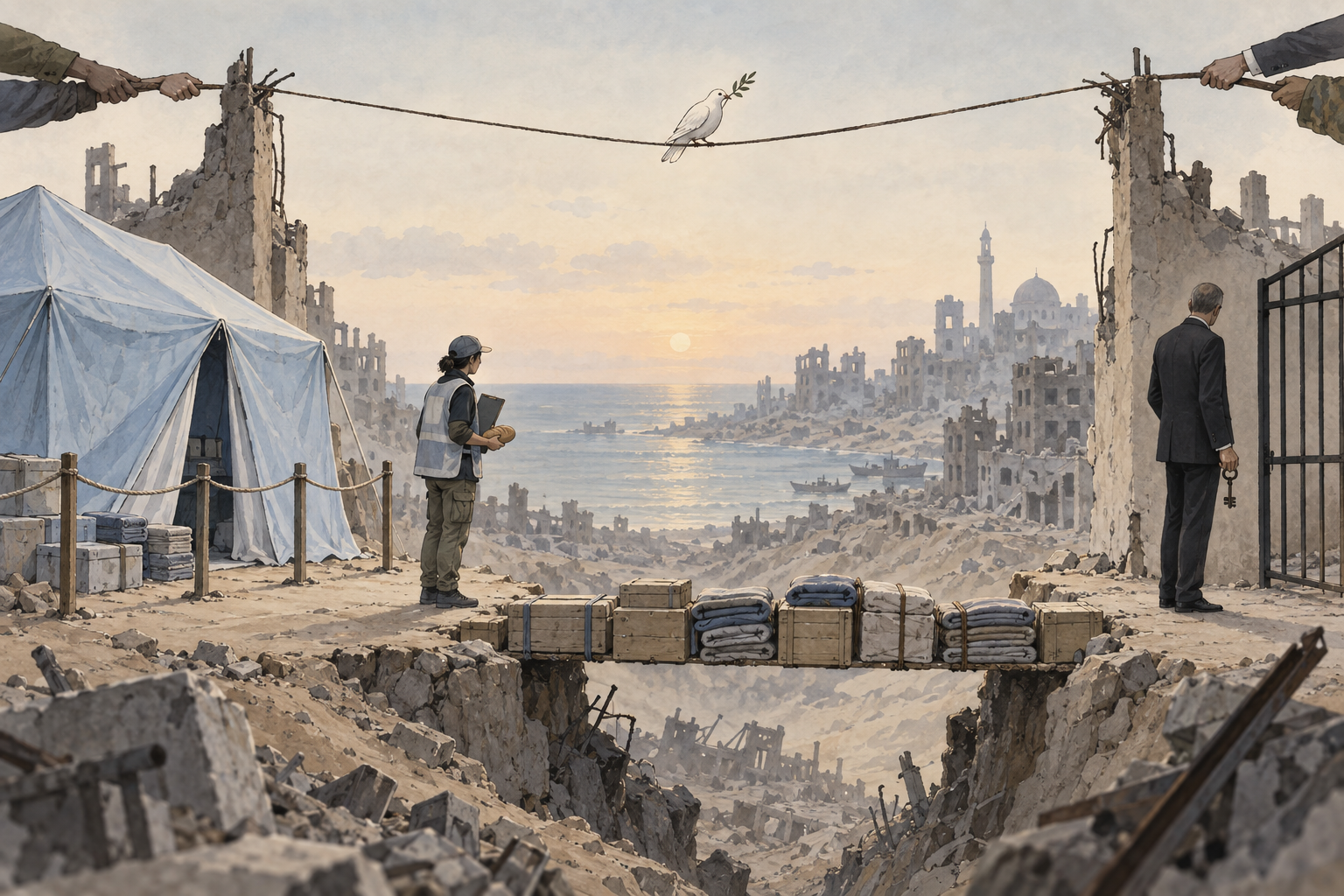
UNRWA
The United Nations Relief and Works Agency for Palestine Refugees, created in 1949 to provide services such as education, health care and relief to Palestinian refugees.
Board of Peace
A US-created body linked to Trump’s Gaza plan and described in Palestinian coverage as part of the transitional structure for coordinating Gaza’s reconstruction and governance.
Right of return
A core Palestinian political claim that refugees and their descendants should be allowed to return to homes or lands from which they were displaced.
Governance vacuum
A gap in authority or service delivery that can emerge when an existing institution is removed before a capable replacement is operating.
Untracked bias
Bias and factuality ratings from Media Bias Fact Check. Outlets without a rating are marked “Untracked.”
Aid flashpoint
Hamas criticized the Board of Peace after it said it would not work with UNRWA in Gaza operations.
Governance test
The dispute raises questions over who will administer relief and reconstruction under Gaza’s ceasefire framework.
Schools affected
UNRWA remains tied to daily services, including schools that have only partly reopened in Gaza.
Hamas condemned the US-created Board of Peace on Saturday after the body said it would not work with UNRWA in Gaza operations, escalating a dispute over whether the UN agency for Palestinian refugees will remain central to relief, schools and recovery under the territory’s fragile ceasefire.1
The row is less a technical disagreement over humanitarian contracting than a governance test for postwar Gaza. The Board has said it will work only with partners it considers able to deliver aid and contribute to what it called a deradicalized Gaza. Hamas and other Palestinian voices argue that excluding UNRWA would leave a service gap and weaken the institutional link to Palestinian refugee rights.12
Hamas spokesperson Hazem Qassem said the Board’s position aligned with Israel’s long-running effort to end UNRWA’s role. He accused the body of trying to prevent the agency from delivering relief and undermine the right of return for Palestinian refugees.3 The Board said Friday that “UNRWA’s involvement in Gaza is unchanged,” but also said it would work only with “trusted partners” and that UNRWA did not meet its tests.16
The dispute matters because UNRWA is not just another aid contractor in Gaza. Established in 1949, the agency has provided education, health, relief and protection services to Palestinian refugees in Gaza, the West Bank, Jordan, Lebanon and Syria, funded largely by donor contributions.4
In Gaza, where schools have only partly reopened and reconstruction remains stalled, any decision to bypass the agency could affect service continuity as much as diplomacy.
Al Jazeera reported that Palestinian students returned to an UNRWA school in Nuseirat for the new school year on September 19, underscoring the agency’s continuing role in daily civilian life as the political argument over its future intensifies.1
The practical question is whether alternative agencies and contractors can rapidly assume functions UNRWA has built over decades, or whether excluding it would create a vacuum in aid delivery and local administration.
The Board’s public line has also appeared more rigid than some reported private contacts. The Associated Press, cited by Al Jazeera and Aaj English TV, reported that Board members had held several meetings with UNRWA officials, even as the agency was omitted from the list of UN partners named at a Board briefing to the UN General Assembly.16
One Board official told AP that UNRWA programs could continue if they served Gaza’s residents, while still saying the agency’s era was over.6
For Palestinians, the UNRWA question is inseparable from refugee status and the right of return. Al Jazeera Arabic reported that Hamas framed the Board’s stance as serving Israeli aims to end the agency’s work and strike at refugee return claims.2
Sada News Agency similarly linked the dispute to fears that reshaping Gaza’s postwar institutions could become a way to dilute the refugee issue during reconstruction planning.4
The Board of Peace is described in Palestinian coverage as part of the transitional governance architecture for Gaza, responsible for setting frameworks and coordinating funding for redevelopment under President Donald Trump’s plan.4 That gives the fight over UNRWA broader policy significance: whoever controls aid channels may also influence Gaza’s postwar administration, donor priorities and public services.
The Popular Committees for Palestinian Refugees also criticized the Board’s stance, warning that pressure on UNRWA could affect the safety of its personnel and the agency’s ability to keep serving millions of Palestinian refugees.5
Ahmad Abu Holi, a Palestine Liberation Organization official responsible for refugee affairs, called for political support for UNRWA to be translated into financial commitments, including about $100 million to address the agency’s deficit.24
The Board’s argument is that reconstruction should reduce long-term dependence on aid and help build a sustainable Gaza economy with jobs and improved living standards.4 But that goal depends on near-term delivery. Food, shelter, schooling, health care and winter supplies must move before reconstruction plans can become credible.
Philippe Lazzarini, who led UNRWA until earlier this year, accused the Board of failing to deliver on its mandate and said crossings should be opened so supplies can enter at scale.16
His criticism reflects a wider concern among aid actors and Palestinian officials: a transition away from UNRWA, if pursued without a working substitute, could slow relief at the moment the ceasefire is being judged by civilian outcomes rather than diplomatic language.
Regional and diaspora media quickly picked up the dispute after the Al Jazeera report, reflecting how the UNRWA question resonates beyond Gaza as a test of the ceasefire’s political intent and humanitarian capacity.7
For Middle East policymakers, the immediate issue is not only whether the Board can design a new reconstruction system. It is also whether it can keep essential services functioning while doing so.
If the ceasefire’s next phase is measured by aid access, school reopening and reconstruction starts, the UNRWA dispute may become one of its earliest stress tests. Excluding the agency could satisfy Israeli and Board preferences for a new aid architecture. Failing to replace its operational footprint could leave Gaza’s civilians facing the costs of an institutional gap.





Comments