West Bank olive harvest violence tests security forces amid Gaza tensions
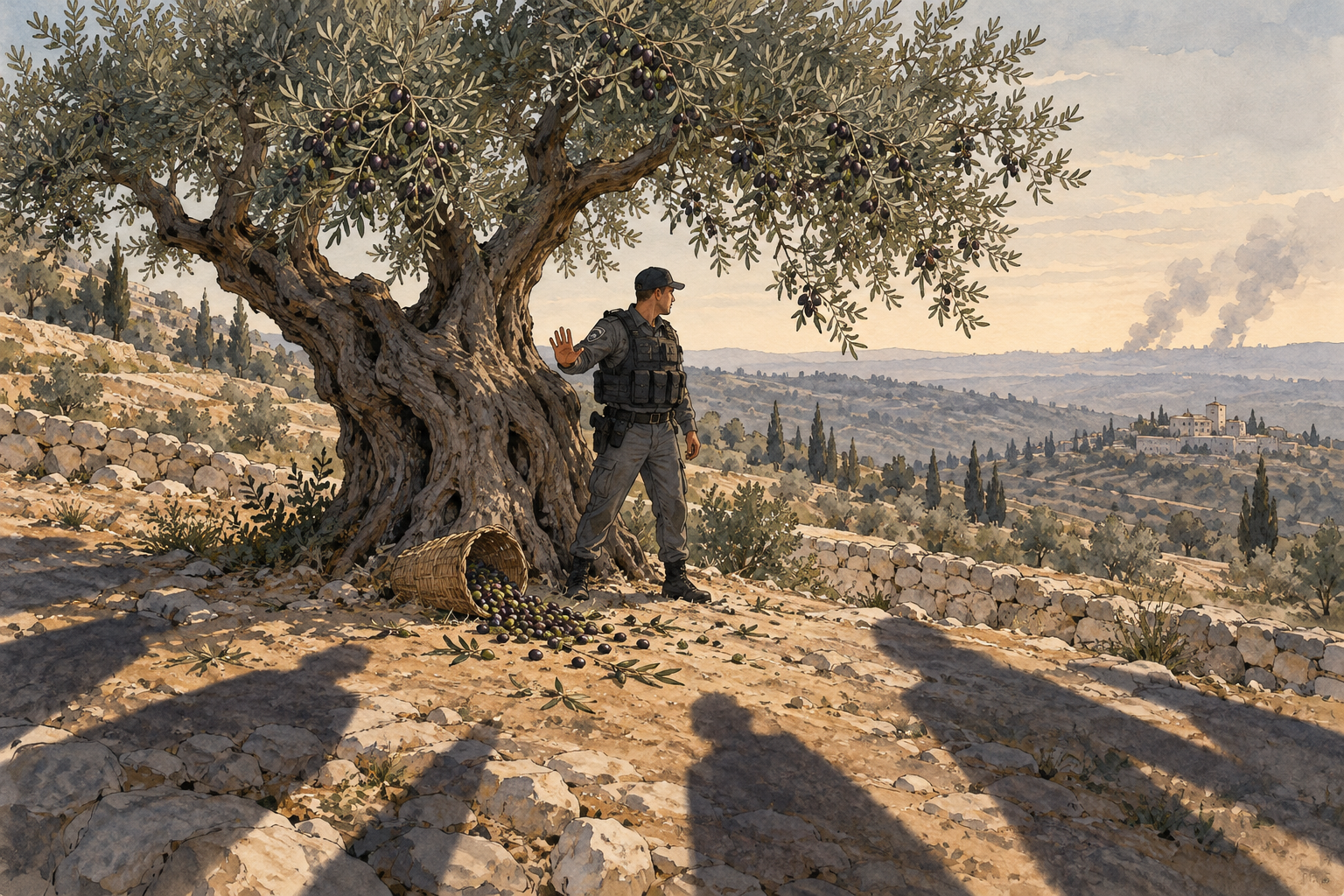
Olive harvest
A key annual agricultural season for Palestinian families, often requiring access to groves near settlements, outposts or restricted areas.
Palestinian National Security Forces
A Palestinian Authority security body operating in parts of the West Bank, with limited authority under Israeli overriding security control.
Israeli settlements
Israeli civilian communities built in the occupied West Bank; most of the international community considers them illegal under international law, a position Israel disputes.
Settler violence
Attacks or intimidation by Israeli settlers against Palestinians, their property or farmland, a recurring source of tension in the West Bank.
Associated Press
news
3 killed in Saudi airport attacks, olive harvesters shot in West Bank and other Mideast developments
WAFA
government
UPDATE: Palestinian killed, 16 injured in colonist attack on olive Palestinian harvesters near Nablus
WAFA / Palestinian Ministry of Foreign Affairs and Expatriates
government
Foreign Ministry condemns escalating Israeli colonist attacks on Palestinian farmers
Untracked bias
67% of tracked sources are High factuality
The Jordan News Agency (Petra)
Palestinian Killed, 14 Injured in Settler Attack Near Nablus
The Irish News
Israelis mourn on October 7 anniversary as Palestinians live in devastated Gaza
Investing.com
Palestinian killed in Israeli settler attack during olive harvest, officials say
Internazionale
Palestinian killed in Israeli settler attack during olive harvest, officials say
MarketScreener
Palestinian killed in Israeli settler attack during olive harvest, officials say
The Straits Times
Palestinian killed in Israeli settler attack during olive harvest, officials say
Bias and factuality ratings from Media Bias Fact Check. Outlets without a rating are marked “Untracked.”
Officer killed
Palestinian officials identified the man killed as Ali Hassan Yasser al-Bazzari, a 44-year-old Palestinian National Security Forces member.
16 wounded
Palestinian medical and official accounts said 16 people were wounded in the October 7 attack near Burqa and Sahl Ramin.
No arrest answer
AP reported that Israeli military and police did not answer whether the person who killed al-Bazzari had been arrested.
Israeli settlers opened fire on Palestinian olive harvesters in the occupied West Bank on Wednesday, October 7, killing a Palestinian security officer who had responded to the scene and wounding 16 people, Palestinian officials said. The incident has sharpened concerns that the annual harvest is becoming a broader security crisis.1
The man killed was identified as Ali Hassan Yasser al-Bazzari, 44, a member of the Palestinian National Security Forces who responded after reports of an attack near Burqa, close to Nablus, according to the Associated Press, citing his cousin Abdul Latif al-Bazzari, who was also injured.1 WAFA, the Palestinian state news agency, said the Palestinian Health Ministry and the Palestinian Red Crescent Society reported 16 injuries, including from gunfire and beatings. Eyewitnesses accused settlers accompanied by Israeli forces of attacking farmers in Sahl Ramin as they harvested olives.2
The Israeli military gave a different account. AP reported that the army said forces went to the area after receiving reports that an Israeli civilian had been injured by a rock and that several Palestinians suspected of throwing rocks were detained for questioning.1 Another report relaying the Israeli military account said soldiers and Border Police were dispatched to Bazariya after a report of rocks thrown at an Israeli civilian. It said a confrontation involving Palestinians and Israeli civilians followed, and that the military said a commander “neutralized” a man carrying a suspicious object. The incident was under review.6
AP said the Israeli military and police did not answer questions about whether the person who shot and killed al-Bazzari had been arrested.1 That gap is central to the political fallout: Palestinian officials describe the killing as settler violence carried out under military protection, while the Israeli account emphasizes stone-throwing, civilian injury, arrests of Palestinian suspects and an internal review.16
The Burqa village council told AP that Israeli forces prevented emergency responders from reaching the injured for more than an hour.1 WAFA reported that Israeli forces assaulted ambulance crews near Sahl Burqa, detained three paramedics and a volunteer, seized ambulance keys and forced them to leave the area.2
Eyewitnesses cited by WAFA said settlers blocked ambulances from reaching some of the wounded and threatened to fire on anyone approaching, delaying evacuation to hospitals.2 Those allegations could not be independently confirmed from the available accounts. But they place the incident beyond a clash over land access and into a direct test of emergency response and policing in a volatile rural area.
The Palestinian Foreign Ministry condemned the attack as part of escalating settler assaults on farmers, called for international protection and accountability, and said Palestinian farmers must be guaranteed access to their land.3 The ministry framed the Burqa and Sahl Ramin incident as evidence that the harvest is not only an agricultural season, but also a confrontation over security, movement and impunity.3
The violence did not appear to stop with the October 7 killing. WAFA reported on Thursday, October 8, that settlers attacked Palestinian olive harvesters in Abwein, northwest of Ramallah, and al-Laban al-Sharqiya, south of Nablus. It said the attacks forced farmers from their land and damaged a farmer’s vehicle.4
WAFA said the attacks came as violence against harvesters has intensified across the West Bank with the start of the olive harvest season. It linked the new incidents to the fatal attack near Burqa and Sahl Ramin the previous day.4 Al Jazeera, citing Palestinian sources, reported that harvest-season violence fits into a wider pattern of settler attacks and Israeli army raids in the West Bank since October 2023.5
The harvest is economically and symbolically important for Palestinian rural communities. It requires farmers to reach groves that are often near settlements, outposts, bypass roads or areas where Israeli military movement restrictions apply.
That makes policing and access arrangements decisive. If Israeli authorities fail to prevent attacks or investigate shootings, Palestinian farmers may be deterred from reaching their land. If Palestinian security forces respond, they can become exposed in areas where Israel maintains overriding security control.
The West Bank violence is unfolding as Gaza-related tensions remain high despite ceasefire claims and continued international pressure over accountability. Ahram Online connected the October 7 West Bank killing to wider Israeli violence in Gaza and the West Bank on the anniversary of the Hamas-led October 7, 2023 attacks. It reported that Israeli strikes in Gaza and West Bank incidents continued amid ceasefire pressures.7
The same report cited Palestinian figures saying settler and Israeli military violence in the West Bank had killed 1,210 Palestinians, wounded 13,350 and led to 24,600 arrests since the Gaza war began. It also cited the Palestinian Colonization and Wall Resistance Commission as saying settlers had carried out 14,742 attacks since October 2023, killing 66 Palestinians.7 Al Jazeera also cited the commission’s figure of nearly 15,000 settler attacks in the occupied West Bank since October 7, 2023.5
The United Nations human rights office, in remarks reported by WAFA, said a chronic lack of accountability for Israeli violations had worsened since October 2023. It linked Gaza ceasefire violations, humanitarian restrictions and escalating West Bank land seizures to a broader deterioration.8
While that assessment is broader than the Burqa incident, it underscores why the olive harvest is being watched as a test case: whether Israeli authorities will curb settler violence, whether Palestinian security personnel can respond without becoming targets, and whether Gaza-linked tensions will further destabilize the West Bank.
For now, the known facts remain contested. Palestinian official and eyewitness accounts say settlers opened fire on farmers and obstructed medical access, killing a Palestinian officer who responded.12 The Israeli military account says forces were responding to an injured Israeli civilian, detained Palestinians suspected of stone-throwing and are reviewing the fatal confrontation.16 What remains unclear is whether any Israeli civilian suspected of shooting Palestinians has been arrested — a key measure of whether law enforcement is matching the scale of the crisis.1








Comments