GE Aerospace’s CPP Deal Targets a Bottleneck, Not Full Vertical Integration
Vertical integration
A strategy in which a company owns more stages of its supply chain, such as bringing key suppliers or production processes in-house.
Precision castings
Specialized metal components made through casting processes that can produce complex, high-performance parts for jet engines.
Airfoils
Engine components such as blades and vanes shaped to manage airflow; they are critical to turbine performance and efficiency.
Supply-chain bottleneck
A constrained part, process or supplier that limits the output of the larger manufacturing system.
Targeted deal
GE Aerospace says its $11.75 billion CPP acquisition is a unique case, not a broader vertical-integration template.
Casting choke point
CPP makes precision-cast engine parts, including turbine blades and vanes, that can constrain jet-engine production.
Demand pressure
GE reported GEnx deliveries rose 50% year over year in the second quarter as aerospace capacity constraints persisted.
GE Aerospace is trying to solve a specific production bottleneck, not remake its supply-chain model. That was the message from Chief Financial Officer Rahul Ghai after the engine maker agreed to buy Consolidated Precision Products, a supplier of precision-cast components used in jet engines, for $11.75 billion.1
The distinction matters because aerospace manufacturers are still operating in a capacity-constrained environment. The CPP deal gives GE more direct control over castings used in high-value engine parts, including turbine blades and vanes. But Ghai said the transaction should not be read as a template for broad vertical integration across GE’s production system.3
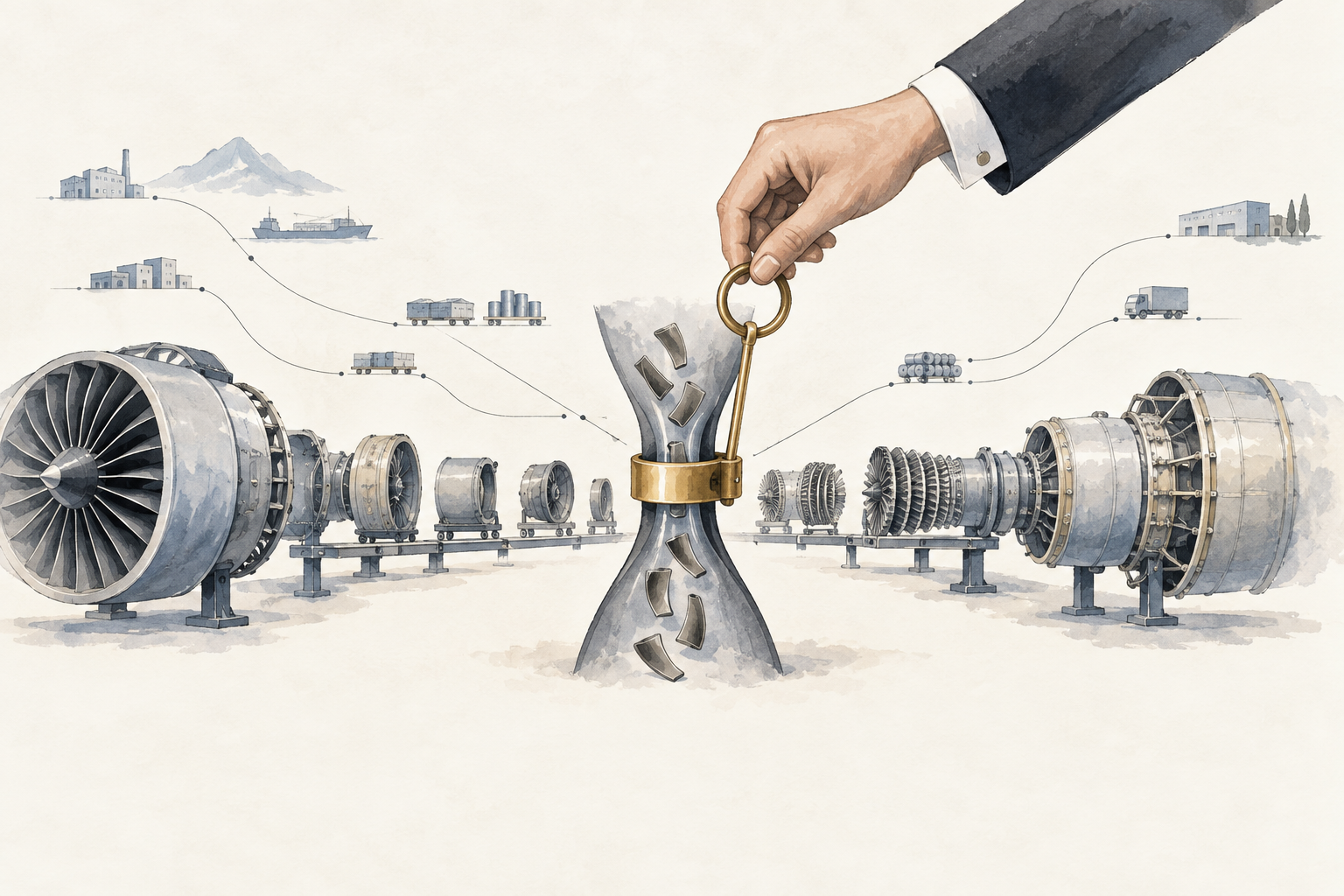
In industrial-strategy terms, the acquisition looks less like a return to fully integrated manufacturing and more like targeted ownership of a choke point. GE is moving to control a supplier category where late parts can delay entire engine builds, while still signaling that outside suppliers remain central to its production scale-up.
Reuters reported that Ghai described the CPP acquisition as a “unique situation” and said GE does not see broad vertical integration as the answer to aerospace supply-chain constraints.1 He told a Morgan Stanley conference that the company is not planning to vertically integrate “every single part” of its value stream, even as it works to improve delivery performance in critical areas.1
The transaction is still strategically significant. CPP produces precision-cast metal parts used in jet engines, including turbine blades and vanes. Those components are closely tied to engine performance, durability and production timing.3 If they arrive late, an engine maker cannot easily work around the gap.
That makes castings a logical target for selective ownership. According to Reuters’ account of Ghai’s remarks, the acquisition is intended to help GE improve CPP’s delivery performance, expand output and accelerate the introduction of new airfoil technology.1
GE’s insistence that CPP is not a blueprint reflects a basic trade-off in aerospace manufacturing. Owning suppliers can improve coordination and visibility, but it also adds capital intensity, operating complexity and management burden. For a company managing large installed fleets, new-engine deliveries and services growth, buying every constrained supplier would be costly and could dilute focus.
The company’s comments point to a more selective playbook: identify parts where control materially reduces delivery risk, while keeping the broader outsourced network intact. Finimize framed the transaction in similar terms, describing it as a one-off move to control a specific precision-castings choke point while broader aerospace supply constraints persist.7
That model preserves the advantages of outsourcing. Specialist suppliers retain scale across multiple customers, GE avoids absorbing every upstream process, and the company can focus ownership where a bottleneck has an outsized effect on engine output.
The timing of the deal is shaped by demand as much as supply. At the Morgan Stanley Laguna Conference, where Ghai appeared on September 17, GE Aerospace management emphasized strong commercial momentum. That included more than 1,800 new engine orders at Farnborough and a large LEAP-1A order from IndiGo Airlines, according to a transcript of the event.5 GE’s investor-relations calendar also listed Ghai’s Morgan Stanley appearance for September 17.4
Reuters reported that GEnx engine deliveries rose 50% year over year in the second quarter and that GE expected stronger year-over-year and sequential growth in the third quarter.1 At the same time, Ghai said the industry still needed more manufacturing capacity in several areas and that the capacity squeeze was not going away quickly.1
That combination explains the strategic logic. When demand is resilient and final assembly depends on scarce specialized inputs, one late component can have financial consequences beyond its own value. Owning a bottleneck supplier can reduce that risk without requiring a company to abandon the asset-light portions of its supply chain.
The CPP deal fits a pattern likely to interest other industrial manufacturers: selective reintegration where supply risk is acute, rather than a wholesale reversal of decades of outsourcing. Aerospace companies may not want to own every upstream process. But they may increasingly seek direct control over suppliers whose output governs delivery rates, technology transitions or aftermarket economics.
For GE, the message is deliberately balanced. The company is willing to buy a supplier when a constrained part category threatens engine execution. But its public framing also reassures the rest of its supplier base that the acquisition does not mean GE wants to displace external partners across the value stream.
That balance is the industrial-strategy takeaway. The future of aerospace supply chains may not be a binary choice between outsourcing and vertical integration. It may be a hybrid model in which manufacturers keep broad supplier ecosystems while owning a few critical nodes where capacity, know-how and schedule control matter most.







Comments