LNG Canada Expansion Could Put Kitimat at Center of Asia’s Supply-Security Trade
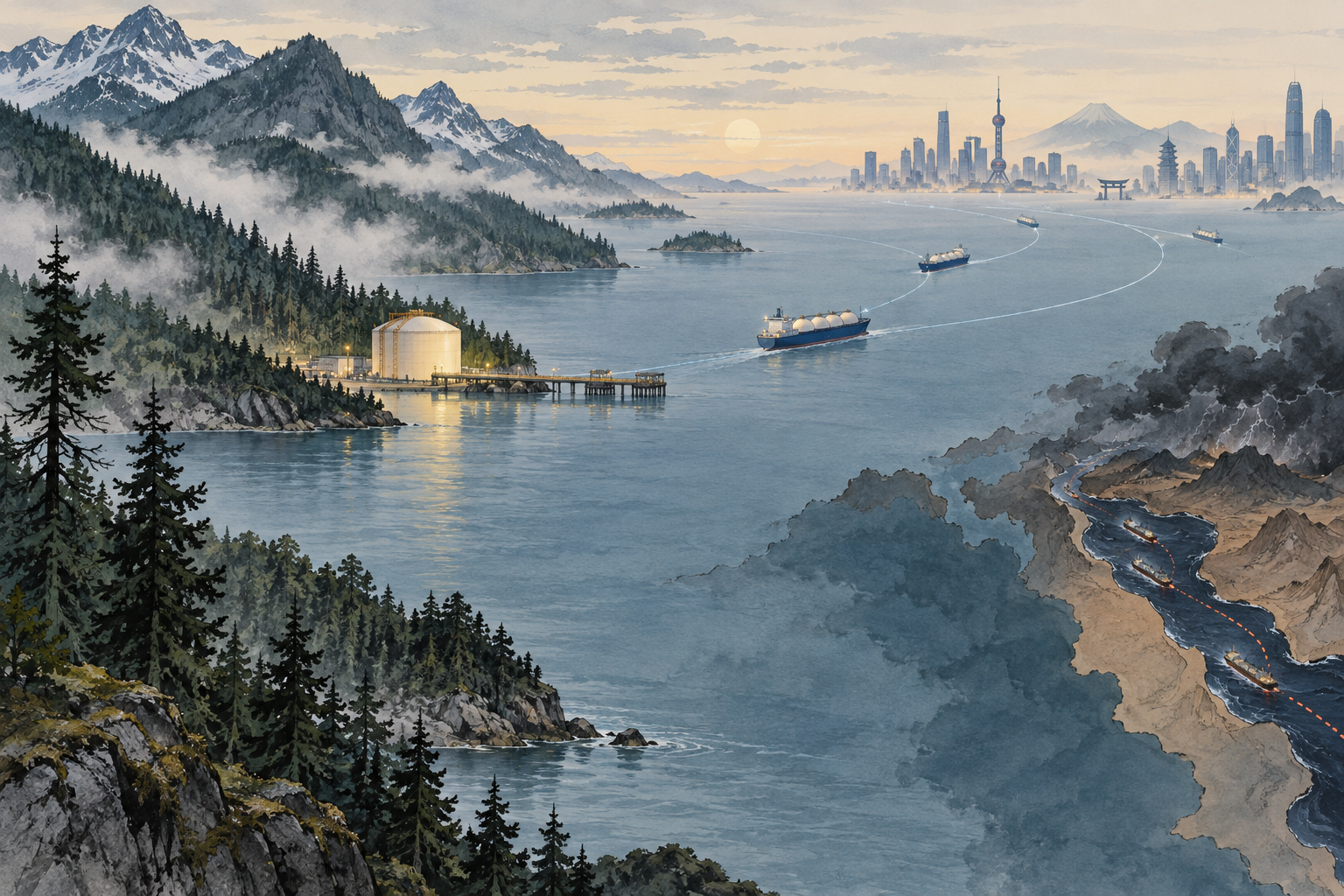
Final investment decision
A formal approval by project owners to commit major capital and proceed with construction or expansion.
Million tonnes per year
A standard LNG industry measure of annual liquefaction or export capacity, often abbreviated as mtpa.
Strait of Hormuz
A critical Middle East shipping chokepoint for oil and LNG exports; disruption risks can affect Asian energy procurement.
Pacific supply route
An LNG shipping path from exporters on the Pacific Coast to Asian import markets, typically shorter and less exposed to some Atlantic or Middle East chokepoints.
28 mtpa
A Phase 2 expansion would double LNG Canada’s capacity at Kitimat to about 28 million tonnes per year.
October FID
Reuters reported that Shell-led LNG Canada partners could approve the expansion as early as October.
Security premium
Middle East shipping concerns are pushing Asian LNG buyers to prioritize diversified and secure supply routes.
Shell and its partners in LNG Canada are nearing a decision that could double the Kitimat export project’s capacity to 28 million tonnes a year, potentially turning Canada from a late entrant in liquefied natural gas into a more consequential supplier for Asian buyers seeking secure Pacific Basin volumes.12
Reuters reported on September 17 that the Shell-led joint venture could approve Phase 2 as early as October, citing sources, while LNG Canada and Shell described the decision process cautiously.2 The project’s strategic importance has grown as Asian importers reassess supply exposure to the Middle East, including potential disruptions around the Strait of Hormuz, and seek diversified LNG portfolios that reduce dependence on any single route, region or seller.34
For Shell, PETRONAS, PetroChina, Mitsubishi and Korea Gas Corp., the decision is not only about whether the economics of an expansion at Kitimat clear the hurdle rate. It is also a capital-allocation choice over whether a Canadian Pacific Coast export platform can retain long-term relevance in a market where buyers increasingly value resilience, route diversity and political reliability alongside price.2
LNG Canada’s first phase was designed around two liquefaction trains with 14 million tonnes a year of capacity. Phase 2 would add two more trains and lift total capacity to about 28 million tonnes a year, according to Reuters and regional coverage from British Columbia.12 That scale would move Kitimat from a single-project national milestone into a larger platform capable of anchoring Canada’s LNG role in Asia-Pacific supply chains.
Location is central to the case. Kitimat offers a direct Pacific export route to North Asian markets, setting Canadian supply apart from U.S. Gulf Coast cargoes that often face longer voyages to Asia and potential chokepoints, depending on routing.2 It also gives buyers another source outside the Middle East at a time when shipping risk has become a procurement issue, not just a geopolitical concern.34
The project’s feedgas base also matters. LNG Canada is tied to Western Canadian gas production, including the Montney formation, giving the expansion a domestic upstream supply story rather than relying on imported molecules or floating portfolio optimization alone.1 That does not eliminate cost, emissions or infrastructure risks. But it strengthens the strategic argument that Canada can offer integrated upstream-to-export exposure to buyers seeking long-term supply security.
Recent Middle East disruptions have sharpened the focus on LNG supply-chain resilience. At Gastech 2026 in Bangkok, energy-security discussions centered on how disruptions affecting oil and LNG shipping through the Middle East could push Southeast Asian governments and utilities toward more diversified and flexible supply arrangements.3 The International Energy Agency’s Fatih Birol also urged South Korea and other Asian LNG importers to diversify supply amid conflict and risks around the Strait of Hormuz, reinforcing the case for future LNG projects outside exposed routes.4
That backdrop creates a more favorable strategic narrative for LNG Canada Phase 2. Buyers in Japan, South Korea, China and Southeast Asia have long balanced LNG portfolios across Qatar, Australia, the United States, Russia and emerging suppliers. But a renewed focus on route security could make a Canadian Pacific Coast cargo more valuable than its commodity price alone might suggest.
South Korea’s policy response illustrates the broader shift. Seoul and the IEA announced cooperation focused on resilient and integrated Asian energy security, showing that diversification is now being treated as both a policy priority and a commercial procurement strategy.6 For LNG Canada, Korea Gas Corp.’s stake in the ownership group adds another link between the project and Asian import-security considerations.2
The Phase 2 decision still has to compete with other uses of capital inside Shell and its partners’ global portfolios. LNG megaprojects require large upfront spending, long construction schedules and confidence that long-term buyers will support returns through contracts or credible demand signals. The broader Gastech 2026 deal environment suggests that buyers, producers and infrastructure companies are again translating energy-security concerns into long-term commitments across LNG, power, shipping and infrastructure.5
That cycle may help Kitimat. Market analysis after Gastech argued that disruption risk around Hormuz has accelerated Asian long-term LNG contracting and reframed supply security as a portfolio-construction problem.7 In that context, LNG Canada’s expansion would compete not only on delivered cost, but on its ability to fit into diversified buyer portfolios as a non-Middle East, non-U.S. Pacific supply option.
Still, the project carries execution risk. A second phase would need to manage construction costs in a remote industrial location, align upstream gas supply and pipeline capacity, maintain support from multiple joint-venture partners, and address Canadian regulatory and emissions expectations. Federal priority-project status and British Columbia’s regional economic interest may help the policy case, but they do not remove the commercial test.1
If the partners approve Phase 2 in October, the decision would signal confidence in three linked assumptions: that Asia will continue to need LNG for energy security and power-system reliability; that buyers will reward supply diversity after Middle East shipping shocks; and that Canada can overcome its history of slow LNG development to become a durable Pacific exporter.
For Shell, the expansion would reinforce its position as a global LNG portfolio leader while adding long-life exposure in a politically stable exporting country. For Canada, it would mark a step toward a more strategic role in Asian energy supply chains. For Asian buyers, it would add another route and supplier category as diversification moves from optional resilience planning to central procurement strategy.
The significance of LNG Canada Phase 2 is therefore larger than the next investment committee vote. A capacity doubling at Kitimat would test whether the post-shock LNG market is willing to finance security of supply — and whether Canada can capture that premium from the Pacific side of the trade.








Comments