Schneider’s Reported $20 Billion PTC Pursuit Points to a Software-First Automation Strategy
Product lifecycle management
Software that manages product data and processes from design and engineering through manufacturing, service and retirement.
Digital thread
A connected flow of data linking product design, production, operations and service so teams can work from consistent information.
Industrial AI
Artificial intelligence applied to manufacturing and infrastructure workflows, such as predictive maintenance, quality control, energy optimization and engineering support.
Automation stack
The layered set of hardware, controls, software, data systems and applications used to run industrial operations.
Financial Times
news
Schneider Electric nears deal to buy software group PTC for $20bn
Reuters via Euronext
news
France's Schneider Electric nears $20 billion deal to acquire US software group PTC, source says
Investing.com
news
Schneider Electric close to $20 bln deal for U.S. software maker PTC - report
$20B Target
Reports say Schneider Electric is nearing a roughly $20 billion acquisition of U.S. industrial software company PTC.
Software Stack
PTC would strengthen Schneider’s position in product design and lifecycle software, extending its reach beyond factory hardware and controls.
AI Strategy
The reported deal aligns with Schneider’s push to connect industrial data, automation systems and AI-enabled workflows.
Schneider Electric is nearing a roughly $20 billion deal to acquire U.S. industrial software company PTC, according to reports citing the Financial Times and Reuters. The transaction would be one of the clearest signs yet that industrial automation leaders see software platforms as critical infrastructure in the next phase of manufacturing competition.12
If completed, the deal would push Schneider further beyond its traditional strengths in electrical equipment, energy management and factory automation controls. It would give the French group deeper exposure to software that manufacturers use to design products, manage product lifecycle workflows and connect engineering data to operations.57
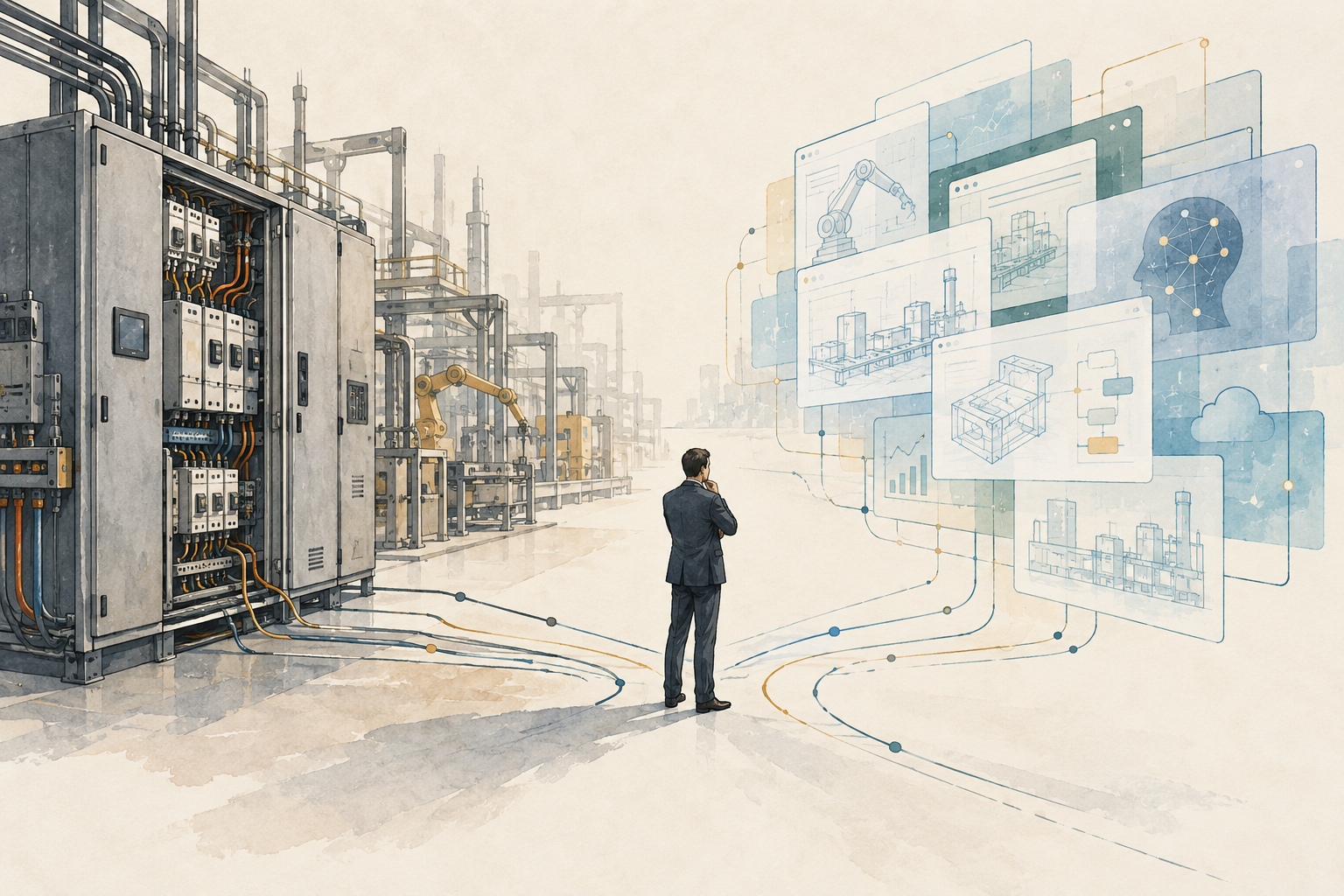
The strategic message is direct: the winners in industrial automation may increasingly be those that own the digital thread from product design to the factory floor, not only the hardware installed on that floor.
Reuters, citing a person close to the transaction, reported on Oct. 5 that the deal would deepen Schneider’s software acquisition push and fit with its industrial artificial intelligence and data strategy.2 The Financial Times reported a day earlier that Schneider was close to a roughly $20 billion acquisition of PTC, a move that would expand Schneider’s industrial software capability.1
For industrial technology executives, the possible deal is less about a single acquisition premium than a broader architecture question. Schneider appears to be positioning for a market in which automation vendors must help customers integrate product data, plant assets, energy systems, operational software and AI applications into one operating model.
PTC is best known for engineering and product lifecycle management software, including design capabilities associated with Creo and lifecycle workflows that help manufacturers manage product data across development, production and service.67 Those capabilities sit upstream from much of Schneider’s core automation footprint, where the company sells electrical distribution, energy management, control and digital operations technologies.
That upstream position is the strategic prize. A manufacturer’s most valuable operational context often begins before production starts: in the design file, the bill of materials, the configuration history, the simulation model and the product lifecycle record. By acquiring PTC, Schneider would gain a stronger position in the software layer where those data structures are created and maintained.
Martin Cid Magazine framed the potential acquisition as a way to link product design software, lifecycle workflows and factory-floor systems under one industrial technology owner.5 That is the crux of the deal rationale. If Schneider can connect engineering intent with production execution, energy optimization, asset management and AI-assisted decision-making, it could offer customers a more integrated industrial stack.
The reported transaction comes as industrial companies try to move artificial intelligence from pilots into workflows that improve engineering productivity, plant uptime, energy performance and quality control. But AI in factories depends heavily on structured, contextualized data. Product models, lifecycle records, asset hierarchies and operational data must be connected before algorithms can generate reliable recommendations.
Reuters reported that the possible PTC deal connects to Schneider’s industrial AI and data strategy.2 Investing.com also noted rising demand for AI tools and placed the reported acquisition in the context of Schneider’s broader software and digital acquisition strategy.3
That matters because industrial AI is not simply a feature that can be layered onto disconnected systems. A useful AI-enabled workflow might need to understand how a product was designed, which variant is being manufactured, what equipment is producing it, how much energy the process is consuming, which maintenance events are likely, and how changes affect cost, quality and delivery.
PTC’s lifecycle and design software would not solve that integration challenge by itself. But it would give Schneider a stronger claim to the engineering and product data layer that many industrial AI use cases require.
The reported talks also fit Schneider’s longer-running effort to increase the software content of its portfolio. Digital Today placed the potential PTC deal alongside Schneider’s Aveva, Cognite and Shelly moves, describing PTC as a likely reinforcement of Schneider’s industrial software position.6
That history matters. Schneider’s 2023 completion of full ownership of Aveva gave it a major industrial software platform spanning operations, engineering and asset information management. A PTC acquisition would extend that software posture toward product development and lifecycle management, potentially creating a wider data bridge between engineering and operations teams.
For customers, the promise would be fewer gaps between design, production and performance management. For Schneider, the commercial logic would be stickier software revenue, deeper executive relationships with manufacturers and a stronger platform for AI-enabled services.
For competitors, the implication is that automation hardware alone may be insufficient. Siemens has long paired automation hardware with industrial software. Rockwell Automation, Emerson, Honeywell and ABB have also expanded software, analytics and lifecycle offerings. A Schneider-PTC combination would intensify the race to own more of the industrial digital stack.
The reported price is substantial. Investing.com cited PTC’s market value at about $15.6 billion, implying that a roughly $20 billion transaction would include a significant premium if structured around that valuation context.3 ETF.net examined potential premium scenarios, share-count context, debt and cash treatment, and financing questions around the reported transaction.4
That means Schneider would need to persuade investors that the strategic benefits justify the financial commitment. Industrial software can command higher margins and recurring revenue, but large software acquisitions bring integration risk, cultural differences and pressure to deliver cross-selling results.
The financing structure would be closely watched. A cash-heavy deal could affect leverage and capital allocation flexibility. A stock component could dilute shareholders. Either structure would require a clear explanation of expected synergies, product roadmap priorities and customer migration plans.
There is also a practical technology question: how tightly should Schneider integrate PTC with its existing software portfolio? Too little integration could limit the strategic benefit. Too much forced integration could disrupt customers that rely on open, heterogeneous environments. Industrial buyers typically operate mixed fleets of equipment and software, so Schneider would need to preserve interoperability while still creating a differentiated platform.
The first issue is whether the deal is formally announced and at what valuation. Reports described Schneider as nearing an agreement, not completing one.12 Until terms are disclosed, executives should treat the transaction as likely but not final.
The second issue is how Schneider defines the combined roadmap. The most important signal will be whether Schneider presents PTC as a standalone software asset, a complement to Aveva, or part of a broader industrial data and AI operating system.
The third issue is customer openness. Manufacturers increasingly want integrated workflows, but they also resist vendor lock-in. Schneider’s challenge would be to show that owning more layers of the stack improves outcomes without limiting customer choice.
The fourth issue is competitive response. If Schneider proceeds, rivals may accelerate partnerships or acquisitions in product lifecycle management, simulation, industrial data platforms and AI workflow orchestration. The deal could reset expectations for what a full-stack industrial automation provider must control.
A Schneider-PTC deal would be a major bet that industrial automation is converging around software-defined workflows. Hardware, controls and electrical infrastructure would remain essential, but differentiation would increasingly come from how well vendors connect those systems to product data, operational context and AI tools.
That is why the reported transaction matters beyond its price tag. It suggests Schneider is trying to close the gap between the physical factory, the engineering office and the emerging AI layer that sits above both.
If the company can integrate those domains without creating complexity for customers, it could strengthen its position in the next phase of industrial automation. If it cannot, the deal could become an expensive reminder that buying software assets is easier than turning them into a coherent industrial platform.





Comments