UK Factory Hiring Muddies Dovish Signal From Softer PMI
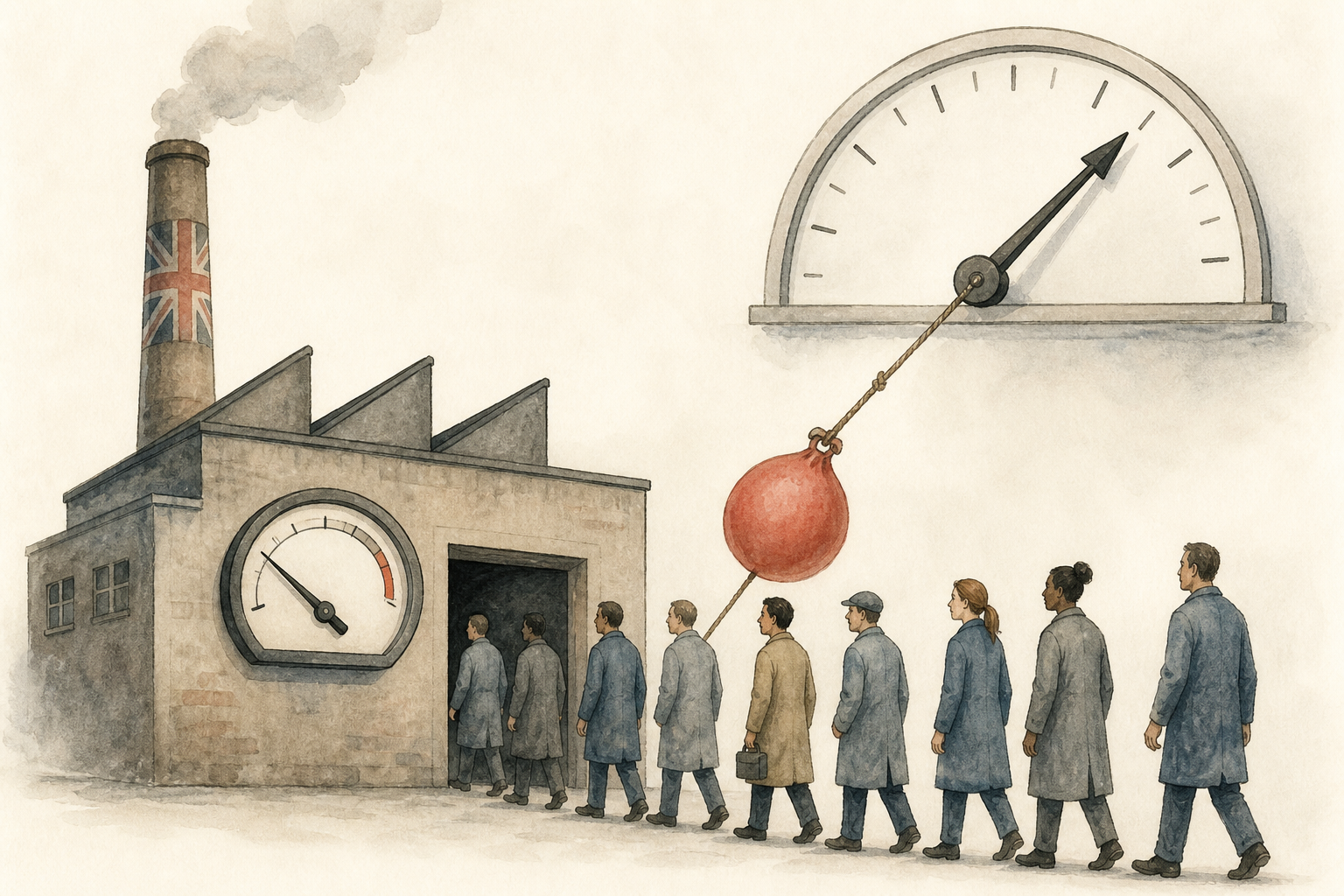
Manufacturing PMI
A survey-based index tracking factory activity. Readings above 50 indicate expansion, while readings below 50 indicate contraction.
Dovish policy
A monetary-policy stance that favours lower interest rates or easier financial conditions to support growth.
Gilt yields
The interest rates paid on UK government bonds. Rising gilt yields usually signal tighter financial conditions or expectations of higher policy rates.
Input-cost inflation
The rate at which manufacturers’ costs for materials, energy and other inputs are rising.
PMI Slips
The final UK manufacturing PMI fell to 51.7 in August from 51.9 in July, the weakest reading since March but still above the expansion threshold.
Hiring Jumps
Factory employment rose at the fastest pace in more than two years, limiting the dovish signal from softer output and new orders.
BoE Caution
Resilient labour demand suggests the manufacturing sector is not weak enough to ease the Bank of England’s inflation concerns.
The UK manufacturing sector lost some momentum in August, but not enough to give the Bank of England a clear disinflation signal. S&P Global’s final manufacturing purchasing managers’ index slipped to 51.7 from 51.9 in July, the weakest reading since March. Still, it beat the 51.5 consensus forecast and remained above the 50 line that separates expansion from contraction.12
For UK rates, the key detail is not the modest fall in the headline index but the labour-market signal beneath it. Factories increased staffing at the fastest pace in more than two years, even as output and new-order growth softened.23 That makes the PMI awkward for investors looking for evidence that manufacturing weakness will push the BoE toward an easier policy bias.
In short, the sector is slowing at the margin, but it is not under acute stress. Manufacturers are still hiring, business optimism has improved, and new work continues to expand. For the Monetary Policy Committee, that reduces the value of the headline PMI decline as evidence that demand is cooling enough to offset wage and services-inflation concerns.
The August PMI marked the slowest manufacturing expansion in five months, reinforcing the view that the early-summer rebound has lost some force.36 Output and new orders both grew more slowly, suggesting domestic demand is no longer accelerating and external conditions remain uneven.59
Still, 51.7 is not a recessionary print. It is an above-forecast expansion reading, and the decline from July was only 0.2 points.1 For policy, that distinction matters. A softer diffusion index can support a wait-and-see stance, but it does not justify a dovish turn when labour demand is strengthening.
The details also suggest demand has not rolled over. New orders continued to improve, while export demand showed signs of resilience in some summaries of the survey.5 If firms were seeing a material deterioration in forward demand, employment would normally come under pressure. Instead, the staffing index moved the other way.
The fastest pace of job creation in more than two years is the clearest reason the PMI is not straightforwardly dovish.34 For the BoE, employment growth matters because it can sustain wage pressure, support household incomes and slow the return of domestically generated inflation to target.
That is especially relevant because the UK inflation problem has been less about manufacturing volumes than the persistence of pay growth and service-sector price-setting. Manufacturing accounts for a smaller share of the economy than services, but the direction of hiring still matters as a cyclical signal. If even a cooling factory sector is adding staff, the broader labour market may not be weakening quickly enough to reassure policymakers.
Market-facing commentary drew the same distinction: factories cooled slightly in August, but continued hiring could keep wage and inflation concerns alive for the BoE.7 That interpretation fits the rates-market reaction function better than a narrow focus on the headline PMI.
There was some relief in the inflation components. Input-cost inflation eased, according to PMI coverage, which may point to less pressure from supply chains, commodities or imported goods prices.5 Supplier conditions and purchasing inventories also suggested the goods side of the economy is not suffering the acute bottlenecks seen in earlier inflation episodes.10
But easing input costs are not the same as a decisive disinflation signal. If firms are hiring more aggressively, labour costs can offset part of the benefit from lower materials inflation. That is the policy trade-off: the PMI suggests less goods-price pressure, but also enough confidence and demand to support payroll growth.
For the BoE, that combination argues for caution rather than easing. A dovish pivot would require clearer evidence that demand is weakening, unemployment risks are rising or inflation persistence is fading. The August PMI offers only partial support on the first point and little support on the second.
Another reason the report is not especially dovish is the improvement in sentiment. UK manufacturers’ optimism rose to a six-month high, according to market coverage of the S&P Global survey.8 That matters because employment decisions are forward-looking. Firms tend to add workers when they believe demand will hold up, not when they expect a downturn.
The confidence signal also helps explain why weaker output momentum did not translate into lower staffing. Companies may be looking through a temporary slowdown, preparing for a steadier order pipeline or rebuilding capacity after a cautious period.
There are caveats. Smaller producers reportedly remained under more pressure, while energy costs and inflation risks were still cited as headwinds in UK business coverage.11 The PMI therefore does not describe a uniformly strong factory sector. But the balance of evidence points to moderation, not contraction.
The manufacturing PMI landed against an already tense UK rates backdrop. Separate market reporting said 10-year gilt yields had reached their highest level since 2008, while investors were pricing a quarter-point BoE increase by year-end.15 That context makes the August PMI important: it did not deliver the kind of downside surprise that would challenge a higher-for-longer rates narrative.
The BoE’s own July money and credit data also point to a policy environment that is restrictive but not frozen. Mortgage approvals, consumer credit and business borrowing show how higher rates are feeding through to households and companies.13 Effective interest-rate data show the pass-through of policy tightening into borrowing rates for households and firms.14
Those official datasets matter because the BoE is trying to judge whether monetary policy is doing enough to restrain demand. The PMI suggests restraint is visible in slower manufacturing momentum, but not yet severe enough to stop firms hiring.
For UK macro and rates readers, the August manufacturing PMI should be read as mixed but ultimately non-dovish. The headline eased, output and order growth slowed, and cost pressures were less intense. But the sector stayed in expansion, beat expectations and generated the strongest employment growth in more than two years.123
That combination weakens the argument that manufacturing softness will force the BoE to turn dovish. Unless upcoming labour-market, wage and services-inflation data show clearer cooling, policymakers are likely to treat August’s factory survey as evidence of a slowing economy that still has enough underlying demand to keep inflation risks alive.







Comments